

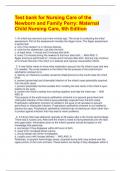
Test bank for Nursing Care of the Newborn and Family Perry: Maternal Child Nursing Care, 6th Edition 1. An infant boy was born just a few minutes ago. The nurse is conducting the initial assessment. Part of the assessment includes the Apgar score. The Apgar assessment is performed: a. only if the newborn is in obvious distress. b. once by the obstetrician, just after the birth. c. at least twice, 1 minute and 5 minutes after birth. d. every 15 minutes during the newborn's first hour after birth. - ANS ANS: C Apgar scoring is performed at 1 minute and 5 minutes after birth. Scoring may continue at 5-minute intervals if the infant is in distress and requires resuscitation efforts 2. A new father wants to know what medication was put into his infant's eyes and why it is needed. The nurse explains to the father that the purpose of the erythromycin ophthalmic ointment is to: a. destroy an infectious exudate caused by Staphylococcus that could make the infant blind. b. prevent gonorrheal and chlamydial infection of the infant's eyes potentially acquired from the birth canal. c. prevent potentially harmful exudate from invading the tear ducts of the infant's eyes, leading to dry eyes. d. prevent the infant's eyelids from sticking together and help the infant see. - ANS ANS: B The purpose of the erythromycin ophthalmic ointment is to prevent gonorrheal and chlamydial infection of the infant's eyes potentially acquired from the birth canal. Prophylactic ophthalmic ointment is instilled in the eyes of all neonates to prevent gonor rheal or chlamydial infection. Prophylactic ophthalmic ointment is not instilled to prevent dry eyes. Prophylactic ophthalmic ointment has no bearing on vision other than to protect against infection that may lead to vision problems. 3. A 3.8 -kg infant was delivered vaginally at 39 weeks after a 30 -minute second stage. There was a nuchal cord. After birth the infant is noted to have petechiae over the face and upper back. Information given to the infant's parents should be based on t he knowledge that petechiae: a. are benign if they disappear within 48 hours of birth. b. result from increased blood volume. c. should always be further investigated. d. usually occur with forceps delivery. - ANS ANS: A Petechiae, or pinpoint hemorrhagic areas, acquired during birth may extend over the upper portion of the trunk and face. These lesions are benign if they disappear within 2 days of birth and no new lesions appear. Petechiae may result from decreased platelet formation. In this situation the presence of petechiae is most likely a soft -tissue injury resulting from the nuchal cord at birth. Unless they do not dissipate in 2 days , there is no reason to alarm the family. Petechiae usually occur with a breech presentation vaginal birth. 4. A newborn is jaundiced and receiving phototherapy via ultraviolet bank lights. An appropriate nursing intervention when caring for an infant with hyperbilirubinemia and receiving phototherapy by this method would be to: a. apply an oil -based lotion to the newborn's skin to prevent dying and cracking. b. limit the newborn's intake of milk to prevent nausea, vomiting, and diarrhea. c. place eye shields over the newborn's closed eyes. d. change the newborn's position every 4 hours. - ANS ANS: C The infant's eyes must be protected by an opaque mask to prevent overexposure to the light. Eye shields should cover the eyes completely but not occlude the nares. Lotions and ointments should not be applied to the infant because they absorb heat, and this can cause burns. The lights increase insensible water loss, placing the infant at risk for fluid loss and dehydration. Therefore, it is important that the infant be adequately hydrated. The infant should be turned every 2 hours to expose all body surfaces to the light. 5. Early this morning, an infant boy was circumcised using the PlastiBell method. The nurse tells the mother that she and the infant can be discharged after: a. the bleeding stops completely. b. yellow exudate forms over the glans. c. the PlastiBell rim falls off. d. the infant voids. - ANS ANS: D The infant should be observed for urination after the circumcision. Bleeding is a common complication after circumcision. The nurse will check the penis for 12 hours after a circumcision to assess and provide appropriate interventions for prevention and treatment of bleeding. Yellow exudates cover the glans penis in 24 hours after the circumcision. This is part of normal healing and not an infective process. The PlastiBell remains in place for about a week and falls off when healing has taken place. 6. A mother expresses fear about changing her infant's diaper after he is circumcised. What does the woman need to be taught to take care of the infant when she gets home? a. Cleanse the penis with prepackaged diaper wipes every 3 to 4 hours. b. Apply constant, firm pressure by squeezing the penis with the fingers for at least 5 minutes if bleeding occurs. c. Cleanse the penis gently with water and put petroleum jelly around the glans after each diaper change. d. Wash off the yellow exudate that forms on the glans at least once every day to prevent infection. - ANS ANS: C Cleansing the penis gently with water and putting petroleum jelly around the glans after each diaper change are appropriate when caring for an infant who has had a
Preview 2 out of 7 pages
Exam (elaborations)
Test bank for Nursing Care of the Newborn and Family Perry: Maternal Child Nursing Care, 6th Edition
Preview 2 out of 7 pages
1. An infant boy was born just a few minutes ago. The nurse is conducting the initial assessment. Part of the assessment includes the Apgar score. The Apgar assessment is performed: a. only if the newborn is in obvious distress. b. once by the obstetrician, just after the birth. c. at least twice, 1 minute and 5 minutes after birth. d. every 15 minutes during the newborn's first hour after birth. - ANS ANS: C Apgar scoring is performed at 1 minute and 5 minutes after birth. Scoring may continue at 5-minute intervals if the infant is in distress and requires resuscitation efforts 2. A new father wants to know what medication was put into his infant's eyes and why it is needed. The nurse explains to the father that the purpose of the erythromycin ophthalmic ointment is to: a. destroy an infectious exudate caused by Staphylococcus that could make the infant blind. b. prevent gonorrheal and chlamydial infection of the infant's eyes potentially acquired from the birth canal. c. prevent potentially harmful exudate from invading the tear ducts of the infant's eyes, leading to dry eyes. d. prevent the infant's eyelids from sticking together and help the infant see. - ANS ANS: B The purpose of the erythromycin ophthalmic ointment is to prevent gonorrheal and chlamydial infection of the infant's eyes potentially acquired from the birth canal. Prophylactic ophthalmic ointment is instilled in the eyes of all neonates to prevent gonorrheal or chlamydial infection. Prophylactic ophthalmic ointment is not instilled to prevent dry eyes. Prophylactic ophthalmic ointment has no bearing on vision other than to protect against infection that may lead to vision problems. 3. A 3.8-kg infant was delivered vaginally at 39 weeks after a 30-minute second stage. There was a nuchal cord. After birth the infant is noted to have petechiae over the face and upper back. Information given to the infant's parents should be based on the knowledge that petechiae: a. are benign if they disappear within 48 hours of birth. b. result from increased blood volume. c. should always be further investigated. d. usually occur with forceps delivery. - ANS ANS: A Petechiae, or pinpoint hemorrhagic areas, acquired during birth may extend over the upper portion of the trunk and face. These lesions are benign if they disappear within 2 days of birth and no new lesions appear. Petechiae may result from decreased platelet formation. In this situation the presence of petechiae is most likely a soft-tissue injury resulting from the nuchal cord at birth. Unless they do not dissipate in 2 days, there is no reason to alarm the family. Petechiae usually occur with a breech presentation vaginal birth. 4. A newborn is jaundiced and receiving phototherapy via ultraviolet bank lights. An appropriate nursing intervention when caring for an infant with hyperbilirubinemia and receiving phototherapy by this method would be to: a. apply an oil-based lotion to the newborn's skin to prevent dying and cracking. b. limit the newborn's intake of milk to prevent nausea, vomiting, and diarrhea. c. place eye shields over the newborn's closed eyes. d. change the newborn's position every 4 hours. - ANS ANS: C The infant's eyes must be protected by an opaque mask to prevent overexposure to the light. Eye shields should cover the eyes completely but not occlude the nares. Lotions and ointments should not be applied to the infant because they absorb heat, and this can cause burns. The lights increase insensible water loss, placing the infant at risk for fluid loss and dehydration. Therefore, it is important that the infant be adequately hydrated. The infant should be turned every 2 hours to expose all body surfaces to the light. 5. Early this morning, an infant boy was circumcised using the PlastiBell method. The nurse tells the mother that she and the infant can be discharged after: a. the bleeding stops completely. b. yellow exudate forms over the glans. c. the PlastiBell rim falls off. d. the infant voids. - ANS ANS: D The infant should be observed for urination after the circumcision. Bleeding is a common complication after circumcision. The nurse will check the penis for 12 hours after a circumcision to assess and provide appropriate interventions for prevention and treatment of bleeding. Yellow exudates cover the glans penis in 24 hours after the circumcision. This is part of normal healing and not an infective process. The PlastiBell remains in place for about a week and falls off when healing has taken place. 6. A mother expresses fear about changing her infant's diaper after he is circumcised. What does the woman need to be taught to take care of the infant when she gets home? a. Cleanse the penis with prepackaged diaper wipes every 3 to 4 hours. b. Apply constant, firm pressure by squeezing the penis with the fingers for at least 5 minutes if bleeding occurs. c. Cleanse the penis gently with water and put petroleum jelly around the glans after each diaper change. d. Wash off the yellow exudate that forms on the glans at least once every day to prevent infection. - ANS ANS: C Cleansing the penis gently with water and putting petroleum jelly around the glans after each diaper change are appropriate when caring for an infant who has had
Content preview
Document information
- Uploaded on
- May 24, 2024
- Number of pages
- 7
- Written in
- 2023/2024
- Type
- Exam (elaborations)
- Contains
- Questions & answers
$10.49
Wrong document? Swap it for free
Within 14 days of purchase and before downloading, you can choose a different document. You can simply spend the amount again.
Written by students who passed
Immediately available after payment
Read online or as PDF


