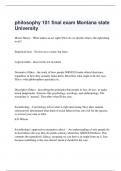
philosophy 101 final exam Montana state University
Moral Theory - What makes an act right? How do we decide what is the right thing to do? Empirical facts - Not for us to create, but learn Logical truths - discovered, not invented Normative Ethics - the study of how people SHOULD make ethical decisions, regardless of how they actually make them. Describes what ought to be the case. This is what philosophers specialize in. Descriptive Ethics - describing the principles that people in fact, do use , to make moral judgements. Sciences like psychology, sociology, and anthropology. The researcher is "neutral." Describes what IS the case. Sociobiology - Can biology tell us what is right and wrong? Key idea: natural selection has determined what kind of social behavior has survival for the species, or at least your clan or tribe. E.O Wilson Sociobiology's approach to normative ethics - -An understanding of why people do in fact behave the way they do yields a theory about they SHOULD behave. This commits the naturalistic fallacy, assuming we can derive an ought from an is. Just because something is the case doesn't mean it should be the case. -This argument might have more force if we were bound by our biology and couldn't do otherwise. But the history of moral progress would indicate that's not true. We have eliminated slavery, for example. Emotivism - -the doctrine that moral utterances are simply expressions of emotions, and have no truth value , for they are not making any real claims about the world. -For example, saying cheating on a test is wrong is actually equivalent to saying, "cheating? Boo"
Document information
- Uploaded on
- May 21, 2024
- Number of pages
- 21
- Written in
- 2023/2024
- Type
- Exam (elaborations)
- Contains
- Questions & answers