Topic 3.1: Periodicity – Periodic table
The arrangement of elements in the periodic table helps to predict their electron configuration.
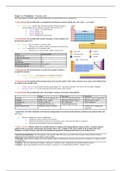
• Understanding: The periodic table is arranged into four blocks associated with the four sub- levels—s, p, d, and f.
▪ Periodic table: a table of the chemical elements arranged in order of
atomic number into four blocks associated with four sub-levels
▪ s-block: group 1, 2 and He element
▪ d-block: group 3-12
▪ p-block: group 12-18
▪ f-block: lanthanoids and actinoids
• Understanding: The periodic table consists of groups (vertical columns) and
periods (horizontal rows).
▪ Groups: vertical columns of a periodic table
• Elements have similar chemical and physical characteristics
▪ Periods: horizontal rows of a periodic table
• Elements have same periodic number (energy level)
Name Group number
Alkali metals 1
Alkaline earth metals 2
Halogens 17
Noble gases 18
Main group elements 1-2, 12-18
Transition elements 3-11
• Understanding: The period number (n) is the outer energy level that is
occupied by electrons.
▪ Periodic number (n): outer energy level occupied by electrons
• For example, Calcium (Ca) is in period 4, so n=4
• Understanding: The number of the principal energy level and the number of the valence electrons in an atom can be deduced from
its position on the periodic table.
▪ Valance electrons: can be found from the group number of s- and p-block elements (in p-block, the first digit is dropped)
▪ Principal energy level: can be found from the period number of the element
• Understanding: The periodic table shows the positions of metals, non-metals and metalloids.
Metal Non-metal Metalloids
Location Right side of the diagonal line Left side of the diagonal line Elements close to diagonal line
Example Sodium, zinc, copper Hydrogen, helium, oxygen Silicon, boron, arsenic
Conductivity Good conductors Poor conductors Semi-conductors
Reaction Typically lose electrons Typically gain electrons
Other characteristics Malleable, ductile and shiny Conductivity is temperature
dependent
• Applications and skills: Deduction of the electron configuration of an atom from the element’s position on the periodic table, and
vice versa.
▪ Process of finding the electron configuration
▪ Deduce the atomic number of the element
▪ Determine the period (energy level) and group (valance electrons) the element is placed in
▪ Illustrate the full/condensed electron configuration
• Nature of science: Obtain evidence for scientific theories by making and testing predictions based on them—scientists organize
subjects based on structure and function; the periodic table is a key example of this. Early models of the periodic table from
Mendeleev, and later Moseley, allowed for the prediction of properties of elements that had not yet been discovered.
• International-mindedness: The development of the periodic table took many years and involved scientists from different countries
building upon the foundations of each other’s work and ideas.
• Utilization: Other scientific subjects also use the periodic table to understand the structure and reactivity of elements as it applies to their
own disciplines.
• Guidance: The terms alkali metals, halogens, noble gases, transition metals, lanthanoids and actinoids should be known.
• Guidance: The group numbering scheme from group 1 to group 18, as recommended by IUPAC, should be used.