Topic 21.1: Measurement and analysis – Spectroscopic identification of organic compounds
Although spectroscopic characterization techniques form the backbone of structural identification of compounds, typically no one technique
results in a full structural identification of a molecule
• Understanding: Structural identification of compounds involves several different analytical techniques including IR, 1H NMR and
MS.
• Applications and skills: Deduction of the structure of a compound given information from a range of analytical characterization
techniques (X-ray crystallography, IR, 1H NMR and MS).
Name Abbreviation Measures Determines
Proton nuclear magnetic 1H NMR Absorption of radiation by nuclei of Isomers, hydrogen in different environments
resonance spectroscopy hydrogen atom and ratio between the different hydrogens
Infrared spectroscopy IR Bond vibration frequencies in molecules Different functional group
Mass spectroscopy MS Mass of molecules/fragments and the Fragmentation patterns, mass of molecules
relative abundance of each
• Understanding: In a high resolution 1H NMR spectrum, single peaks present in low resolution can split into further clusters of
peaks.
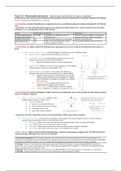
▪ 1H NMR spectrum (high resolution): measures absorption of radiation by nuclei of hydrogen atom
• Number of peaks: number of different hydrogen environment
• Area under each peak: illustrated using an integration line; gives the
simple ratio between the various types of hydrogen
▪ Measure the distance between the top and bottom lines
• Chemical shift: difference between resonance frequency of the hydrogen
and the resonance frequency of the standard TMS
• Splitting patterns: (n+1) where n is the number of neighbouring
hydrogen atom; interaction between nearby protons results splitting
▪ Magnetic interaction from nearby hydrogen can cause the
applied magnetic field (B0) to be deshielded to be slightly
greater (downfield) or shielded to be slightly less (upfield)
50% of the time
▪ Spin-spin coupling: magnetic interaction between
neighbouring, non-equal nuclei of a proton
▪ Relative intensity: follows pattern of Pascal’s triangle
▪ Example: doublets (1,1), triplets (1,2,1), quartets (1,3,3,1)
• Understanding: The structural technique of single crystal X-ray crystallography can be used to identify the bond lengths and bond
angles of crystalline compounds.
▪ Single crystal X-ray crystallography: measures bond-
lengths and bond angles in a single crystal
• Equation: 2dsinθ=nλ
• n = number of wavelength differences
• d = distance between two layers of crystal
• λ = wavelength of the X rays
• θ = angle of the incident radiation
• Applications and skills: Explanation of the use of tetramethylsilane (TMS) as the reference standard.
▪ Tetramethylsilane (TMS): position of the 1H depends on the strength of the external magnetic field, so universal reference
standard has been agreed upon relative to the signal from TMS
• Structure: 12 protons are in the same chemical environments so there is only one single strong peak
• Inert: TMS is inert so it will not interfere with the sample
• Absorption: absorbs upfield well removed from most other protons in organic compounds
• Removable: can be easily removed as it has a low boiling point (is volatile)
• Nature of science: Improvements in modern instrumentation—advances in spectroscopic techniques (IR, 1H NMR and MS) have
resulted in detailed knowledge of the structure of compounds.
• International-mindedness: The chemical community often shares chemical structural information on the international stage. The
Cambridge Crystallographic Database, ChemSpider developed by the Royal Society of Chemistry and the Protein Data Bank (RCSB PDB)
(at Brookhaven National Laboratory, USA) are examples which highlight the international nature of the scientific community.
• Utilization: Protons in water molecules within human cells can be detected by magnetic resonance imaging (MRI), giving a three-
dimensional view of organs in the human body. Why is MRI replacing computerized tomography (CT) scans for some applications but is
used as a complementary technique for others?
• Utilization: MS (and other techniques such as TLC, GC, GC-MS and HPLC) can be used in forensic investigations at crime scenes.
• Utilization: Analytical techniques can be used to test for drug abuse by high-performance athletes.