

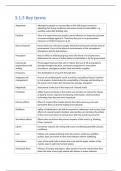
3.1.5 Key terms
Adaptation Attempts by people or communities to live with hazard events by
adjusting their living conditions and reduce levels of vulnerability, e.g
avoiding vulnerable building sites
Fatalism View of a hazard that says people cannot influence or shape the outcome
so cannot mitigate against it. Therefore they put in no preventative
measures or limited measures at all
Natural hazards Event which are a threat to people, the built environment and the natural
environment. Occur in the physical environments of the atmospheric,
lithosphere and the hydrosphere
Perception Way in which an individual/group views the threat of a hazard event,
determines the course of action taken by individuals or by the government
Community Prearranged measures that aim to reduce the loss of life and property
preparedness/risk damage through education, awareness programmes, evacuation
striking procedures, emergency medial, food and shelter supplies.
Frequency The distribution of a hazards through time
Integrates risk Process of considering the social, economic and political factors involved
management in risk analysis; determining the acceptability of damage and deciding on
the actions to be taken the minimise the damage, disruption
Magnitude Assessment of the size of the impact of a hazard event
Prediction Ability to give warnings so that action can be taken to reduce the impact
of hazard events. Improved monitoring, information, communication
technology have become more important
Primary effects Effect of a hazard that results directly from the events e.g. lava and
pyroclastic flows or ground shaking and rupturing
Resilience Ability of individuals to be able to respond to, withstand, and recover from
effects of natural hazards. Resilient communities can minimise the effects
of the event and return to normal soon after the event has occurred
Secondary effects Effects that result from the primary impacts of the event e.g. flooding,
lahars, tsunamis
Lahars Formed by volcanic ash mixing with water and flowing downhill (volcanic
mudflows)
Lava Molten rock (magma) flowing onto the surface, acidic lava solidifies
quickly, basic lava tends to flow some distance before solidifying
Lithosphere Layer of the earth with contains the crust and the upper section of the
mantle, layer is split into tectonic plates
Pyroclastic flows Mixture of hot gas and tephra, after ejection from the volcano they flow
down the sides at very high speeds also known as nuées ardentes
, Tephra Solid matter ejected by a volcano into the air, ranges from volcanic bombs
or ash
Earthquake As the crust moves there is a slow build up of stress within the rocks, as
the pressure is released some of the surface experiences shaking for a
short period, this is an earthquake
Retrofitting Buildings can be fitted with devices like shock absorbers and cross bracing
to make them more earthquake proof
Tsunamis Giant sea waves generated by shallow-focus underwater earthquakes,
violent eruptions and landslides into the sea
Mitigation Designed to reduce risks to people and property from natural hazards,
reduce the impact it can have and results in saving of money, people and
property
Storm surge A rapid rise in sea level and the water is piled up agains the coastline,
normally during a tropical storm with wind driven waves piling up due to
the ocean piling up from lower air pressure
Retardants Chemicals that are sprayed on fires to slow them down made from
nitrated, ammonia, phosphates, sulphates and thickening agents
Pyrophytic vegetation Phyrophytes are plants that are adapted to tolerate fire by having thick
bark, moisture in their tissues and under group storage structures
3.1.5.1 The concept of hazard in a
geographical context
The concept of a natural hazard and its potential impact
A natural hazard is an event that threatens both life and property and often results in loss of
life/damage to the built environment. Natural hazards can be Geophysical (landslides, costal erosion,
earthquakes, volcanic eruptions), Atmospheric (thunderstorms, hurricanes, tornadoes),
Hydrological(avalanches, floods, storm surges). Hazards pose a risk to humans as we build
settlements in areas with active faults and susceptible areas. Hazards effects on people have
common characteristics: Clear origins, distinct effects, short warning time, most losses of life and
property damage occur shortly after the event, effects are felt for a long time afterwards and the
scale requires an emergency response.
Risk and vulnerability
Risk is the exposure of people to a hazardous event presenting themselves to a threat. People are at
risk to hazard as: Hazard events are unpredictable as we cannot predict the frequency, magnitude or
scale of the hazard. Lack of alternatives as they cant just leave their homes, land and employment.
Changing the level of risks as place may become more risky overtime. Cost is another reason as the
hazardous places offer other advantages. Risk isn’t the same in all parts of the world as peoples
wealth and level of technology affects the impact upon them. Richer countries can protect
themselves better and also be more aware of the hazards.
The perception of natural hazards
People react to the threat of hazards in different ways due to social factors like: socio-economic
status, level of education, employment status, religion, ethnic background, family, past experience
, and values. Perception changes between different wealth countries and changes the course of action
taken by individuals. The sense of protection comes with wealthier countries and poorer countries
experience more of a sense of helplessness. Fatalism is a sense of idea that these hazards are
inevitable and ”God’s will”. Adaptation is when people survive the events by prediction, preparation
and protection.
Management of natural hazards
People respond to risk by reducing the risk, responses come from individuals, community,
governments and agencies. Community resilience is the ability of the community to use resources
and recover from the hazards. Integrated risk management includes the identification of the hazard,
risk analysis, priorities and implements a risk reduction plan. People try to mange hazards in the
following way:
Prediction- Warning can be given to allow action to be taken, improved monitoring gives predictions
Prevention- Its quite unrealistic as but there have been ideas and schemes which are being tested
Protection- The aim is to protect people and the environment from theses hazards, can be done by
modifying buildings
All attempts at management must be evaluated in terms of their success.
Disaster/risk management cycle
This illustrates the ongoing process which is used to plan for/reduce the impact of disasters, react
during and immediately after an event. Following these steps lead to greater preparedness, better
warning, reduced vulnerability or prevention of hazards. One of the main goals is the promotion of
sustainable livelihoods, their protection and recovery. This gives them a greater capacity to deal with
disasters and a rapid recovery.
Park Model
Shows that hazard events can have varying impacts over time, the model shows where life is normal
before the disaster, here they are trying to prevent the events and prepare for when they do. When
the event hits the quality of life drops and they take action to preserve life and the environment. In
relief rescue service and care are delivered and the quality of life starts to increase. Then in
rehabilitation people try to return back to normal by providing water, food or shelter. Finally in
reconstruction the property and infrastructure are reconstructed and crops are regrown, they also
Adaptation Attempts by people or communities to live with hazard events by
adjusting their living conditions and reduce levels of vulnerability, e.g
avoiding vulnerable building sites
Fatalism View of a hazard that says people cannot influence or shape the outcome
so cannot mitigate against it. Therefore they put in no preventative
measures or limited measures at all
Natural hazards Event which are a threat to people, the built environment and the natural
environment. Occur in the physical environments of the atmospheric,
lithosphere and the hydrosphere
Perception Way in which an individual/group views the threat of a hazard event,
determines the course of action taken by individuals or by the government
Community Prearranged measures that aim to reduce the loss of life and property
preparedness/risk damage through education, awareness programmes, evacuation
striking procedures, emergency medial, food and shelter supplies.
Frequency The distribution of a hazards through time
Integrates risk Process of considering the social, economic and political factors involved
management in risk analysis; determining the acceptability of damage and deciding on
the actions to be taken the minimise the damage, disruption
Magnitude Assessment of the size of the impact of a hazard event
Prediction Ability to give warnings so that action can be taken to reduce the impact
of hazard events. Improved monitoring, information, communication
technology have become more important
Primary effects Effect of a hazard that results directly from the events e.g. lava and
pyroclastic flows or ground shaking and rupturing
Resilience Ability of individuals to be able to respond to, withstand, and recover from
effects of natural hazards. Resilient communities can minimise the effects
of the event and return to normal soon after the event has occurred
Secondary effects Effects that result from the primary impacts of the event e.g. flooding,
lahars, tsunamis
Lahars Formed by volcanic ash mixing with water and flowing downhill (volcanic
mudflows)
Lava Molten rock (magma) flowing onto the surface, acidic lava solidifies
quickly, basic lava tends to flow some distance before solidifying
Lithosphere Layer of the earth with contains the crust and the upper section of the
mantle, layer is split into tectonic plates
Pyroclastic flows Mixture of hot gas and tephra, after ejection from the volcano they flow
down the sides at very high speeds also known as nuées ardentes
, Tephra Solid matter ejected by a volcano into the air, ranges from volcanic bombs
or ash
Earthquake As the crust moves there is a slow build up of stress within the rocks, as
the pressure is released some of the surface experiences shaking for a
short period, this is an earthquake
Retrofitting Buildings can be fitted with devices like shock absorbers and cross bracing
to make them more earthquake proof
Tsunamis Giant sea waves generated by shallow-focus underwater earthquakes,
violent eruptions and landslides into the sea
Mitigation Designed to reduce risks to people and property from natural hazards,
reduce the impact it can have and results in saving of money, people and
property
Storm surge A rapid rise in sea level and the water is piled up agains the coastline,
normally during a tropical storm with wind driven waves piling up due to
the ocean piling up from lower air pressure
Retardants Chemicals that are sprayed on fires to slow them down made from
nitrated, ammonia, phosphates, sulphates and thickening agents
Pyrophytic vegetation Phyrophytes are plants that are adapted to tolerate fire by having thick
bark, moisture in their tissues and under group storage structures
3.1.5.1 The concept of hazard in a
geographical context
The concept of a natural hazard and its potential impact
A natural hazard is an event that threatens both life and property and often results in loss of
life/damage to the built environment. Natural hazards can be Geophysical (landslides, costal erosion,
earthquakes, volcanic eruptions), Atmospheric (thunderstorms, hurricanes, tornadoes),
Hydrological(avalanches, floods, storm surges). Hazards pose a risk to humans as we build
settlements in areas with active faults and susceptible areas. Hazards effects on people have
common characteristics: Clear origins, distinct effects, short warning time, most losses of life and
property damage occur shortly after the event, effects are felt for a long time afterwards and the
scale requires an emergency response.
Risk and vulnerability
Risk is the exposure of people to a hazardous event presenting themselves to a threat. People are at
risk to hazard as: Hazard events are unpredictable as we cannot predict the frequency, magnitude or
scale of the hazard. Lack of alternatives as they cant just leave their homes, land and employment.
Changing the level of risks as place may become more risky overtime. Cost is another reason as the
hazardous places offer other advantages. Risk isn’t the same in all parts of the world as peoples
wealth and level of technology affects the impact upon them. Richer countries can protect
themselves better and also be more aware of the hazards.
The perception of natural hazards
People react to the threat of hazards in different ways due to social factors like: socio-economic
status, level of education, employment status, religion, ethnic background, family, past experience
, and values. Perception changes between different wealth countries and changes the course of action
taken by individuals. The sense of protection comes with wealthier countries and poorer countries
experience more of a sense of helplessness. Fatalism is a sense of idea that these hazards are
inevitable and ”God’s will”. Adaptation is when people survive the events by prediction, preparation
and protection.
Management of natural hazards
People respond to risk by reducing the risk, responses come from individuals, community,
governments and agencies. Community resilience is the ability of the community to use resources
and recover from the hazards. Integrated risk management includes the identification of the hazard,
risk analysis, priorities and implements a risk reduction plan. People try to mange hazards in the
following way:
Prediction- Warning can be given to allow action to be taken, improved monitoring gives predictions
Prevention- Its quite unrealistic as but there have been ideas and schemes which are being tested
Protection- The aim is to protect people and the environment from theses hazards, can be done by
modifying buildings
All attempts at management must be evaluated in terms of their success.
Disaster/risk management cycle
This illustrates the ongoing process which is used to plan for/reduce the impact of disasters, react
during and immediately after an event. Following these steps lead to greater preparedness, better
warning, reduced vulnerability or prevention of hazards. One of the main goals is the promotion of
sustainable livelihoods, their protection and recovery. This gives them a greater capacity to deal with
disasters and a rapid recovery.
Park Model
Shows that hazard events can have varying impacts over time, the model shows where life is normal
before the disaster, here they are trying to prevent the events and prepare for when they do. When
the event hits the quality of life drops and they take action to preserve life and the environment. In
relief rescue service and care are delivered and the quality of life starts to increase. Then in
rehabilitation people try to return back to normal by providing water, food or shelter. Finally in
reconstruction the property and infrastructure are reconstructed and crops are regrown, they also


