

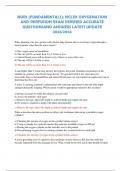
NURS (FUNDAMENTAL S): NCLEX OXYGENATION AND PERFUSION EXAM VERIFIED ACC URATE QUESTIONSAND ANSWERS LATEST UPDATE 2023/2024 When planning care for a patient with chronic lung disease who is receiving oxygen through a nasal cannula, what does the nurse expect? a) The oxygen must be humidified. b) The rate will be no more tha n 2 to 3 L/min or less. c) Arterial blood gases will be drawn every 4 hours to assess flow rate. d) The rate will be 6 L/min or more. b) The rate will be no more than 2 to 3 L/min or less. A rate higher than 3 L/min may destroy the hypoxic drive that stim ulates respirations in the medulla in a patient with chronic lung disease. Oxygen delivered at low rates does not necessarily have to be humidified, and arterial blood gases are not required at regular intervals to determine the flow rate. A nurse is securing a patient's endotracheal tube with tape and observes that the tube depth changed during the retaping. Which action would be appropriate related to this incident? a) Instruct assistant to notify the primary care provider. b) Assess the patient's vital signs. c) Remove the tape, adjust the depth to ordered depth and reapply the tape. d) No action is required as depth will adjust automatically. c) Remove the tape, adjust the depth to ordered depth and reapply the tape. What action does the nurse perform to follow safe technique when using a portable oxygen cylinder? a) Checking the amount of oxygen in the cylinder before using it b) Using a cylinder for a patient transfer that indicates available oxygen is 500 psi c) Placing the oxygen cyl inder on the stretcher next to the patient d) Discontinuing oxygen flow by turning cylinder key counterclockwise until tight a) Checking the amount of oxygen in the cylinder before using it A nurse providing care of a patient's chest drainage system observ es that the chest tube has become separated from the drainage device. What would be the first action that should be taken by the nurse in this situation? a) Notify the physician. b) Apply an occlusive dressing on the site. c) Assess the patient for signs of respiratory distress. d) Put on gloves and insert the chest tube in a bottle of sterile saline. d) Put on gloves and insert the chest tube in a bottle of sterile saline. When a chest tube becomes separated from the drainage device, the nurse should fir st put on gloves, open a sterile bottle of normal saline or water, and insert the chest tube into the bottle without contaminating the chest tube. This creates a water seal until a new drainage unit can be attached. Then the nurse should assess vital signs and notify the physician. An emergency department nurse is using a manual resuscitation bag (Ambu bag) to assist ventilation in a patient with lung cancer who has stopped breathing on his own. What is an appropriate step in this procedure? a) Tilt the pa tient's head forward. b) Hold the mask tightly over the patient's nose and mouth. c) Pull the patient's jaw backward. d) Compress the bag twice the normal respiratory rate for the patient. b) Hold the mask tightly over the patient's nose and mouth. Which a ssessments and interventions should the nurse consider when performing tracheal suctioning? Select all that apply. a) Closely assess the patient before, during, and after the procedure. b) Hyperoxygenate the patient before and after suctioning. c) Limit t he application of suction to 20 to 30 seconds. d) Monitor the patient's pulse frequently to detect potential effects of hypoxia and stimulation of the vagus nerve. e) Use an appropriate suction pressure (80 -150 mm Hg). f) Insert the suction catheter no fur ther than 1 cm past the length of the tracheal or endotracheal tube. a, b, d, e. Close assessment of the patient before, during, and after the procedure is necessary to limit negative effects. Risks include hypoxia, infection, tracheal tissue damage, dysr hythmias, and atelectasis. The nurse should hyperoxygenate the patient before and after suctioning and limit the application of suction to 10 to 20 seconds. The nurse should also take the patient's pulse frequently to detect potential effects of hypoxia an d stimulation of the vagus nerve. Using an appropriate suction pressure (80 -150 mm Hg) will help prevent atelectasis related to the use of high negative pressure. Research suggests that insertion of the suction catheter should be limited to a predetermined length (no further than 1 cm past the length of the tracheal or endotracheal tube) to avoid tracheal mucosal damage, including epithelial denudement, loss of cilia, edema, and fibrosis The nurse is conducting a respiratory assessment of a client age 71 ye ars who has been recently admitted to the hospital unit. Which assessment finding should the nurse interpret as abnormal? a) resonance on percussion of lung fields b) vesicular breath sounds audible over peripheral lung fields c) fine crackles to the base s of the lungs bilaterally d) respiratory rate of 18 breaths per minute c) fine crackles to the bases of the lungs bilaterally Except in the case of infants, fine crackles always constitute an abnormal assessment finding. A client with chronic obstructive pulmonary disease requires low flow oxygen. How will the oxygen be administered? a) Simple oxygen mask b) Partial rebreather mask c) Venturi mask d) Nasal cannula d) Nasal cannula A nurse caring for a patient with chronic obstructive pulmonary disease (COPD) knows th at hypoxia may occur in patients with respiratory problems. What are signs of this serious condition? Select all answers that apply. a) Dyspnea b) Hypotension c) Small pulse pressure d) Decreased respiratory rate e) Pallor f) Increased pulse rate a, c, e, f If a problem exists in ventilation, respiration, or perfusion, hypoxia may occur. Hypoxia is a condition in which an inadequate amount of oxygen is available to cells. The most common symptoms of hypoxia are dyspnea (difficulty breathing), an elevated blood pressure with a small pulse pressure, increased respiratory and pulse rates, pallor, and cyanosis.
Preview 3 out of 23 pages
Exam (elaborations)
NURS (FUNDAMENTALS): NCLEX OXYGENATION AND PERFUSION EXAM VERIFIED ACCURATE QUESTIONSAND ANSWERS LATEST UPDATE 2023/2024
Preview 3 out of 23 pages
NURS (FUNDAMENTALS): NCLEX OXYGENATION AND PERFUSION EXAM VERIFIED ACCURATE QUESTIONSAND ANSWERS LATEST UPDATE 2023/2024
Content preview
Document information
- Uploaded on
- May 16, 2024
- Number of pages
- 23
- Written in
- 2023/2024
- Type
- Exam (elaborations)
- Contains
- Questions & answers
$10.99
Wrong document? Swap it for free
Within 14 days of purchase and before downloading, you can choose a different document. You can simply spend the amount again.
Written by students who passed
Immediately available after payment
Read online or as PDF

Reputation scores are based on the amount of documents a seller has sold for a fee and the reviews they have received for those documents. There are three levels: Bronze, Silver and Gold. The better the reputation, the more your can rely on the quality of the sellers work.
Available in package deal
Package deal
My study pack


