
Anthropology 101 Questions with Correct Answers (1)
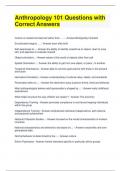
Anthropology 101 Questions with Correct Answers (1) Culture is created and learned rather than .. - Answer-Biologically inherited Enculturation begins. .. - Answer-soon after birth Self awareness is... - Answer-the ability to identify oneself as an object, react to ones self, and appraise or evaluate oneself Object orientation.. - Answer-aware of the world of objects other than self Spatial Orientation... - Answer-the ability to get from one object, or place , to another Temporal Orientations - Answer-able to connect past actions with those in the present and future Normative Orientation - Answer-understanding of cultural value, ideals, and standards Personality refers to.... - Answer-the distinctive ways a person thinks, feels and behaves Most anthropologists believe adult personality is shaped by.... - Answer-early childhood experiences What helps structure the way children are raised ? - Answer-The economy Dependence Training - Answer-promotes compliance in and favors keeping individuals within the group Independence Training - Answer-emphasized individual independence, self-reliance, and personal achievement National Character Studies.. - Answer-focused on the modal characteristics of modern countries National characteristics are believed to be based on.... - Answer-unscientific and over generalized data Normal behavior is determined by the.... - Answer-culture Ethnic Psychoses - Answer-mental disorders specific to particular ethnic groups Amok. Who does it belong to? What is it? - Answer-Maylaya, sudden outbursts of aggression in which the afflicted person may kill or injure others Anorexia Nervosa. Who does it belong to? What is it? - Answer-Western countries, Disorder in which a preoccupation with thinness produces a refusal to eat Latah. Who has it? What is it? - Answer-Malay, Fear reaction in middle-aged women of low intelligence who are subservient Koro. Who has it? What is it? - Answer-Southeast Asia, Fear reaction in which the person fears his penis will withdraw into his abdomen and he will die Windigo. Who has it? what is it? - Answer-Algoquian Indians of Canada and northern U.S, A hunter becomes convinced that he is bewitched Kitsunetsuki. Who has it? what is it? - Answer-Japan, victims believe they are possessed by foxes and change facial expression to resemble foxes. Pibloktoq and other arctic hysterias. who has it? what is it? - Answer-Circumpolar peoples from Lapland eastward across siberia, northern Alaska, and Canada to Greenland, victims may tear clothes off, jump in water or fire, roll in snow, try to walk on the ceiling, throw things, thrash about,and "speak in tongues." Adaptation - Answer-how humans manage to deal with the contingencies of daily life Ecosystem - Answer-the physical enviornment and the orgainsms living in it Convergent Evolution - Answer-two different cultures that develop simiar adaptations to similar enviornments parallel evolution - Answer-two similar cultures that develop similar adaptations to similar enviornments Change - Answer-may be rapid followed by relative stability, and stability indicated success. Culture area - Answer-geographic region where different societies follow similar patterns of life Culture type - Answer-Culture described in terms of the relation between its technology and the environment Cultural Ecology - Answer-The study of the interaction of culture and environment. Pioneered by Julian Steward Food found in southwest asia - Answer-Wheat, barley, flax, rye, millet, cow,sheep, goat Mesoamerica - Answer-corn, beans, squash, chile, dog, turkey, honey bee Peru - Answer-Potato, guinea pig, llama, alpaca Southeast Asia - Answer-rice, taro, yams americas - Answer-manioc cultural ecology - Answer-study of interaction between culture and enviornment ethnoscientists - Answer-anthropologist who studies the principles behind folk ideologies and the way they help a people survive economic systems - Answer-means of producing, distributing, and consuming goods and services. Can not be understood without considering culture. The Kula Ring - Answer-ceremonial exchange of prestige items in the Trobriland Islands patterns of Labor - Answer-age division of labor, cooperation, craft specialization Rigid Segregation - Answer-almost all work is defined as masculine or feminine, men and women are separated. Dual sex configuration - Answer-Men and women carry out their work separately, a relationship of balanced complementary, each gender manages its own affairs Control of Land - Answer-all societies allocate land resources, technology - Answer-tools and other materials equipment together with the knowledge of how to make and use them Leveling Mechanisms - Answer-societal obligations to distributes goods so that no one accumulates more wealth than anyone Modes of Distributing Goods: Karl Polyani - Answer-Reciprocity, redistribution, and market exchange Reciprocity categories: - Answer-generalized, balanced, negative Generalized reciprocity - Answer-the value of what is given is not calculated and repayment is not specified
Document information
- Uploaded on
- May 14, 2024
- Number of pages
- 5
- Written in
- 2023/2024
- Type
- Exam (elaborations)
- Contains
- Questions & answers


