
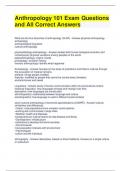
Anthropology 101 Exam Questions and All Correct Answers (1)
Anthropology 101 Exam Questions and All Correct Answers (1) What are the four branches of anthropology (CLAP) - Answer-physical anthropology archaeology anthropological linguistics cultural anthropology physical/biology anthropology - Answer-studies both human biological evolution and contemporary physical variations among peoples of the world paleoanthropology- origins, fossils primatology- evolution history forensic anthropology- identify what happened Archaeology - Answer-focuses on the study of prehistoric and historic cultures through the excavation of material remains artifacts- things people modified features- modified by people that cannot be carried away (temples) ecofacts-bones and seeds Linguistics - Answer-study of human communication within its sociocultural context historical linguistics- how languages emerge and change over time descriptive: how languages are constructed ethnolinguistics: relationship between language and culture sociolinguistics: how language is used in different social contexts socio-cultural anthropology (4 branches specializations (DUMPE) - Answer-cultural similarities and differences • Urban: rural populations/more complex social systems -working with communities in large cities • Medical: health and diseases -biological/socio-cultural factors to help disease and illness • Development: infrastructure -institutions to develop 3rd world countries • Environmental -how population interacts with environment • Psychological -culture and the individual ethnography - Answer-descriptive, based on direct fieldwork, focuses on a single culture or subculture ethnology - Answer-comparative, uses data collected by other ethnographers, generalizes across cultures or subcultures 3 things make cultural anthropology unique? (HEC) - Answer-holistic comparative ethnographic holistic (cultural anthropology) - Answer-see things connected as a system and how those parts are interrelated o Biological and sociocultural approach o Research over a long time frame o Involve an array of people (diverse) o Study different aspects of human experience ethnographic (cultural anthropology) - Answer-deeply involved i.e. traveling ethnocentrism (cultural anthropology) - Answer-seeing your culture as superior than others cultural relativism (cultural anthropology) - Answer-making its your own culture, not being judgemental Emic approach (cultural anthropology) - Answer-insider, classifying the world around them open minded, view the world as if its your own culture etic approach (cultural anthropology) - Answer-outsider, your own culture provokes thoughts and behaviors Applied anthropology - Answer-more knowledge of society so you can address the societies problems emphasize theories, methods, and insights of cultural anthropology can help solve societal problems specialized roles of applied anthropology - Answer-Adjustment -participate in designing/measuring programs and policies Administrative -have a specific role Advocate -active supporter of a particular group of people Adolescent drug dealers (applied anthropology) - Answer-Urban anthropology income from drugs to help meet family expenses -important policy implications, such as improving the vocational and educational skills of adolescents so they will have more access to legitimate work or treat drug dependency Nestle baby formula (applied anthropology) - Answer-medical anthropology baby formula in 3rd world countries, got diseases because there was no access to fresh/clean water Barriers to biogas in China (applied anthropology) - Answer-development anthropology clean-energy initiative -financial -shortage of labor -sufficient number of pigs -lack of general education -high cost of repairing agrochemical effects (applied anthropology) - Answer-ecological anthropology -widespread use and misuse of biocides also had major negative effects on the natural environments of these three caribbean island -contaminated crops -chickens died -health risks between government and trukese village (applied anthropology) - Answer-political anthropology -made planst to expand the airport but it would destroy local fishing areas, villages, historical landmark -used anthropologist to mediate between the villagers and government culture defined - Answer-• thing or artifacts, ideas and knowledge and patterns of behavior •Not innate, you can pick up and learn •Culture is learned, shared knowledge symbol - Answer-create and meaning to symbols that helps people identify, sort, and classify things, ideas i.e. cultural diversity in symbols such as new years eve explicit culture - Answer-knowledge people can talk about • i.e. "the kids are playing" tacit culture - Answer-cant articulate whats going on • i.e. speaking distance • (intimate, personal, social) six characteristics of culture: CLASSP - Answer-changes: diffusion/innovation learned: enculturation/conscious/unconscious adaptive/maladaptive shared: taken for granted symbolic/classification systems: symbol/multivocal patterned/integrated culture shock (culture is shared) - Answer-a psychological disorientation experienced when attempting to operate in a radically different cultural environment subculture (culture is shared) - Answer-a subdivision of a national culture that shares some features with the largest society and also differs in some respects -government, economics, and education pluralistic societies (culture is shared) - Answer-societies composed of a number of different cultural or subcultural groups -i.e. subcultures may have a lot of influence because they considered "mainstream"; teacher thought vietnamese girl was abused enculturation (culture is learned) - Answer-the process by which human infants learn their culture learning vs. instincts (culture is learned) - Answer-if humans are to survive, they must learn most of their coping skills from others in their culture learning different content (culture is learned) - Answer-people learn what they need to know to best adapt to the environment - grow up learning how to farm vs. learning how to sustain and education/career Culture is taken for granted (culture is learned) - Answer-rational and sufficient pervasive traditions in our lives
Document information
- Uploaded on
- May 14, 2024
- Number of pages
- 10
- Written in
- 2023/2024
- Type
- Exam (elaborations)
- Contains
- Questions & answers


