
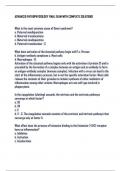
Advanced Pathophysiology Final Exam With Complete Solutions
ADVANCED PATHOPHYSIOLOGY FINAL EXAM WITH COMPLETE SOLUTIONS What is the most common cause of Down syndrome? a. Paternal nondisjunction b. Maternal translocations c. Maternal nondisjunction d. Paternal translocation - C What does activation of the classical pathway begin with? a. Viruses b. Antigen-antibody complexes c. Mast cells d. Macrophages - B. Activation of the classical pathway begins only with the activation of protein C1 and is preceded by the formation of a complex between an antigen and an antibody to form an antigen-antibody complex (immune complex). Infection with a virus can lead to the start of the inflammatory process, but is not the specific activation factor. Mast cells release the contents of their granules to initiate synthesis of other mediators of inflammation among other actions. Macrophages are one cell type involved in phagocytosis. In the coagulation (clotting) cascade, the intrinsic and the extrinsic pathways converge at which factor? a. XII b. VII c. X d. V - C. The coagulation cascade consists of the extrinsic and intrinsic pathways that converge only at factor X. What effect does the process of histamine binding to the histamine-2 (H2) receptor have on inflammation? a. Inhibition b. Activation c. Acceleration d. Termination - A. Binding histamine to the H2 receptor is generally antiinflammatory because it results in the suppression of leukocyte function. Binding to H2 receptors does not cause activation, acceleration, or termination of the inflammatory process. Lead poisoning affects the nervous system by A. Interfering with the function of neurotransmitters B. Inhibiting the production of myelin around nerves C. Increasing the resting membrane potential D. Altering the transport of potassium into the nerves - A Water movement between the intracellular fluid (ICF) compartment and the extracellular fluid (ECF) compartment is primarily a function of: A. Osmotic Forces B. Plasma Oncotic Pressure C. Antidiuretic hormone D. Hydrostatic forces - A
Document information
- Uploaded on
- May 11, 2024
- Number of pages
- 32
- Written in
- 2023/2024
- Type
- Exam (elaborations)
- Contains
- Questions & answers


