

NR 599 : Week 3 discussion post - Pros & Cons of EHR, Latest 2019/2020 complete solution.
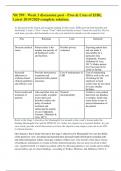
NR 599 : Week 3 discussion post - Pros & Cons of EHR, Latest 2019/2020 complete solution. As discussed in the lesson and assigned reading for this week, EHRs provide both benefits and drawbacks. Create a “Pros” versus “Cons” table and include at least 3 items for each list. Next to each item, provide a brief rationale as to why you selected to include it on the respective list. Pros Rationale Cons Rationale Decrease medical errors Patient safety is the number one priority of all healthcare works and facilities. Possible privacy violations Exposing patient data and can make it unavailable for a particular time (Alghamdi, Alomari, Althubaiti & Aziz, 2017). Makes patient lose trust and can be costly to facility. Increased adherence to evidence-based clinical guidelines and effective care Provides best practice to patients and promotes better patient outcomes. Cost of maintenance of EHR Cost of maintaining ERH as well as the cost of training for the employee to learn system may be too much for some smaller facilities. Faster results and treatment of patients Labs and other tests are more readily available to providers and therefore reduces the delay of medical treatment and enhancing the quality of care (Alghamdi, Alomari, Althubaiti & Aziz, 2017). National interoperability Unable to cross patient data from one database to another, which may cause delay in care or missed information of the patient. Refer to the Stage 3 objectives for Meaningful Use located in this week’s lesson under the heading Meaningful Use and the HITECH Act. Select two objectives to research further. In your own words, provide a brief discussion as to how the objective may impact your role as an APN in clinical practice. One objective that I found relevant in the stage 3 objectives for Meaningful Use was the ability of the patient to view, download and transmit their personal health information including labs and other information within a four-day window of their visit. One benefit of the direct release of healthcare information is it leads to better-informed patients who are more involved in their care. Another benefit is it improves patient safety by allowing patients to see results and avoiding missed follow-ups of critical findings. According to Walker, Meltsner, and Delbanco (2015) 8– 26% of abnormal test results are not followed up in a timely manner and therefore, can lead to delay in care for the patient. This can lead to unwanted outcomes and failed or missed treatment of the patient. By allowing the patient access to their record impacts the APN in many ways. For example, it allows the patient to be more involved in their care as well as answering some of the questions the patient may have regarding their visit. Another objective that I see significant is the use of the patients’ viewing visit summary and clinical summary notes of the providers. Studies showed that patients who accessed their clinical notes described having a better understanding of the importance of their medications and gave them more motivation to comply to treatment plans (Walker, Meltsner & Delbanco, 2015). I believe this can benefit the APN because it allows the patient a better understanding of the physical exam and outcome of the visit. Studies have shown the benefits of sharing clinical notes with patient and how it helps patients adhere to treatment and understand their health better. This allows for better patient outcomes and compliance of treatment that the provider gave. Patients often forget what was discussed with the provider during a visit and allowing access to the summary of the visit aids in the patient’s knowledge and engagement which leads to better patient outcomes. This can also impact APN in a negative manner because may have to spend additional time carefully composing each note and fear that there may be multiple questions raised from medical terminology that the patient may not understand (Walker, Meltsner & Delbanco, 2015). Krista Longmore References Alghamdi, M., Alomari, S., Althubaiti, M., & Aziz, A. (2017). A Review of TQM and EHR Focused Quality. IARJSET, 4(5), 100-104. doi: 10.17148/iarjset.2017.4519 Pillemer, F., Price, R., Paone, S., Martich, G., Albert, S., & Haidari, L. et al. (2016). Direct Release of Test Results to Patients Increases Patient Engagement and Utilization of Care. PLOS ONE, 11(6), e0154743. doi: 10.1371/.0154743 Walker, J., Meltsner, M., & Delbanco, T. (2015). US experience with doctors and patients sharing clinical notes. BMJ, 350(feb10 14), g7785-g7785. doi: 10.1136/bmj.g7785 Hello Alisha, I think the most important thing about EMR is the ability to prevent errors and keep patients safe. When I worked in long term care and rehab facilities, the medications were all paper charting, and the medications were in bottles or came on a Kardex. I found it very easy to make errors in picking up the wrong medication or not having the ability to check to see if it was the correct patient. Going from paper charting to electronic charting felt much better to provide safer patient care knowing there are several checks in place. Electronic medical records have shown to improve quality of care, patient outcomes, and safety, also while reducing medication errors (Manca, 2015). I believe this also leads to increased nurse and patient satisfaction because the nurse can feel more comfortable giving medications and the patient feels safer knowing there are checks in place to ensure they are getting the right medications and dosages. I also believe that it helps conserve time for the nurse to do electronic documenting rather
Document information
- Uploaded on
- May 11, 2024
- Number of pages
- 4
- Written in
- 2023/2024
- Type
- Exam (elaborations)
- Contains
- Questions & answers


