KINE 3020 Exam 2 || with 100% Errorless Solutions.
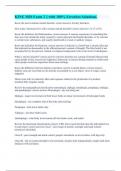
Know the most common mental disorder. correct answers Anxiety disorders. How many Americans live with a serious mental disorder? correct answers 1 in 17 or 6%. Know the definition for Hallucination. correct answers A sensory experience of something that does not exist outside the mind, caused by various physical and mental disorders, or by reaction to certain toxic substances, and usually manifested as visual or auditory images. Know the definition for Delusion. correct answers A delusion is a belief that is clearly false and that indicated an abnormality in the affected person's content of thought. The false belief is not accounted for by the person's cultural or religious background or his or her level of intelligence. What is anxiety disorder? correct answers Anxiety disorders are a group of mental illnesses that cause people to feel excessively frightened, distressed, or uneasy during situation in which most other people would not experience these same feelings. Know the difference between indirect cost/direct cost for a mental illness. correct answers Indirect costs are costs that are not directly accountable to a cost object. (loss of wages, social supports) Direct costs refer to materials, labor and expenses related to the production of a product. (medical bills, hospital, meds) Review the topographical classification (monoplegia, diplegia, hemiplegia, paraplegia, triplegia, and quadriplegia. correct answers Monoplegia - any one body part Diplegia - major involvement of both lower limbs or minor involvement of both upper limbs Hemiplegia - one complete side of the body (arm and leg) Paraplegia - both lower limbs only Triplegia - any three limbs (rare) Quadriplegia - total body involvement (all four limbs, neck, and trunk) Review the functional classifications (class I-VIII). How much function does the individual have in each class? correct answers Class I - poor range of motion, strength, and trunk control' motorized wheelchair Class II - poor strength and trunk control; propels wheelchair on level surface with legs only Class III - fair to normal strength in one extremity; propels chair independently; might walk short distances with assistance
Document information
- Uploaded on
- May 10, 2024
- Number of pages
- 5
- Written in
- 2023/2024
- Type
- Exam (elaborations)
- Contains
- Questions & answers