ENGINEERING FUNDAMENTALS REVIEW QUESTIONS AND ANSWERS, GRADED A+| latest update 2024/25|
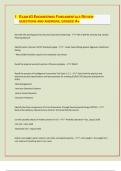
ENGINEERING FUNDAMENTALS REVIEW QUESTIONS AND ANSWERS, GRADED A+ Describe the starting point for Security requirement planning - -UFC 4-020-01 Security Eng. Facility Planning Manual Identify when minimum AT/FP standards apply - -- Asset Value Rating against Aggressor Likelihood Rating - Most CONUS facilities require min standards: low threat Recall the physical security function of fences and gates - -DELAY Recall the purpose of Intelligence Community Tech Spec 1.5.1 - --Sets forth the physical and technical security specifications and best practices for meeting ICS/ICD 705 (Security Standards for SCIFs) -Risk Management -Intrusion Detection Systems -Access Control Systems -Acoustic Protection Identify the three components of Crime Prevention Through Environmental Design (CPTED) - - Natural Surveillance, Natural Access Control, Territorial Reinforcement List the possible phases of matter present in soil - --Partially saturated = Gas, Liquid, Solid -Dry soil = Gas, Solid -Saturated soil = Liquid, Solid Define unit weight, water content, void ratio, and specific gravity - --Unit weight = the weight of a unit volume of anything (soil in our case) -Specific Gravity (G) = the ratio of any material's unit weight to the unit weight of water -Water content = "Is there more water or solids?" (no max) -Void ratio = "Are there more voids or solids?" (no max) Use a phase diagram to calculate various weight-volume relationships of soil - - Summarize how the soil formation process affects the expected soil characteristics at a given location - -§ Parent rock - Igneous, Sedimentary, Metamorphic § Weathering - Mechanical, Chemical § Residual = weathers in place / Transported = deposited away from parent rock Explain the interaction between shape, size, & gradation of the soil solids and the in-place density of the soil - -- We want angular, well graded, high density - Varying shape and size created higher density and less voids! Differentiate between the Plastic Limit (PL) and the Liquid Limit (LL) - -- Plastic limit = Soil forms without crumbling - Liquid Limit = Soil flows under own weight Recall the two phases of soil that are available to handle an applied load - -Pore water (liquid phase) and Soil skeleton (solid phase) Explain what is meant by the phrase 'soil skeleton' -
Document information
- Uploaded on
- May 9, 2024
- Number of pages
- 19
- Written in
- 2023/2024
- Type
- Exam (elaborations)
- Contains
- Questions & answers