

HESI CRITICAL THINKING EXAMINATION BEST GRADED 100% 2024
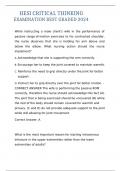
While instructing a male client's wife in the performance of passive range-of-motion exercises to his contracted shoulder, the nurse observes that she is holding his arm above and below the elbow. What nursing action should the nurse implement? A. Acknowledge that she is supporting the arm correctly. B. Encourage her to keep the joint covered to maintain warmth. C. Reinforce the need to grip directly under the joint for better support. D. Instruct her to grip directly over the joint for better motion. - CORRECT ANSWER The wife is performing the passive ROM correctly, therefore the nurse should acknowledge this fact (A). The joint that is being exercised should be uncovered (B) while the rest of the body should remain covered for warmth and privacy. (C and D) do not provide adequate support to the joint while still allowing for joint movement. Correct Answer: A What is the most important reason for starting intravenous infusions in the upper extremities rather than the lower extremities of adults? A. It is more difficult to find a superficial vein in the feet and ankles. B. A decreased flow rate could result in the formation of a thrombosis. C. A cannulated extremity is more difficult to move when the leg or foot is used. D. Veins are located deep in the feet and ankles, resulting in a more painful procedure. - CORRECT ANSWER Venous return is usually better in the upper extremities. Cannulation of the veins in the lower extremities increases the risk of thrombus formation (B) which, if dislodged, could be life-threatening. Superficial veins are often very easy (A) to find in the feet and legs. Handling a leg or foot with an IV (C) is probably not any more difficult than handling an arm or hand. Even if the nurse did believe moving a cannulated leg was more difficult, this is not the most important reason for using the upper extremities. Pain (D) is not a consideration. Correct Answer: B The nurse observes an unlicensed assistive personnel (UAP) taking a client's blood pressure with a cuff that is too small, but the blood pressure reading obtained is within the client's usual range. What action is most important for the nurse to implement? A. Tell the UAP to use a larger cuff at the next scheduled assessment. B. Reassess the client's blood pressure using a larger cuff. C. Have the unit educator review this procedure with the UAPs. D. Teach the UAP the correct technique for assessing blood pressure. - CORRECT ANSWER The most important action is to ensure that an accurate BP reading is obtained. The nurse should reassess the BP with the correct size cuff (B). Reassessment should not be postponed (A). Though (C and D) are likely indicated, these actions do not have the priority of (B). Correct Answer: B A client is to receive cimetidine (Tagamet) 300 mg q6h IVPB. The preparation arrives from the pharmacy diluted in 50 ml of 0.9% NaCl. The nurse plans to administer the IVPB dose over 20 minutes. For how many ml/hr should the infusion pump be set to deliver the secondary infusion? - CORRECT ANSWER The infusion rate is calculated as a ratio proportion problem, i.e., 50 ml/ 20 min : x ml/ 60 min. Multiply extremes and means 50 × 60 /20x 1= 300/20=150 Correct Answer: 150 Twenty minutes after beginning a heat application, the client states that the heating pad no longer feels warm enough. What is the best response by the nurse? A. That means you have derived the maximum benefit, and the heat can be removed. B. Your blood vessels are becoming dilated and removing the heat from the site. C. We will increase the temperature 5 degrees when the pad no longer feels warm. D. The body's receptors adapt over time as they are exposed to heat. - CORRECT ANSWER (D) describes thermal adaptation, which occurs 20 to 30 minutes after heat application. (A and B) provide false information. (C) is not based on a knowledge of physiology and is an unsafe action that may harm the client. Correct Answer: D The nurse is instructing a client with high cholesterol about diet and life style modification. What comment from the client indicates that the teaching has been effective? A. If I exercise at least two times weekly for one hour, I will lower my cholesterol. B. I need to avoid eating proteins, including red meat. C. I will limit my intake of beef to 4 ounces per week. D. My blood level of low density lipoproteins needs to increase. - CORRECT ANSWER Limiting saturated fat from animal food sources to no more than 4 ounces per week (C) is an important diet modification for lowering cholesterol. To be effective in reducing cholesterol, the client should exercise 30 minutes per day, or at least 4 to 6 times per week (A). Red meat and all proteins do not need to be eliminated (B) to lower cholesterol, but should be restricted to lean cuts of red meat and smaller portions (2- ounce servings). The low density lipoproteins (D) need to decrease rather than increase. Correct Answer: C The UAPs working on a chronic neuro unit ask the nurse to help them determine the safest way to transfer an elderly client with left-sided weakness from the bed to the chair. What method describes the correct transfer procedure for this client? A. Place the chair at a right angle to the bed on the client's left side before moving. B. Assist the client to a standing position, then place the right hand on the armrest. C. Have the client place the left foot next to the chair and pivot to the left before sitting. D. Move the chair parallel to the right side of the bed, and stand the client on the right foot. - CORRECT ANSWER (D) uses the client's stronger side, the right side, for weight-bearing during the transfer, and is the safest approach to take. (A, B, and C) are unsafe methods of transfer and include the use of poor body mechanics by the caregiver. Correct Answer: D
Document information
- Uploaded on
- May 9, 2024
- Number of pages
- 61
- Written in
- 2023/2024
- Type
- Exam (elaborations)
- Contains
- Questions & answers


