NUR 256 MENTAL EXAM 1.docx
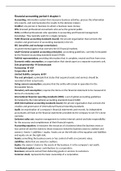
Mental Health vs. Mental Illness - correct answer Health= successful performance of mental functions, resulting in the ability to engage in productive activities and enjoy fulfilling relationships, adapt to change, and cope with adversity. Illness= medical conditions that affect a person's thinking, feeling, mood, ability to relate to others, and daily functioning mental health continuum - correct answer Ranges from Mild, Moderate, to Severe. Occasional to MILD- No impairment (Pt can work with stress) Mild to MODERATE- Mild or temporary impairment (Starting to be noticed at work, but not too bad) MARKED DISTRESS- moderate to disabling or chronic impairment. (Inpatient, suicidal, ITS NOW A PROBLEM) Biological and genetic factors: Social and economic factors: Environmental factors: - correct answer Resilience- the ability and capacity for people to secure resources needed for well-being •Family, peer groups, school - promote confidence, coping skills, inadequacy, instilling anxiety •Culture - different views on mental illness diathesis-stress model Diathesis= Stress= Both diathesis and stress are present for... - correct answer Suggests that a person may be predisposed for a mental disorder that remains unexpressed until triggered by stress. Predisposition (Genetic) Triggers the disorder The disorder DSM Diagnostic Criteria: Must be present in How many areas of the 9 - correct answer Five or More Sigmund Freud Believed that: His theory structure includes? - correct answer •majority of mental issues were the result of issues unresolved in childhood. ID- unconscious and impulsive EGO- problem solver and reality tester Superego- Represents the conscience, holds rules, values for socially acceptable behavior Examples of ID EGO SUPEREGO - correct answer Id: is instinct reaction (natural response) I'm hungry I'm going to eat; baby is going to cry to get needs met Ego: I'm Hungry and I'm in a McDonald's line, I know I have to wait to get the food and I cannot just cry and skip the line. Superego: I am Hungry and broke. I may think about stealing food, but my Superego will counteract that thought because I know stealing is wrong. What are defense mechanisms? - correct answer Mental processes that protect individuals from strong or stressful emotions and situations. Unconscious response to stress. IT CAN HELP OR BE MALADAPTIVE examples of defense mechanisms - correct answer repression, regression, denial, projection, suppression, rationalization, compensation Harry Stack Sullivan's - correct answer The purpose of all behavior is to get needs met through interpersonal interactions (relationships) and to decrease or avoid anxiety. Therapy - correct answer •Goal is to reduce/eliminate sx by improving interpersonal function •Develop satisfaction through social relationships •Tx - Depression Peplau's Theory - correct answer •Nurse-patient relationship - the foundation of nursing practice •Shift from what nurses "do to" patients - "do with" patients (Ivan Pavlov) - correct answer Classical Conditioning Theory •Dog would anticipate food once the bell is rung, salivate before receiving food •Response is involuntary •It will take time and conditioning (consistency and effort) (B.F. Skinner) - correct answer Operant Conditioning Theory •Method of learning through rewards and punishment •Positive reinforcement or negative reinforcement Help the patient reconcile and know that they can be rewarded instead of punished if they have control over their behavior Modeling Operant Conditioning Systematic Desensitization Aversion Therapy - correct answer •Patient learns through imitation. •Positive reinforcement to increase desired behaviors •Form of behavior modification •4 steps - Breaking down fear, exposure (little by little), hierarchy of fears, practice •Gradually help someone being able to overcome •Pairing a negative stimuli with target behavior (Antabuse) (it will make them very sick and discourage negative behavior like drinking once they drink it will make them really sick and won't want to do it again) Aaron Beck's Cognitive Therapy - correct answer •identified that patients with depression thought differently than those w/o •Negative thinking •Self-Critical thinking Negative thoughts, Negative self-perception, Negative response Maslow's Hierarchy of Needs level 1= level 2= level 3= level 4= level 5= - correct answer physiologic needs (air, water, food, shelter, clothing, sleep) Safety (personal security, employment, health) Love and belonging (friendships, intimacy) Esteem (respect, self-esteem, freedom, recognition)
Written for
- Institution
- Nur 256
- Course
- Nur 256
Document information
- Uploaded on
- May 8, 2024
- Number of pages
- 33
- Written in
- 2023/2024
- Type
- Exam (elaborations)
- Contains
- Questions & answers
Subjects

Also available in package deal