HESI Management Practice test 100% Solved 2024
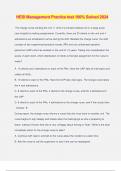
HESI Management Practice test 100% Solved 2024 The charge nurse working the 3 to 11 shift of a 24-bed medical unit in a large acute care hospital is making assignments. Currently, there are 20 clients on the unit and 4 admissions are scheduled to arrive during the shift. Besides the charge nurse, the staff consists of two experienced practical nurses (PN) and one unlicensed assistive personnel (UAP) who has worked on the unit for 10 years. Taking into consideration the acuity of each client, which distribution of clients is the best assignment for the nurse to make? A. 10 clients and 2 admissions to each of the PNs. Have the UAP take all vital signs and collect all I&Os. B. 10 clients to each of the PNs. Have the UAP take vital signs. The charge nurse takes the 4 new admissions. C. 8 clients to each of the PNs, 4 clients to the charge nurse, and the 4 admissions to the UAP. D. 8 clients to each of the PNs, 4 admissions to the charge nurse, and 4 low-acuity clien - Answer- B During report, the charge nurse informs a nurse that she must work on another unit. The nurse begins to sign deeply and tosses about her belongings as she is preparing to leave, making it known that she is very unhappy about having to "float." What is the best immediate action for the charge nurse to take? A. Continue with report, and talk to the nurse about the incident at a later time. B. Ask the nurse to call the supervisor to see if she can be reassigned. C. Stop report and remind the nurse that all the staff must "float" at some time. D. In the presence of other staff members, inform the nurse that her behavior is inappropriate. - Answer- A The nurse is giving change-of-shift report for four clients in the emergency center and reports the client with the terminal disease has a living will and a "Do not resuscitate" (DNR) order on file. Which client fits the criteria for a terminal illness? A. 2-year-old child with esophageal burns from drinking drain cleaner who now has a gastrostomy tube. B. 76-year-old female client with Alzheimer's disease who is pacing the halls and trying to "go home". C. 52-year-old male client who had a partial lobectomy and on a ventilator on the 2 postoperative day. D. 43-year-old male with amyotrophic lateral sclerosis who is refusing artificial nutrition or hydration. - Answer- D The charge nurse assigns the care of a client with diabetes who has hyperglycemia to a practical nurse (PN). In supervising the PN, what is the charge nurse's most important action? A. Decide which sliding scale insulin dose should be administered. B. Obtain the blood sugar results via skin puncture and glucometer. C. Notify the healthcare provider of the daily serum glucose results. D. Confer with the PN about any manifestations the client is exhibiting. - Answer- D The charge nurse working on a surgical unit must discharge as many clients as possible to prepare for emergency admissions. Which client is stable enough to be discharged from the unit? A. An elderly client with end-stage cirrhosis who had a liver biopsy 4 hours ago. B. A client scheduled for a femoro-popliteal bypass surgery tomorrow. C. A middle-aged client with acute pancreatitis and lower left quadrant pain. D. A female client with angina and ectopy noted on the telemetry monitor - Answer- B An emergency room anticipates an influx of injured clients from a large motor vehicle collision on a major freeway. Which client should the triage nurse send to the trauma staff for immediate intervention? A. A young adult male with a suspected closed head injury who has no respirations despite having his airway repositioned by the emergency medical team. B. An adult with a suspected intraabdominal bleed who was not breathing on arrival, but is currently responding since repositioning the airway. C. A teenager with a suspected fractured left leg whose respirations are 26 breaths/min, capillary refill 2 seconds, and who can follow simple commands. D. A young adult with a facial laceration that is controlled by pressure and whose respiratory rate, capillary refill, and ability to follow commands are all WNL. - Answer- B The nurse receives report in the emergency center for four clients. Which client should the nurse assess first? A. A screaming child with a compound fracture of the wrist. B. A diabetic client with a laceration on the sole of the foot. C. A client experiencing shortness of breath and dyspnea. D. A geriatric client with many new and old bruises noted. - Answer- C The nurse witnesses a male client's signature for surgical consent for a Billroth II procedure after the surgeon discusses the procedure and its implication with the client. After signing the consent, the client questions the importance of a change in his diet postoperatively. What action should the nurse implement? A. Review information about dumping syndrome. B. Have the client sign another consent. C. Notify the surgeon about the client's comment. D. Explain the surgical procedure. - Answer- A The nurse is designing a program to control nosocomial infections on a geriatric unit of an acute care hospital. What strategy should be included in this plan? A. Do not allow those with influenza to be admitted to the unit. B. Require that all clients receive a pneumonia vaccine pr
Document information
- Uploaded on
- May 7, 2024
- Number of pages
- 8
- Written in
- 2023/2024
- Type
- Exam (elaborations)
- Contains
- Questions & answers