
EDUC 181 Final Exam Questions and Answers Already Passed
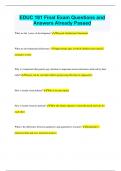
EDUC 181 Final Exam Questions and Answers Already Passed What are the 3 areas of development? Physical, Intellectual, Emotional What are developmental milestones? approximate ages at which children reach specific normative events Why is it important that parents pay attention to important motor milestones achieved by their child? Parents can be sure their child is progressing like they're supposed to How is family form defined? Who is in your family How is family function defined? How the family operates to meet the needs and care for each other What is the difference between qualitative and quantitative research? Quantitative - numerical data and uses statistical analyses Qualitative - verbal and textual data What is considered non-empirical research versus empirical research? Empirical research is when individuals use systematic observations to test hypotheses, or predictions that can be tested, and answer research questions Non-empirical research are things like reflections, anecdotes, positions, or authority/experience What is generalizability? how well the sample of people represent a larger population What is the difference between basic and applied research? Basic research - test and build theories Applied research - aimed at solving day-to-day problems How do longitudinal and cross-sectional research studies differ? Longitudinal studies - same group of participants over time Cross-sectional - different ages of participants at approximately the same time Define theory. A theory is a set of interconnected ideas/arguments that logically explain a particular pattern of behaviors and events (usually deriving from data). What is Bronfenbrenner's Theory and it's various systems? Bronfenbrenner's bioecological systems theory focuses on various contexts or ecologies Microsystem - immediate environment (daily home, school or daycare, peer group and community environment of the children) Mesosystem - connections (linkages between home and school, between peer group and family, and between family and community) Exosystem - indirect environment (may include the parents' workplaces, extended family members, and the neighborhood the children live in) Macrosystem - social and cultural values
Document information
- Uploaded on
- May 7, 2024
- Number of pages
- 17
- Written in
- 2023/2024
- Type
- Exam (elaborations)
- Contains
- Questions & answers


