
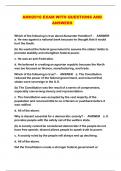
AMH2010 EXAM WITH QUESTIONS AND ANSWERS Which of the following is true about Alexander Hamilton? - ANSWER a. He was against a national bank because he thought that it would hurt the South. (b) He wanted the federal government to assume the states' debts to promote stability and strengthen federal power. c. He was an anti-Federalist. d. He believed in creating an agrarian republic because the North was too focused on finance, manufacturing, and trade. Which of the following is true? - ANSWER a. The Constitution reduced the power of the federal government, and ensured that states were sovereign in the U.S. (b) The Constitution was the result of a series of compromises, especially concerning slavery and representation. c. The Constitution was accepted by the vast majority of the population and received little to no criticism or pushback before it was ratified. d. All of the above. Why is dissent essential for a democratic society? - ANSWER a. It provides people with the safety net of the welfare state. (b) A society cannot be considered democratic if the people do not have free speech; dissent allows people to speak truth to power. c. A society ruled by the people will always end up declining. d. All of the above. Did the Constitution create a stronger federal government or stronger state governments relative to the Articles of Confederation? - ANSWER (a) The Constitution created a stronger federal government. b. The Constitution granted more powers to the state governments than they had enjoyed under the Articles. c. The Constitution increased the power of the smaller states, while decreasing the power of the larger states and decreasing the power of the federal government. d. None of the above; the relative power of the state and federal governments did not change with the switch to the Constitution. The Constitutional Convention needed to be called because... - ANSWER (a) Congress lacked power because it lacked authority to tax. b. Congress could only collect taxes. c. Congress did not want to carry on diplomacy with other nations. d. The federal government was gaining too much power. Which of the following was an immediate change that resulted from the American Revolution? - ANSWER a. The situation improved for Native Americans since British policy, not American policy, was hostile to Native Americans. b. The immediate abolition of slavery, especially in the Middle and Northern states. (c) An end to mercantilism in the U.S. d. Women gained new rights including property rights for married women. What effect did the French Revolution have on the U.S. in the 1790s? - ANSWER a. It proved to all that the ideals of liberty and democratic governance would create more allies for the Unite d States. b. It distracted France from its war with Britain, which meant the seas were safe for American merchants. c. It led Washington, and then Adams, to support the French revolutionaries, which hurt U.S. relations with Britain. (d) It contributed to the first party system - Republicans versus Federalists - in the U.S. Which of the following is true regarding The Federalist Papers? - ANSWER a. The papers were published in book form in 1787 with the main purpose to explain the meaning of the Declaration of Independence. (b)They were originally published as articles in New York newspapers in an attempt to persuade New Yorkers to ratify the Constitution. c. They were written by Washington, Adams, and Jefferson. d. They were written by Sam Adams and Patrick Henry in order to persuade Americans to support a Bill of Rights. Whose experience with the British crown and parliament influenced the American revolutionaries when they were creating the Bill of Rights? - ANSWER (a) John Wilkes. b. Robespierre. c. Lord Rockingham. d. The Jacobins. What contributed to Napoleon agreeing to sell the Louisiana territory to the United States? - ANSWER (a) France lost the profitable sugar colony of Haiti, along with a number of French troops to a yellow fever epidemic, and so Napoleon decided to cut his losses. b. Robert R. Livingston, an expert negotiator, convinced Napoleon to sell the territory at a loss for France. c. Robert R. Livingston, U.S. minister to France, offered so much money for the territory that the French could not turn it down. d. All of the above. Which political party feared the excesses of the French Revolution during the 1790s? - ANSWER a. The Republicans. (b) The Federalists. c. The Tories. d. The Democrats. Why did the Federalist support Jay's Treaty? - ANSWER (a) It allowed the U.S. to continue to trade and maintain neutrality while Britain and France were at war.
Preview 4 out of 31 pages
Exam (elaborations)
AMH2010 EXAM WITH QUESTIONS AND ANSWERS
Preview 4 out of 31 pages
AMH2010 EXAM WITH QUESTIONS AND ANSWERS ...
Content preview
Document information
- Uploaded on
- May 7, 2024
- Number of pages
- 31
- Written in
- 2023/2024
- Type
- Exam (elaborations)
- Contains
- Unknown
$13.09
Wrong document? Swap it for free
Within 14 days of purchase and before downloading, you can choose a different document. You can simply spend the amount again.
Written by students who passed
Immediately available after payment
Read online or as PDF

Reputation scores are based on the amount of documents a seller has sold for a fee and the reviews they have received for those documents. There are three levels: Bronze, Silver and Gold. The better the reputation, the more your can rely on the quality of the sellers work.
Available in package deal
Package deal
AMH2010 /AMH 2010 PACKAGED EXAMS 2024/2025

