
Pharmacology Study Guide With Actual Answers Well Elaborated/2024.
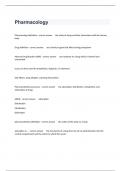
Pharmacology Definition - correct answer the study of drugs and their interactions with the human body Drug definition - correct answer any chemical agent that affects living protoplasm Adverse Drug Reaction (ADR) - correct answer any response to a drug which is harmful and unintended occurs at doses used for prophylaxis, diagnosis, or treatment side effects, drug allergies ,and drug interactions Pharmacokinetics processes - correct answer the absorption, distribution, metabolism, and elimination of drugs ADME - correct answer Absorption Distribution Metabolism Elimination pharmacokinetics definition - correct answer the action of the body on a drug absorption is... - correct answer the movement of a drug from its site of administration into the central compartment and the extent to which this occurs effects of solid capsules and absorption - correct answer solid dosage forms require dissolution of the capsule first, then absorption can occur passive transport - correct answer diffusion from higher to lower concentration active transport - correct answer against a concentration gradient, requires energy absorption and stomach - correct answer some medications need an empty stomach for basic environment, some need an acidic environment after absorption comes - correct answer distribution distribution - correct answer drug is transported to a site where it reacts with various bodily tissues and/or receptors what determines the rate of delivery and potential amount of drug distributed to tissues - correct answer cardiac output, regional blood flow, capillary permeability, and tissue volume what organs receive most of the drug first - correct answer liver, kidney, brain, and other well-perfused organs medicines that can cross blood-brain barrier - correct answer lipophilic medicines, good for getting into CNS second distribution phase - correct answer slower, delivers to muscle, most viscera, skin, and fat lipid soluble drugs have a high affinity for - correct answer adipose tissue where they are stored examples of highly lipid soluble drugs - correct answer phenothiazines, benzodiazepines, barbiturates metabolism function - correct answer to convert active lipid soluble compounds to inactive water-soluble substances to be primarily excreted by the kidney phase 1 of metabolic process - correct answer hepatic microsomal enzymes oxidize, demethylate, and hydrolyze drugs more significant DIs phase 2 of metabolic process - correct answer large water-soluble substances are attached to the drug for those who aren't water soluble enough to go through phase 1 may need to do a few times until it's hydrolyzed enough to exit Hepatic Microbial Enzymes - correct answer phase 1 CYP450 isoenzymes either induce or inhibit metabolism CYP450 classification scheme - correct answer CYP # X # enzyme inhibition and its effect on metabolism - correct answer decrease the rate of metabolism enzyme inhibitors effect on concentration - correct answer increases the drug concentration enzyme induction of CYP 450 - correct answer stimulates the increase in CYP 450 enzyme activity
Document information
- Uploaded on
- May 2, 2024
- Number of pages
- 8
- Written in
- 2023/2024
- Type
- Exam (elaborations)
- Contains
- Questions & answers


