IB TOPIC 11 | ANIMAL PHYSIOLOGY
2016 | SYJ0014
Topic 11.1: Animal physiology – Antibody production and vaccination
Immunity is based on recognition of self and destruction of foreign material.
• Understanding: Every organism has unique molecules on the surface of its cells.
Antigens: molecules recognized as foreign by the immune system
Antibodies: globular proteins that recognize and act against a specific antigen
Major Histocompatibility Complex (MHC): set of cell surface proteins essential for the acquired
immune system to recognize foreign molecules and oneself
Unique nature of MHC: every individual expresses different MHC
Recognizing foreign material: MHC is used by the immune system to recognize its
own or foreign material
Problem with MHC: MHC is responsible for the rejection of tissue/organ transplant
MHC recognition and rejection mechanism:
NK cell management: NK cells kills cells that do not express own MHC
T cell and B cell management: T and B cells only react with antigens
that are presented by own MHC
• Understanding: Pathogens can be species-specific although others can cross species barriers.
Pathogens: diseases causing organism
Species specific: able to infect a certain type of organism
Species general: are able to cross the species barrier
Zoonosis: name given to a pathogen that can cross the species barriers
Factors affecting zoonosis: growth of contact between animals and human through livestock and disruption of habitat
• Understanding: B lymphocytes are activated by T lymphocytes in mammals.
T helper cells: plays a role in the production of antibodies by B cells and activation of cytotoxic cells
B helper cells: produces specific antibodies as a part of specific immunity
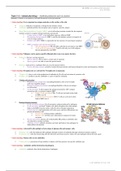
T-helper cell activation:
Phagocyte enter lymph node: macrophage/dendritic cells travel to lymph
node once engulfed antigen
Phagocyte antigen presentation: macrophage/dendritic cells present antigen
on cell surface
T cell activation: T cell recognize the antigen presented by APC (antigen
presenting cells) via protein complex MHC
Helper T cell activation: CD4+ T cells are activated as they bind
to MHC class II
Cytotoxic T cell activation: CD8+ T cells are activated as they
bind to MHC class I
Humoral immune response:
B cell encounters antigens: B cell encounters antigen produced by pathogens
B cell activation: activated T helper cells which recognizes the same antigen
binds to the MHC II on the surface of the B cell to stimulate maturation
Clonal selection: rapid replication of B cells occurs and they differentiate into
plasma and memory cells
Plasma cell: cell that produce antibodies
Memory cell: cell that stores information to prepare for future
invasions
Plasma cell activity: plasma cell (with plentiful ER) produces antibodies that
are released to circulate our body
Antibody activity: antibody circulates our body and binds to free pathogen for
indirect/direct destruction
• Understanding: Activated B cells multiply to form clones of plasma cells and memory cells.
B plasma cells: cells that indirectly kills pathogen through secretion of antibodies through a humoral immune response
B memory cells: cells that remain long after the infection and remain inactive unless the same pathogen infects the body again
• Understanding: Plasma cells secrete antibodies.
Clonal selection: generation of large number of plasma cells that generate one specific antibody type
• Understanding: Antibodies aid the destruction of pathogens.
Antibodies: molecules that aid the destruction of pathogens
LAST EDITED 2017-03-17 | 1