
NU 216 Abdomen Exam Questions with Correct Answers (1)
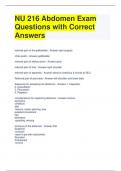
NU 216 Abdomen Exam Questions with Correct Answers (1) referred pain of the gallbladder - Answer-right scapula chole prefix - Answer-gallbladder referred pain of kidney stone - Answer-groin referred pain of liver - Answer-right shoulder referred pain of appendix - Answer-starts at umbilicus & moves to RLQ Referred pain of pancreas - Answer-left shoulder and lower back Sequence for assessing the abdomen - Answer-1. Inspection 2. Auscultation 3. Percussion 4. Palpation considerations for inspecting abdomen - Answer-contour symmetry umbilicus skin -lesions, moles, piercing, scar pulsation/movement hair demeanor -guarding, wincing Contours of the abdomen - Answer-Flat Scaphoid -concave -seen in pts with malnutrition Rounded Protuberant -convex -ascites, pregnancy normla bowel sounds - Answer-gurgling, high pitched irregular 5-30 / min borborygmus - Answer-the rumbling noise caused by the movement of gas in the intestine -extreme amount of bowel sounds hypoactive bowel sounds - Answer-less than 5 /minute hyperactive bowel sounds - Answer-more than 30/ minute vascular bowel sounds location - Answer-aorta left/right renal artery left/right iliac artery left/right femoral artery looks for presence of bruits how do you listen for bruits? - Answer-with bell of stethoscope general tympany - Answer-Percuss in all 4 quadrants to determine the prevailing amount of tympany and dullness Move clockwise: RLQ, RUQ, LUQ, LLQ what should be heard when percussing organs - Answer-dullness splenic dullness - Answer-Percuss the lowest costal interspace in the left anterior axillary line. This area is normally tympanic Ask pt to take deep breath and percuss area again. Dullness in this area is sign of splenic enlargement costovertebral angle tenderness - Answer-Tenderness to percussion over the costovertebral angle; a common finding in infections of the kidney Percuss pts back and observe for any pain Liver Span Percussion - Answer-- 6-10cm is normal percuss downward from the chest in the right midclavicular line until you detect top edge of liver dullness percuss upward from the abdomen in the same line until you detect the bottom edge of liver dullness measure liver span between these two points fluid wave - Answer-A sign of free fluid in the abdominal cavity; tapping on one side of the abdomen transmits a wave that is felt on the opposite side tells if patient has ascites or extra fat normal abdomen should feel - Answer-soft and nontender one handed palpation - Answer-for light bimanual palpation - Answer-for deep Rebound Tenderness (Blumberg Sign) - Answer-Press on abdomen and take hand off fast If they feel pain when you take your hand off, that's a sign of peritonitis Start away from painful side and work towards it Inspiratory Arrest (Murphy's Sign) - Answer-Normally, palpating the liver causes no pain. In a person with inflammation of the gallbladder (cholecystitis), pain occurs. Hold your fingers under the liver border. Ask the person to take a deep breath. A normal response is to complete the deep breath without pain. Iliopsoas muscle test - Answer-RLQ pain that occurs when placing pressure against a raised leg, suggesting appendicitis Obturator test - Answer-Use when appendicitis or peritonitis is suspected 1. Person supine, lift right leg, flexing at hip and 90 degrees at knee 2. Hold ankle and rotate leg internally and externally; negative or normal response is no pain
Document information
- Uploaded on
- April 30, 2024
- Number of pages
- 5
- Written in
- 2023/2024
- Type
- Exam (elaborations)
- Contains
- Questions & answers


