
NFPA 70 Definitions Set One Questions with Answers
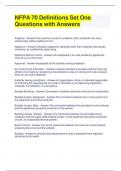
NFPA 70 Definitions Set One Questions with Answers Ampacity - Answer-The maximum current in amperes, that a conductor can carry continuously without getting too hot Appliance - Answer-Utilization equipment, generally other than industrial, like laundry machines, air conditioning, deep frying Appliance Branch Curcuit - Answer-All receptacles in an area containing appliances must all run on one circuit Approved - Answer-Acceptable to the authority having jurisdiction Arc-Fault Circuit Interrupter - Answer-A device intended to provide protection from the effects of arc faults by recognizing characteristics unique to arcing and to de-energize when an arc fault is detected Authority Having Jurisdiction - Answer-An organization, office, or individual responsible for enforcing the requirements of a code or standard, or for approving equipment, materials, an instillation, or a procedure. Bonded (Bonding) - Answer-Connected to establish electrical continuity and conductivity Bonded Jumper, Equipment - Answer-The connection between two or more portions of the equipment grounding conductor Bonded Jumper, Main - Answer-The connection between the grounded circuit conductor and the equipment grounding conductor at the service Bonding Jumper, System - Answer-The connection between the grounded circuit conductor and the supply-side bonding jumper, or the equipment grounding conductor, or both, at a separately derived system. Branch Circuit - Answer-The circuit conductors between the final over-current device protecting the circuit and the outlet(s) Building - Answer-A structure that stands alone or that is separated from adjoining structures by fire walls Cabinet - Answer-An enclosure that is designed for either surface mounting or flush mounting and is provided with a frame, mat, or trim in which a swinging door or doors are or can be hung Circuit Breaker - Answer-A device designed to open or close a circuit by nonautomatic means and to open the circuit automatically on a predetermined overcurrent without damage to itself when properly applied within its rating. Concealed - Answer-Rendered inaccessible by the structure or finish of the building Continuous Duty - Answer-Operation at a substantially constant load for an indefinitely long time Continuous Load - Answer-A load where the maximum current is expected to continue for 3 hours or more Controller - Answer-A device or group of devices that serves to govern, in some predetermined manner, the electric power delivered to the apparatus to which it is connected Covered Conductor - Answer-A conductor encased within material of composition or thickness that is not recognized by this code as electrical insulation Cutout Box - Answer-An enclosure designed for surface mounting that has swinging doors or covers secured directly to and telescoping with the walls of the enclosure Damp Location - Answer-Locations protected by weather and not subject to saturation with water or other liquids but subject to moderate degrees of moisture Dead Front - Answer-Without live parts exposed to a person on the operating side of the equipment Demand Factor - Answer-The ration of the maximum demand of a system, or a part of a system, to the total connected load of a system or the part of the system under consideration Device - Answer-A Unit of an electrical system, other than a conductor, that carries or controls electric energy as its principal function. Disconnecting Means - Answer-A device, or a group of devices, or other means by which the conductors of a circuit can be disconnected from their source of supply Dry Location - Answer-A location not normally subject to dampness or wetness. A location classified as dry may be temporarily subject to dampness or wetness, as in the case of a building under construction Dusttight - Answer-Enclosures constructed so that dust will not enter under specified test conditions Dwelling Unit - Answer-A single unit, providing complete and independent living facilities for one or more persons, including permanent provisions for living, sleeping, cooking, and sanitation Effective Ground-Fault Current Path - Answer-An intentionally constructed, low- impedance electrically conductive path designed and intended to carry current under ground-fault conditions from the point of a ground fault on a wiring system to the electrical supply source and that facilitates the operation of the overcurrent protective device or ground-fault detectors Enclosed - Answer-Surrounded by a case, housing, fence, or wall(s) that prevents persons from accidentally contacting energized parts Enclosure - Answer-The case or housing apparatus, or the fence or walls surrounding an instillation to prevent personnel from accidentally contacting energized parts to protect the equipment from physical damage Energized - Answer-Electrically connected to, or is, a source of voltage Equipment Grounding Conductors - Answer-The conductive path(s) that provides a ground-fault current path and connects normally non-current-carrying metal parts of equipment together and to the system grounded conductor or to the grounding electrode conductor, or both Explosion proof Equipment - Answer-Equipment enclosed in a case that is capable of withstanding an explosion Exposed (as applied to wiring methods) - Answer-Capable of being inadvertently touched or approached nearer than a safe distance by a person Feeder - Answer-All circuit conductors between the service equipment the source of a separately derived system, or other power supply source and the final branch-circuit overcurrent device
Document information
- Uploaded on
- April 30, 2024
- Number of pages
- 8
- Written in
- 2023/2024
- Type
- Exam (elaborations)
- Contains
- Questions & answers


