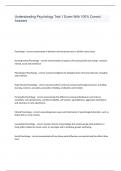
Understanding Psychology Test 1
Psychology - correct answerstudy of behavior and mental process in all their many facets Developmental Psychology - correct answerstudies all aspects of human growth and change - physical, mental, social and emotional Physiological Psychology - correct answerinvestigates the biological basis of human behavior, thoughts and emotions Experimental Psychology - correct answerconducts research on basic psychological process, including learning, memory, sensation, perception, thinking, motivation and emotion Personality Psychology - correct answerstudy the differences among individuals in such traits as sociability, conscientiousness, emotional stability, self-esteem, agreeableness, aggressive inclinations, and openness to new experiences Clinical Psychology - correct answerdiagnoses causes and treatments of psychological disorders, such as depression or acute anxiety Counseling Psychology - correct answera branch of psychology that assists people with problems in living (often related to school, work, or marriage) and in achieving greater well-being Social Psychology - correct answerstudy of how these social influences are exerted and the effects they have Industrial and Organizational Psychology - correct answerapply the principles of psychology to the workplace scientific method - correct answeran approach to knowledge that relies on collecting data, generating a theory to explain the data, producing testable hypotheses based on the theory, and testing those hypothesis empirically theory - correct answersystematic explanation of a phenomenon; it organizes known facts, allows us to predict new facts, and permits us to exercise a degree of control over the phenomenon hypothesis - correct answerspecific, testable predictions derived from a theory voluntarism - correct answerattention is actively controlled by intentions and motives - attention controls such other psychological processes as perceptions, thoughts, and memories - Wilhelm Wundt structuralism - correct answerstresses the basic units of experience and the combination in which they occur - Edward Titchener functionalist theory - correct answerfocused on how individuals use their perceptual abilities to adapt and function in their environment - William Jones free association - correct answerlie on a couch and say whatever comes to their mind - Sigmund Freud psychodynamic theory - correct answerbehavior results from psychological factors that interact within the individual, often outside conscious awareness behaviorism - correct answerstudies only observable and measurable behavior - John B Watson displacement - correct answerneurotic response that he traced to the unconscious - John B Watson
Document information
- Uploaded on
- April 28, 2024
- Number of pages
- 5
- Written in
- 2023/2024
- Type
- Exam (elaborations)
- Contains
- Questions & answers