

MEMBRANE PROTEINS
3 a Movement of Molecules across Membranes
FLUID MOSAIC MODEL OF CELL MEMBRANES
The membranes of cells
are made of a PHOSPHOLIPID BILAYER with globular
proteins penetrating the bilayer or attached to its surface The phospholipid
bilayer can move so it is a fluid and the separate proteins are like
small pieces of a mosaic
A phospholipid molecule has a hydrophilic head and hydrophobic tails
The phospholipids form a bilayer with the hydrophilic heads towards
the aqueous cytoplasm and the aqueous external fluid and the
hydrophobic tails to the inside of the bilayer
MEMBRANE PROTIENS
The three major roles of membrane proteins are
Movement of molecules across membranes
Transmission
of extracellular signals ie signal transduction
Detecting and amplifying stimuli photoreceptor protein systems
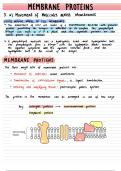
The proteins in the membrane can be arranged in one of two ways
key Intergral proteins s transmembrane proteins
peripheral proteins
BBB to
g qui g qq
, I N T E G R AL P RO T I EN s
These proteins are embedded in the membrane in some way Integral protiens
that extend the width of the membrane are known as transmembrane
proteins
Integral proteins penetrate the hydrophobic interior of the phospholipid bilayer
and are folded so that they have regions of hydrophobic R groups These
regions of hydrophobic R groups form strong hydrophobic interactions
which hold integral membrane proteins within the phospholipid bilayer
integral membrane proteins interact extensively with the hydrophobic
region of membrane phospholipids
Integral proteins have more hydrophobic R groups than peripheral proteins
P E R I P H E R AL P R OT I E N S
These are found on the surface of the membrane either side They are
often attached to integral proteins
Peripheral membrane proteins have hydrophilic R groups on their surface
and are bound to the surface of membranes mainly by ionic and
hydrogen bond interactions
Many peripheral membrane proteins interact with the surfaces of integral
membrane proteins
some peripheral membrane proteins onthe inside of the membrane are
attached to the cytoskeleton which helps to give mechanical support
and shape to the cells
membrane permeability
The phospholipid bilayer is a barrier to ions eg Ht Nat and most
uncharged polar molecules eg water and glucose
The hydrophobic centre of the phospholipid bilayer allows oxygen and carbon
dioxide to pass through directly because they are small non polar
molecules
Any ion or polar molecule that can pass across the membrane can only
do so through a specific channel protein or transporter protein For example
there are specific transmembrane proteins that act as sodium channels
glucose transporters or proton pumbs
3 a Movement of Molecules across Membranes
FLUID MOSAIC MODEL OF CELL MEMBRANES
The membranes of cells
are made of a PHOSPHOLIPID BILAYER with globular
proteins penetrating the bilayer or attached to its surface The phospholipid
bilayer can move so it is a fluid and the separate proteins are like
small pieces of a mosaic
A phospholipid molecule has a hydrophilic head and hydrophobic tails
The phospholipids form a bilayer with the hydrophilic heads towards
the aqueous cytoplasm and the aqueous external fluid and the
hydrophobic tails to the inside of the bilayer
MEMBRANE PROTIENS
The three major roles of membrane proteins are
Movement of molecules across membranes
Transmission
of extracellular signals ie signal transduction
Detecting and amplifying stimuli photoreceptor protein systems
The proteins in the membrane can be arranged in one of two ways
key Intergral proteins s transmembrane proteins
peripheral proteins
BBB to
g qui g qq
, I N T E G R AL P RO T I EN s
These proteins are embedded in the membrane in some way Integral protiens
that extend the width of the membrane are known as transmembrane
proteins
Integral proteins penetrate the hydrophobic interior of the phospholipid bilayer
and are folded so that they have regions of hydrophobic R groups These
regions of hydrophobic R groups form strong hydrophobic interactions
which hold integral membrane proteins within the phospholipid bilayer
integral membrane proteins interact extensively with the hydrophobic
region of membrane phospholipids
Integral proteins have more hydrophobic R groups than peripheral proteins
P E R I P H E R AL P R OT I E N S
These are found on the surface of the membrane either side They are
often attached to integral proteins
Peripheral membrane proteins have hydrophilic R groups on their surface
and are bound to the surface of membranes mainly by ionic and
hydrogen bond interactions
Many peripheral membrane proteins interact with the surfaces of integral
membrane proteins
some peripheral membrane proteins onthe inside of the membrane are
attached to the cytoskeleton which helps to give mechanical support
and shape to the cells
membrane permeability
The phospholipid bilayer is a barrier to ions eg Ht Nat and most
uncharged polar molecules eg water and glucose
The hydrophobic centre of the phospholipid bilayer allows oxygen and carbon
dioxide to pass through directly because they are small non polar
molecules
Any ion or polar molecule that can pass across the membrane can only
do so through a specific channel protein or transporter protein For example
there are specific transmembrane proteins that act as sodium channels
glucose transporters or proton pumbs


