
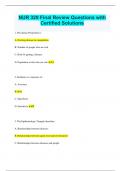
NUR 329 Final Review Questions with Certified Solutions
NUR 329 Final Review Questions with Certified Solutions 1. Prevalence Proportion is: A. Existing disease in a population B. Number of people who are sick C. Risk for getting a disease D. Population at risk who are sick A 2. Incidence is a measure of: A. Accuracy B. Risk C. Specificity D. Sensitivity B 3. The Epidemiologic Triangle describes: A. Relationships between diseases B. Relationships between agent, host and environment C. Relationships between diseases and people D. Relationships between the environment and people B The Centers for Disease Control & Prevention is investigating a E. Coli outbreak in 8 states. The investigators have traced the disease back to lettuce grown on Happy Acres Farm. The farm also includes a pig farm where run off from the pig pens is not controlled. 4. What is the Agent? A. Pigs B. Lettuce C. E. Coli D. Salmonella C The Centers for Disease Control & Prevention is investigating a E. Coli outbreak in 8 states. The investigators have traced the disease back to lettuce grown on Happy Acres Farm. The farm also includes a pig farm where run off from the pig pens is not controlled. 5. Who is the host? A. People B. Pigs C. Lettuce D. Pig poop A, B The Centers for Disease Control & Prevention is investigating a E. Coli outbreak in 8 states. The investigators have traced the disease back to lettuce grown on Happy Acres Farm. The farm also includes a pig farm where run off from the pig pens is not controlled. 6. What is/are the environmental factors A. Not washing the pigs B. People not washing the radishes C. Contamination from the pig run-off D. The farm workers not washing their hands C 1. Disease surveillance, a critical role function for the public health nurse (PHN), can best be defined as the ongoing, systematic collection, analysis, interpretation, and dissemination of specific health data relevant to public health. The nurse's knowledge and understanding of surveillance systems is critical to: a. detecting epidemics and pandemics. b. facilitating planning and policy changes. c. improving the quality and usefulness of the data collected. d. understanding the relationship between epidemiologic principles. C 2. A PHN uses the state health department's reportable disease system to complete a community assessment of a rural county with issues of access to primary care services. This can best be described as what type of surveillance system? a. Active b. Passive c. Sentinel d. Special B 3. The nurse epidemiologist in a local health district receives a report from a local pediatrician that a case of chickenpox has been diagnosed in a second grader at one of the local elementary schools. The nurse proceeds to contact the school to determine whether or not any other children are absent for illness or were recently seen by the school nurse. Other area pediatricians are also contacted to determine whether or not any other cases have been identified. The nurse works with the school to notify parents about what signs and symptoms they should look for and how to manage a child with such symptoms. This is an example of which type of surveillance? a. Active b. Passive c. Sentinel
Document information
- Uploaded on
- April 26, 2024
- Number of pages
- 50
- Written in
- 2023/2024
- Type
- Exam (elaborations)
- Contains
- Questions & answers


