BBS 2001 Summary
Part 1
HOLD ONTO YOUR HORSES and let’s dive into the gross world of threats and disease
Case 1- The First Aid Troops
Problem Statement: How do the inflammation and coagulation system work together to heal a wound
Keywords:
- Coagulation cascade (CC):
- Thrombin burst
- Primary Hemostasis (platelets)
- Secondary Hemostasis (coagulation)
- Extrinsic and Intrinsic Coagulation cascades (Tissue Factor, Damaged collagen, cleaving
of coagulation factors, Factor X, Factor II (thrombin), fibrin formation and stabilization)
- Fibrinolysis (plasmin)
- Inhibition of coagulation
- Leukocytes: myeloid (monocytes, macrophages, dendritic cells, granulocytes) and lymphoid (T-
and B-cells, NK cells)
- Inflammation (≠ infection)
- Leukocyte transmigration (selectins - rolling, chemokines - affinity maturation, integrins – firm
adhesion, junctional molecules – diapedesis)
Learning Goals
- Recap of BBS1002- function of blood cells
- What is the step by step process of the wound healing
- What is hemostasis
- What are the intrinsic and extrinsic pathways of the coagulation cascade
- How is 10A formed,
- What happens after this/ what is the thrombin burst
- How is the cascade regulated
- What are the cells involved at each step
- What signals are used (and how do they travel) to provoke each step
- Afterwards- How does scarring happen
- What is inflammation and why does it occur after a wound
1
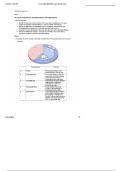
,The composition of the blood is shown by the diagram below
Plasma
Plasma is between 54% (Males) and 57% (Females) of the total volume of the blood.
It is composed of:
- 92 % H2O
- 7% proteins
- Albumin
- Produced by the liver to help control the osmotic pressure of the blood
- Globulin
- Alpha/ Beta- Mainly transport proteins
2
, - Gamma- Predominantly antibodies released by the immune system
- Fibrinogen
- Forms the fibrin threads of a blood clot
- 1 % dissolved organic molecules and ions
- Traces of elements, vitamins
- Dissolved gases
Cellular Elements
All different blood cells are descendants of a single precursor cell type known as the pluripotent
hematopoietic stem cell. These cells are primarily found in the bone marrow and can differentiate into
any of the blood cells.
Erythrocytes
Red blood cells (RBC’s) have a biconcave shape that increases their surface area. Their lack of a nucleus
means they can easily change shape, helping them fit through the various blood vessels in your body.
The “cells” are bound by a plasma membrane with no proper organelles making them literally just bags
of haemoglobin (Hb). However, having no nucleus also limits the life of the cell as travelling through the
3
, smallest blood vessels damages the cell's membranes and depletes its energy supplies. The cells survive
an average of only 120 days.
The “no organelles” thing extends to not having an endoplasmic reticulum or mitochondria, so they do
not consume the oxygen they carry, making them more efficient. They make ATP by glycolysis and is
required for the active transport of the Na+/K+ ions.
Adult Haemoglobin (Hb A1) is a protein composed of two α- and two β-polypeptide chains and four
heme molecules containing iron ions (Fe2+). Each Erythrocyte can contain 250 million haemoglobin
molecules. Oxyhemoglobin is haemoglobin with Oxygen, Carbaminohemoglobin contains CO2.
I love this photo. Look how freaking cool it is. That is inside you?! It’s so cool that I stole it from BBS1002.
Leukocytes
Leukocytes are responsible for the immune response and defend the body against pathogens. They
circulate through blood but are mostly active in tissues. They are the only cellular elements that are
complete cells with a nucleus, but account for only 1% of the total cells in the blood.
The Leukocytes are split into three groups, which are:
- Lymphocytes
- Form the immune response, but are more commonly found in lymph system
- There are three types
- T- Lymphocytes- act directly against virus-infected cells and tumor cells
- B- Lymphocytes- make plasma cells that release immunoglobulins
- Natural Killer (NK) cells- kills cells infected with viruses and tumour cells
- Phagocytes
- Monocytes
- Are the functional memory of the immune system, form into macrophages
- Granulocytes
- Neutrophils
- Are the first to a site of infection, mainly responsible for killing bacteria
- Eosinophils
4
Part 1
HOLD ONTO YOUR HORSES and let’s dive into the gross world of threats and disease
Case 1- The First Aid Troops
Problem Statement: How do the inflammation and coagulation system work together to heal a wound
Keywords:
- Coagulation cascade (CC):
- Thrombin burst
- Primary Hemostasis (platelets)
- Secondary Hemostasis (coagulation)
- Extrinsic and Intrinsic Coagulation cascades (Tissue Factor, Damaged collagen, cleaving
of coagulation factors, Factor X, Factor II (thrombin), fibrin formation and stabilization)
- Fibrinolysis (plasmin)
- Inhibition of coagulation
- Leukocytes: myeloid (monocytes, macrophages, dendritic cells, granulocytes) and lymphoid (T-
and B-cells, NK cells)
- Inflammation (≠ infection)
- Leukocyte transmigration (selectins - rolling, chemokines - affinity maturation, integrins – firm
adhesion, junctional molecules – diapedesis)
Learning Goals
- Recap of BBS1002- function of blood cells
- What is the step by step process of the wound healing
- What is hemostasis
- What are the intrinsic and extrinsic pathways of the coagulation cascade
- How is 10A formed,
- What happens after this/ what is the thrombin burst
- How is the cascade regulated
- What are the cells involved at each step
- What signals are used (and how do they travel) to provoke each step
- Afterwards- How does scarring happen
- What is inflammation and why does it occur after a wound
1
,The composition of the blood is shown by the diagram below
Plasma
Plasma is between 54% (Males) and 57% (Females) of the total volume of the blood.
It is composed of:
- 92 % H2O
- 7% proteins
- Albumin
- Produced by the liver to help control the osmotic pressure of the blood
- Globulin
- Alpha/ Beta- Mainly transport proteins
2
, - Gamma- Predominantly antibodies released by the immune system
- Fibrinogen
- Forms the fibrin threads of a blood clot
- 1 % dissolved organic molecules and ions
- Traces of elements, vitamins
- Dissolved gases
Cellular Elements
All different blood cells are descendants of a single precursor cell type known as the pluripotent
hematopoietic stem cell. These cells are primarily found in the bone marrow and can differentiate into
any of the blood cells.
Erythrocytes
Red blood cells (RBC’s) have a biconcave shape that increases their surface area. Their lack of a nucleus
means they can easily change shape, helping them fit through the various blood vessels in your body.
The “cells” are bound by a plasma membrane with no proper organelles making them literally just bags
of haemoglobin (Hb). However, having no nucleus also limits the life of the cell as travelling through the
3
, smallest blood vessels damages the cell's membranes and depletes its energy supplies. The cells survive
an average of only 120 days.
The “no organelles” thing extends to not having an endoplasmic reticulum or mitochondria, so they do
not consume the oxygen they carry, making them more efficient. They make ATP by glycolysis and is
required for the active transport of the Na+/K+ ions.
Adult Haemoglobin (Hb A1) is a protein composed of two α- and two β-polypeptide chains and four
heme molecules containing iron ions (Fe2+). Each Erythrocyte can contain 250 million haemoglobin
molecules. Oxyhemoglobin is haemoglobin with Oxygen, Carbaminohemoglobin contains CO2.
I love this photo. Look how freaking cool it is. That is inside you?! It’s so cool that I stole it from BBS1002.
Leukocytes
Leukocytes are responsible for the immune response and defend the body against pathogens. They
circulate through blood but are mostly active in tissues. They are the only cellular elements that are
complete cells with a nucleus, but account for only 1% of the total cells in the blood.
The Leukocytes are split into three groups, which are:
- Lymphocytes
- Form the immune response, but are more commonly found in lymph system
- There are three types
- T- Lymphocytes- act directly against virus-infected cells and tumor cells
- B- Lymphocytes- make plasma cells that release immunoglobulins
- Natural Killer (NK) cells- kills cells infected with viruses and tumour cells
- Phagocytes
- Monocytes
- Are the functional memory of the immune system, form into macrophages
- Granulocytes
- Neutrophils
- Are the first to a site of infection, mainly responsible for killing bacteria
- Eosinophils
4