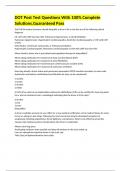
DOT Post Test Questions With 100% Complete Solutions.Guaranteed Pass
DOT Post Test Questions With 100% Complete Solutions.Guaranteed Pass The FMCSA medical examiner should disqualify a driver if he or she has any of the following clinical diagnosis MI, CHF with LVEF less than 40%, Pulmonary Hypertension, or Atrial fibrillation Pulmonary Hypertension, Hypertrophic Cardiomyopathy, Restrictive Cardiomyopathy or CHF with LVEF of 50% Atrial Flutter, Ventricular Tachycardia, or Pulmonary Embolism Hypertrophic Cardiomyopathy, Restrictive Cardiomyopathy or CHF with LVEF less than 40% When should a driver who is prescribed anticoagulation therapy be disqualified? When taking medication for treatment of deep vein thrombosis (DVT) When taking medication for treatment of Atrial Fibrillation When taking medication for treatment post cerebrovascular accident (CVA) When taking medication for treatment of pulmonary embolism How long should a driver status-post permanent pacemaker (PPM) insertion secondary to sinus node dysfunction wait before certification/recertification for duty can be considered? 3 months 1 month 6 months 2 weeks A CMV driver who has an implantable cardioverter-defibrillator (ICD) can be certified for how long when he or she has clearance from a cardiologist indicating that the driver is fit for duty? 6 months 1 year 2 years Disqualified A driver candidate presents to your office for a new medical certification. In his medical history he notes he has an allergy to bee stings. Following his most recent bee sting he developed symptoms of anaphylaxis including angioedema, throat tightness, and dyspnea. What is one effective preventive measure the medical examiner should advise the driver to undertake? Always carry bug spray. Avoid going outdoors when possible and keep all windows in the truck rolled up. Carry an epinephrine injection device in the truck cab. Take 25mg of diphenhydramine twice daily. The medical examiner is determining fitness for duty for a driver candidate with a history of asthma. The driver is using an albuterol inhaler three times daily for treatment of intermittent dyspnea and wheezing. The medical examiner should: Qualify the driver for a period of two years as the asthma is well controlled .Disqualify the driver and have them return to their primary care provider for re evaluation of their asthma treatment regimen. Qualify the driver for a period of one year as they will require more frequent monitoring .Refer the driver for pulmonary function testing. The medical examiner should refer a driver for pulmonary function testing (PFT) when they present with which of the following: History of any specific lung disease Symptoms of shortness of breath, cough, chest tightness, or wheezing Cigarette smoking in drivers 35 years of age or older All of the above When assessing a driver with a suspected diagnosis of chronic obstructive pulmonary disease (COPD), the medical examiner recalls the primary etiologic factor is: Cigarette smoking Morbid obesity Sedentary lifestyleMitral valve prolapse With polysomnogram, diagnosis of obstructive sleep apnea (OSA) is based on the apnea/hypopnea index with over 30 episodes per hour. True False Which of the following is NOT a common daytime symptom of sleep apnea in adults? Excessive sleepiness Awakening with headaches Constipation Decreased concentration and focus Comorbid conditions common in bipolar disorder include which of the following? Alcohol abuse Anxiety Binge eating disorder All of the above A 30 year old driver presents to the medical examiner's office for a biennial recertification. The driver notes in his history that he had 3 episodes of benign positional vertigo 6 months ago but has been asymptomatic since this time. The driver provides the medical examiner with a letter from his neurologist stating he is cleared to return to work and regular duties. All other history for the driver is negative and physical exam uncovers no abnormalities. Based on FMCSA recommendations for benign positional vertigo the medical examiner Disqualifies the driver as they have not completed the recommended waiting period Qualifies the driver for a period of up to two years Refers the driver for tilt table testing Refers the driver for CT Scan of the brain The driver candidate with a history of transient ischemic attack (TIA) is subject to a ___ symptom free waiting period prior to certification. 2 Year 1 Year 6 Month 3 Month The medical examiner is examining a driver 2 years post transient ischemic attack (TIA). The driver has a normal physical examination, neurological examination including neuro-opthalmologic evaluation, and neuropsychological test. The driver has received medical clearance from a neurologist to return to driving. Which of the following findings would cause the medical examiner to disqualify the driver? The driver takes an ace inhibitor to control hypertension The driver takes an antihyperlipidemic agent to control hyperlipidemia The driver takes a beta blocker to control hypertension The driver takes an anticoagulant The risk of a recurrent transient ischemic attack (TIA) or cerebral vascular accident (CVA) is highest: The first few weeks following the initial event Approximately one year following the initial event Five years following the initial event There is no increased risk with any period of time Use of muscle relaxants such as Skelaxin, Soma, or Flexeril in the CMV driver is disqualifying. True False Symptoms of autonomic neuropathy may include: onfusion, forgetfulness, slow reaction time Chest pain, palpitations, dyspnea Lower extremity edema, pleural effusions, decreased left ventricular ejection fraction Exercise intolerance, sluggish pupil reaction, and gastroparesis You are conducting a physical examination on a driver candidate seeking new certification. During the visual acuity portion of the examination you note the driver has monocular vision. At this point you would:
Document information
- Uploaded on
- April 26, 2024
- Number of pages
- 9
- Written in
- 2023/2024
- Type
- Exam (elaborations)
- Contains
- Questions & answers