
Antepartum: prenatal assessment study Guide Questions with Ascertained solutions 2023/2024
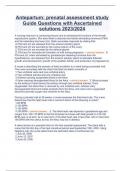
Antepartum: prenatal assessment study Guide Questions with Ascertained solutions 2023/2024 A nursing instructor is conducting lecture and is reviewing the functions of the female reproductive system. She asks Mark to describe the follicle-stimulating hormone (FSH) and the luteinizing hormone (LH). Mark accurately responds by stating that: A.FSH and LH are released from the anterior pituitary gland. B.FSH and LH are secreted by the corpus luteum of the ovary C.FSH and LH are secreted by the adrenal glands D.FSH and LH stimulate the formation of milk during pregnancy. - correct answer A. FSH and LH, when stimulated by gonadotropin-releasing hormone from the hypothalamus, are released from the anterior pituitary gland to stimulate follicular growth and development, growth of the graafian follicle, and production of progesterone. A nurse is describing the process of fetal circulation to a client during a prenatal visit. The nurse accurately tells the client that fetal circulation consists of: 1.Two umbilical veins and one umbilical artery 2.Two umbilical arteries and one umbilical vein 3.Arteries carrying oxygenated blood to the fetus 4.Veins carrying deoxygenated blood to the fetus - correct answer 2. Blood pumped by the embryo's heart leaves the embryo through two umbilical arteries. Once oxygenated, the blood then is returned by one umbilical vein. Arteries carry deoxygenated blood and waste products from the fetus, and veins carry oxygenated blood and provide oxygen and nutrients to the fetus. During a prenatal visit at 38 weeks, a nurse assesses the fetal heart rate. The nurse determines that the fetal heart rate is normal if which of the following is noted? 1.80 BPM 2.100 BPM 3.150 BPM 4.180 BPM - correct answer .3. The fetal heart rate depends in gestational age and ranges from 160-170 BPM in the first trimester but slows with fetal growth to 120-160 BPM near or at term. At or near term, if the fetal heart rate is less than 120 or more than 160 BPM with the uterus at rest, the fetus may be in distress. A client arrives at a prenatal clinic for the first prenatal assessment. The client tells a nurse that the first day of her last menstrual period was September 19th, 2005. Using Nagele's rule, the nurse determines the estimated date of confinement as: 1.July 26, 2006 2.June 12, 2007 3.June 26, 2006 4.July 12, 2007 - correct answer 3. Accurate use of Nagele's rule requires that the woman have a regular 28-day menstrual cycle. Add 7 days to the first day of the last menstrual period, subtract three months, and then add one year to that date. A nurse is collecting data during an admission assessment of a client who is pregnant with twins. The client has a healthy 5-year old child that was delivered at 37 weeks and tells the nurse that she doesn't have any history of abortion or fetal demise. The nurse would document the GTPAL for this client as: 1.G = 3, T = 2, P = 0, A = 0, L =1 2.G = 2, T = 0, P = 1, A = 0, L =1 3.G = 1, T = 1. P = 1, A = 0, L = 1 4.G = 2, T = 0, P = 0, A = 0, L = 1 - correct answer 2. Pregnancy outcomes can be described with the acronym GTPAL. G is gravidity, the number of pregnancies. T is term births, the number born at term (38-41 weeks). P is preterm births, the number born before 38 weeks gestation. A is abortions or miscarriages (included in gravida if before 20 weeks gestation; included in parity if past 20 weeks gestation). L is live births, the number of live births or living children. Therefore, a woman who is pregnant with twins and has a child has a gravida of 2. Because the child was delivered at 37 weeks, the number of preterm births is 1, and the number of term births is 0. The number of abortions is 0, and the number of live births is 1. A nurse is performing an assessment of a primapira who is being evaluated in a clinic during her second trimester of pregnancy. Which of the following indicates an abnormal physical finding necessitating further testing? 1.Consistent increase in fundal height 2.Fetal heart rate of 180 BPM 3.Braxton hicks contractions 4.Quickening - correct answer 2. The normal range of the fetal heart rate depends on gestational age. The heart rate is usually 160-170 BPM in the first trimester and slows with fetal growth, near and at term, the fetal heart rate ranges from 120-160 BPM. The other options are expected. A nurse is reviewing the record of a client who has just been told that a pregnancy test is positive. The physician has documented the presence of a Goodell's sign. The nurse determines this sign indicates: 1.A softening of the cervix 2.A soft blowing sound that corresponds to the maternal pulse during auscultation of the uterus. 3.The presence of hCG in the urine 4.The presence of fetal movement - correct answer 1. In the early weeks of pregnancy the cervix becomes softer as a result of increased vascularity and hyperplasia, which causes the Goodell's sign A nursing instructor asks a nursing student who is preparing to assist with the assessment of a pregnant client to describe the process of quickening. Which of the following statements if made by the student indicates an understanding of this term? 1."It is the irregular, painless contractions that occur throughout pregnancy." 2."It is the soft blowing sound that can be heard when the uterus is auscultated." 3."It is the fetal movement that is felt by the mother." 4."It is the thinning of the lower uterine segment." - correct answer 3. Quickening is fetal movement and may occur as early as the 16th and 18th week of gestation, and the mother first notices subtle fetal movements that gradually increase in intensity. Braxton Hicks contractions are irregular, painless contractions that may occur throughout the pregnancy. A thinning of the lower uterine segment occurs about the 6th week of pregnancy and is called Hegar's sign.
Document information
- Uploaded on
- April 24, 2024
- Number of pages
- 12
- Written in
- 2023/2024
- Type
- Exam (elaborations)
- Contains
- Questions & answers


