Chapter 3 (arguments)
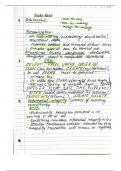
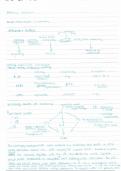
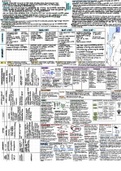
Arguments are collections of statements that are used to logically support a specific point. They consist of premises, which justify the conclusion, and the logical form that connects the premises to the conclusion. Premises and conclusions are statements that are declarative in grammatical form, factual, and in principle verifiable. Certain words or phrases, known as "tell words," can be used to identify whether a statement is a premise or a conclusion. Common tell words include "therefore" and "because." There are three basic types of argument forms: deductive, inductive, and abductive. Deductive arguments have conclusions that contain no new information than what is contained in the premises. Inductive arguments have conclusions that contain new information not found in the premises. Abductive arguments are often explanations, not arguments. Deductive arguments can be valid or invalid. Deductive validity means that if the premises are true, the conclusion is guaranteed to be true. Deductive invalidity occurs when the conclusion is not guaranteed to be true, even if all the premises are true. Deductive soundness refers to deductive arguments that are both valid and have all true premises. Sound arguments must have true conclusions. Misconceptions about deductive and inductive arguments include the belief that deductive arguments must have generalized premises and a particular conclusion, and that inductive arguments always move from specific premises to a generalized conclusion. Inductive arguments can have particular conclusions, and deductive arguments can have generalized conclusions. Inductive arguments can also be categorized as statistical arguments, which use data or quantitative observations as premises, or probative arguments, which use reasons rather than statistics. The principle of charity states that one should choose the most favorable interpretation of an argument that is consistent with the actual argument content. Standardizing arguments involves outlining the argument to reveal its structure. This includes identifying the premises and conclusion, considering any missing or implied premises, and recognizing sub-arguments. Arguments may have unstated premises, which are implied, and assumptions, which are necessary parts of an argument. It is important to make explicit any implied premises when analyzing arguments. Assumptions for which their truth is not probable are called dubious assumptions. Validity based on false assumptions does not guarantee the truth of the conclusion.
Written for
- Institution
-
Sam Houston State University
- Course
-
PHIL 2303
Document information
- Uploaded on
- April 23, 2024
- Number of pages
- 5
- Written in
- 2023/2024
- Type
- Class notes
- Professor(s)
- Brommadge
- Contains
- All classes

Also available in package deal