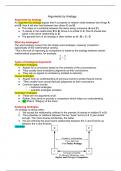
Arguments by Analogy
Arguments by Analogy
An argument by analogy argues that if a property or relation holds between two things A
and B, then it will also hold between two others C and D.
● This relies on a similarity between the items being compared (A and C).
● “A stands in the relationship R to B. Since A is similar to C, then C should also
stand in the same relationship to D.”
● The general form of an analogy is often written as A : B :: C : D
What Are Analogies?
The word analogy comes from the Greek word analogos, meaning “proportion”
(specifically of the mathematical variety).
This is the sort of reasoning by comparison is made by the analogy between certain
mathematical proportions, for example:
Types of Analogical Arguments
Precedent Analogies:
● Argues for a conclusion based on the similarity of the circumstances.
● They usually have evaluative judgments as their conclusions.
● They rely on appeal to consistency (related to reductio).
Causal Analogies:
● Argues from an understanding of previous events to predict futural events.
● They usually have causal (factual) judgments as their conclusions.
● Common types include:
○ • historical analogies
○ • scientific analogies (models)
Illustrative Analogies
● These are not arguments at all.
● Rather, they serve to provide a comparison which helps our understanding.
● Ex: Plato’s “Allegory of the Cave
Analyzing Analogies
An analogy is strong when:
1. We accept the relationship outlined in the premise (A stands in relation R to B).
2. The properties or relations between the two “base” terms (A & C) are similar
enough. The more diverse similarities, the better.
3. We are inferring the exact same relationship between the C and D terms as
between the A and B terms.
Schema
Arguments by Analogy
An argument by analogy argues that if a property or relation holds between two things A
and B, then it will also hold between two others C and D.
● This relies on a similarity between the items being compared (A and C).
● “A stands in the relationship R to B. Since A is similar to C, then C should also
stand in the same relationship to D.”
● The general form of an analogy is often written as A : B :: C : D
What Are Analogies?
The word analogy comes from the Greek word analogos, meaning “proportion”
(specifically of the mathematical variety).
This is the sort of reasoning by comparison is made by the analogy between certain
mathematical proportions, for example:
Types of Analogical Arguments
Precedent Analogies:
● Argues for a conclusion based on the similarity of the circumstances.
● They usually have evaluative judgments as their conclusions.
● They rely on appeal to consistency (related to reductio).
Causal Analogies:
● Argues from an understanding of previous events to predict futural events.
● They usually have causal (factual) judgments as their conclusions.
● Common types include:
○ • historical analogies
○ • scientific analogies (models)
Illustrative Analogies
● These are not arguments at all.
● Rather, they serve to provide a comparison which helps our understanding.
● Ex: Plato’s “Allegory of the Cave
Analyzing Analogies
An analogy is strong when:
1. We accept the relationship outlined in the premise (A stands in relation R to B).
2. The properties or relations between the two “base” terms (A & C) are similar
enough. The more diverse similarities, the better.
3. We are inferring the exact same relationship between the C and D terms as
between the A and B terms.
Schema