

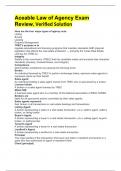
Aceable Law of Agency Exam Review, Verified Solution
Aceable Law of Agency Exam Review, Verified Solution Here are the four major types of agency acts: Listing Buying Leasing Property Management TREC's purpose is to regulate educational and licensing programs that maintain standards AND interpret legislation that affects the real estate profession — primarily the Texas Real Estate License Act (TRELA). Integrity Satisfy to the commission (TREC) that the candidate meets and exceeds their character standards (honesty, trustworthiness, and integrity). Competence Demonstrate competence by passing the licensing exam. Broker: An individual licensed by TREC to perform brokerage duties; sponsors sales agents to represent clients on their behalf Sales agent: An individual holding a sales agent license from TREC who is sponsored by a broker License holder A broker or a sales agent licensed by TREC REALTOR A licensed sales agent who is a member of the National Association of REALTORS®. Brokers are liable for all sponsored actions committed by their sales agents. Sales agents represent their broker in all transactions in real estate dealings and transactions. Listing Agent: A broker representing a seller in a real estate transaction, a.k.a. seller's agent, seller's broker, or listing broker Buyer's Agent: A broker representing a buyer in a real estate transaction, a.k.a. selling agent, buyer's broker, or selling broker Tenant's Agent A broker representing a tenant in a real estate transaction Landlord's Agent: A broker representing a landlord in a real estate transaction Principal The major parties of the transaction (the buyer and seller or landlord and tenant) or a party who has authorized an agent to represent them Client (principal) Anyone who has an agency relationship with you or your broker is your client Customer A party to the transaction who has an agency relationship with another license holder Third Party All non-client parties to a transaction, including real estate professionals Types of Principles: Seller: Party seeking to sell their property in a real estate transaction Buyer: Party seeking to buy property in a real estate transaction Tenant: Party who occupies land or property rented from a landlord Landlord: Party who rents land or property to a tenant Client Vs Customer: A broker/agent works for a client. A broker/agent works with a customer. Agency relationships require the consent of both parties (client and agent), which can be demonstrated by one of three methods: Written agreement Oral agreement Action Agency relationships are fiduciary relationships; The client's interest must always come first. the principal authorizes: the agent to represent their interests. The fiduciary duties (OLD CAR) obedience, loyalty, disclosure, confidentiality, accounting, and reasonable care Real estate brokerage is a type of agency Express Authority when a client has given an agent explicit permission for an action. Express authority can be given both verbally or through a written agreement. Implied authority when an agent takes actions that are considered customary for the profession in order to represent their agent's interests. Agency by ratification is when a license holder acts without authorization on behalf of a principal and the principal accepts those actions after the fact, thus affirming the actions taken and creating retroactive agency. Ostensible agency occurs when a principal allows a license holder to act in such a way as to cause a third party to believe that the license holder is the principal's agent. Agency by estoppel is agency imposed by law when it is determined that ostensible agency existed. occurs in an environment of ostensible agency. Special Agency (Limited Agency) (broker-client) the most limited type of agency relationship. unable to make decisions that may bind or obligate their principals. all sponsored sales agents in that brokerage also owe that client fiduciary duties. General Agency (sales agent-broker) most common type of agency between brokers and their sales agent Gives agents more power AND Holds the principal (broker) responsible for actions performed by their agent Principal: The broker is the principal of the agent. Agent: The sales agent is the agent of the broker. help the broker fulfill their fiduciary duties to their clients Universal Agency (child-parent as executor of will) most broad type of agency general power of attorney: agent has the actual power to sign legal documents on behalf of their principal. the duty of obedience does not apply if the principal's instructions are illegal or unethical in any way. The license holder must disclose who they are representing in the transaction upon first contact Information About Brokerage Services (IABS) serves to establish broker minimum duties and to disclose the types of representation available to the parties right up front. required method to provide that information to those parties. IABS must be given at first substantive communication about a specific property. Substantive communication or substantive dialogue meeting or written communication that involves a serious discussion relating to a specific property. Duty of Honesty License holders are expected to never mislead parties to a transaction
Document information
- Uploaded on
- April 22, 2024
- Number of pages
- 10
- Written in
- 2023/2024
- Type
- Exam (elaborations)
- Contains
- Questions & answers


