KHAN STATISTICS EXAM 1 LATEST 2024 WITH COMPLETE SOLUTION
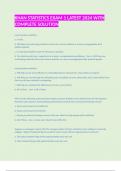
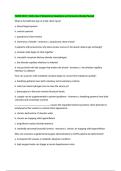
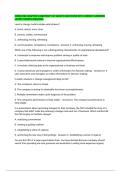
KHAN STATISTICS EXAM 1 LATEST 2024 WITH COMPLETE SOLUTION Learning about statistics: a. Is risky. b. Will help one avoid being misled by those who misuse statistics as a way to propagandize their political agenda. c. Is important despite its lack of relevance to practice. d. Can interfere with one's capacity to be a warm, compassionate practitioner. Ans- b. Will help one avoid being misled by those who misuse statistics as a way to propagandize their political agenda. Learning about statistics: a. Will help you be more effective in marshalling data to advocate for a new policy or program. b. Will help you see through the misleading uses of statistics by your adversaries and to show others how their use of those statistics is misleading. c. Will help you evaluate the effectiveness of your own practice. d. All of these. Ans- d. All of these Which of the following statements best depicts research findings on the effectiveness of interventions that have been popular among helping professionals and that have seemed theoretically sound? a. Some were found to be ineffective b. None were found to be harmful c. Earning a professional degree assures that your efforts to help people will be effective d. All of these Ans- a. Some were found to be ineffective Suppose a newspaper reports that the average number of times students in your college or university engage in binge drinking during the academic year is twice. What is appropriate to conclude? a. The typical student binge drinks approximately twice per year b. Most students binge drink approximately twice per year. c. Both of these are appropriate conclusions. d. None of these Ans- d. None of these Which of the following is/are good reasons for human service practitioners to learn about statistics? a. Some interventions have been found to be harmful. b. Professional ethics. c. Compassion for clients. d. All of these Ans- d. All of these Which of the following is/are true about statistics? a. Nobody misuses statistics to mislead people. b. Statistics are irrelevant to clinical levels of practice. c. Statistics can help you evaluate the effectiveness of your own practice. d. All of these. Ans- c. Statistics can help you evaluate the effectiveness of your own practice. If the average annual income for 10 people who are eating lunch together is $100,000, then: a. The typical person at the table earns $100,000 per year. b. It is conceivable that none of them earn $100,000 per year. c. Most people at the table earn approximately $100,000 per year. d. None of them earns more than $900,000 per year or less than $20,000 per year. Ans- b. It is conceivable that none of them earn $100,000 per year. Which of the following statements is NOT true about learning about statistics/: a. Statistics help us to summarize an otherwise overwhelming mass of data. b. Learning about statistics can help make you a more effective advocate for policies you think are desirable and against policies that you think are undesirable. c. They are not relevant to administrative levels of practice. d. Understanding statistics is an important aspect of evidence-based practice. Ans- c. They are not relevant to administrative levels of practice. T/F: The most important reason why practitioners should learn about statistics is that they want to help people. Ans- true T/F: Understanding statistics makes one a more compassionate practitioner. Ans- true T/F: Keeping current with and critically appraising practice related studies and basing one's practice on evidence-based knowledge makes one a more ethical practitioner. Ans- true T/F: Because anyone can manipulate and distort statistics to support whatever point they are trying to make, it is best to ignore statistics rather than understand them Ans- false T/F: Learning about statistics pertains primarily to levels of practice dealing with policy analysis, and is of much less relevance to clinical practice. Ans- false Evidence-base practice: a. Is a list of empirically supported interventions that practitioners should employ regardless of their practice judgment. b. Is a process for making practice decisions based on integrating the best research evidence with practice expertise and knowledge of client attributes. c. Is a process for making practice decisions based solely on research evidence. d. Assures practice effectiveness. Ans- b. Is a process for making practice decisions based on integrating the best research evidence with practice expertise and knowledge of client attributes. EBP questions can ask: a. What intervention has the most likelihood of success? b. What factors best predict desirable or undesirable outcomes? c. What type of assessment tool should be used? d. All of these. Ans- d. All of these Which of the following statements is true about searching for evidence in the second phase of the EBP process? a. You might have to try different search terms before finding what you need. b. It is a bad idea to start your search by going to the websites of the Cochrane Collaboration or the Campbell Collaboration. c. Professional literature databases should be avoided. d. All search engines will immediately connect you to original research studies that you can read in their entirety. Ans- a. You might have to try different search terms before finding what you need. Which of the following statements is true about published research studies? a. Some published research studies are fatally flawed. b. Being published ensures that a research study is scientifically rigorous. c. To be useful, research studies should be flawless. d. Although some published studies might have minor flaws, none will be fatally flawed Ans- a. Some published research studies are fatally flawed. Which of the following statements is true about selecting and implementing interventions supported by research evidence? a. The best scientific evidence should dictate the choice of intervention. b. No matter how strong an intervention's evidence might be, that intervention is likely to be inapplicable for some clients. c. Once the intervention is chosen and implemented, the EBP process is concluded. d. None of these Ans- b. No matter how strong an intervention's evidence might be, that intervention is likely to be inapplicable for some clients. Which of the following statements is true about research evidence? a. The best evidence available must be strong evidence based on studies that are virtually flawless. b. Interventions with very strong supporting evidence can be assumed to be effective when you implement them. c. If you can find no persuasive research evidence for any intervention applicable to your target problem, and you therefore must intervene in the absence of supporting evidence, the fifth stage of the EBP process (evaluating outcome) is no longer relevant or needed. d. No matter how strong the evidence that supports your chosen intervention may be, you should evaluate whether it achieves the intended outcome when you implement it. Ans- d. No matter how strong the evidence that supports your chosen intervention may be, you should evaluate whether it achieves the intended outcome when you implement it. Descriptive statistics: a. Tell us the probability that a given result can be attributed to chance. b. Can include frequency distributions or measures of central tendency and dispersion. c. Typically involve analysis of variance (ANOVA). d. All of these. Ans- b. Can include frequency distributions or measures of central tendency and dispersion. Inferential statistics: a. Are limited to describing a population. b. Always require the use of parametric tests. c. Always require the use of nonparametric tests. d. Tell us the probability that a given result can be attributed to chance Ans- d. Tell us the probability that a given result can be attributed to chance Which of the following statements is correct about evidence-based practice? a. It is a process. b. It is a list of interventions that will be effective with every client. c. It refers to decisions about intervention effectiveness, only. d. Idiosyncratic client attributes should be ignored when selecting the best intervention Ans- a. It is a process Which of the following statements is correct about evidence-based practice? a. It is mainly a cost cutting tool. b. It does not allow room for practitioner expertise to overrule the best evidence. c. It calls for practitioners to make practice decisions based on the integration of their practice expertise, their knowledge of client attributes, and the best research evidence. d. It has only two stages. Ans- c. It calls for practitioners to make practice decisions based on the integration of their practice expertise, their knowledge of client attributes, and the best research evidence. When searching for evidence, you should: a. Refrain from looking at web sites b. Use only one search term. c. Avoid systematic reviews. d. Examine the Cochrane and Campbell Collaboration resources. Ans- d. Examine the Cochrane and Campbell Collaboration resources. T/F: EBP is a process for integrating the most rigorous research evidence with practice expertise and knowledge of client attributes in making practice decisions Ans- true T/F: EBP is a process for making practice decisions based solely on research evidence. Ans- false T/F: The type of EBP question you ask and your practice role will influence the specific types of statistics you are likely to encounter and how much technical detail you'll need to know about those statistics Ans- true T/F: EBP is a list of empirically supported interventions that practitioners should employ regardless of their practice judgment Ans- false T/F: EBP questions always focus on choosing an intervention Ans- false T/F: Inferential statistics tell us the probability that a given result can be attributed to chance Ans- true T/F: An expedient way to start searching for evidence is by going to the website of the Cochrane Collaboration or the Campbell Collaboration Ans- true T/F: Some published research studies are much more flawed than others Ans- true T/F: Meta-analyses review systematically existing studies and aggregate their statistical results Ans- true T/F: Effect size statistics compare the relative strength of effects of different interventions. Ans- true
Written for
- Institution
- Khan
- Course
- Khan
Document information
- Uploaded on
- April 21, 2024
- Number of pages
- 36
- Written in
- 2023/2024
- Type
- Exam (elaborations)
- Contains
- Questions & answers
Subjects
-
khan statistics exam 1 latest 2024 with complete s
-
which of the following statements best depicts res
-
suppose a newspaper reports that the average numbe
-
which of the following isare good reasons for h

Also available in package deal