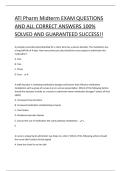
RPSGT- exam 3 Correct Questions & Answers(RATED A)
A collection of electrode derivations used in a sleep study is called a: - ANSWER montage Which of the following terms describes external or environmental time cues? - ANSWER Zeitgeber. At what percentage of the distance from the nasion to the onion is Fz located up from the nasion? - ANSWER 30 % Which of the following techniques best promotes patient compliance with PAP therapy? - ANSWER Management of interface problems and leaks, and nasal congestion and airway dryness. During standard polysomnography, the electrooculogram high frequency filter should be set at: - ANSWER 35 Hz A combination of electrical companents designed to increase power, voltage or current of a signal is a(n): - ANSWER amplifier. Prior to lights out you would explain all of the following EXCEPT: - ANSWER the need to lie supine throughout the entire study. A simple self-administered questionnaire that is used to assess a patient's perception of sleepiness is known as the: - ANSWER Epworth Sleepiness Scale. According to the principes of differential amplification, electrical interference can best be prevented if: - ANSWER electrode impedances are similar. You begin a sleep study on a patient at 9:30 pm. At 10:45 pm, you think to yourself that the patient should be in stage N3 by now, but the EEG does not demonstrate this. You realize that the low frenquency filter is set at 3 Hz. The appropriate instrumentation change would be to : - ANSWER decrease the low frequency filter to 10 Hz. The best description of the PAP Mode: APAP (Automatically titrating airway pressure) is that APAP maintains: - ANSWER varying pressure levels through the night to keep the airway open. The indications for bi-level positive airway pressure are all of the following EXCEPT: - ANSWER restricted total lung capacity. After a successful CPAP titration, the optimal pressure is established at 11 cm H2O. All respiratory events were eliminated. The oxygen saturation, via pulse oximetry, remained stable at 89-90% for the last half hour before the patient was awakened at 6:00 am. The patient: - ANSWER probably does not need oxygen at this time. Bilevel positive airway pressure instruments: - ANSWER deliver highter pressure during inhalation than during exhalation. During the set- up of a patient about to undergo a titration study, the patient asks about possible side affects of CPAP. You explain that serious side effects are infrequent; however, some of the more common possible side effects include all of the following EXCEPT: - ANSWER bed-wetting. Long term PAP compliance is generally established within: - ANSWER the first three months of use.
Written for
- Institution
- RPSGT-
- Course
- RPSGT-
Document information
- Uploaded on
- April 20, 2024
- Number of pages
- 2
- Written in
- 2023/2024
- Type
- Exam (elaborations)
- Contains
- Questions & answers
Subjects
-
rpsgt exam 3 correct questions answersrated a
-
rpsgt exam 3 correct stuvia

Also available in package deal