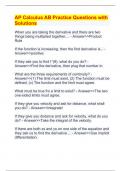
AP Calculus AB Practice Questions with Solutions
When you are taking the derivative and there are two things being multiplied together.... - Answer>>Product Rule
If the function is increasing, then the first derivative is... - Answer>>positive.
If they ask you to find f '(#), what do you do? - Answer>>Find the derivative, then plug that number in.
What are the three requirements of continuity? - Answer>>(1) The limit must exist, (2) The function must be
defined, (c) The function and the limit must agree.
What must be true fro a limit to exist? - Answer>>The two one-sided limits must agree.
If they give you velocity and ask for distance, what shall you do? - Answer>>Integrate!
If they give you distance and ask for velocity, what do you do? - Answer>>Take the integral of the velocity.
If there are both xs and ys on one side of the equation and
they ask us to find the derivative.... - Answer>>Use implicit
differentiation. If they ask for the left-handed Riemann Sums, your arrows
will.... - Answer>>Go to the left and down, skip the last number.
If they ask for the right-handed Riemann Sums, your arrows will... - Answer>>Go to the right and down, skip the
first number.
If they ask for the Trapezoid Sums, you will... - Answer>>Find the average of the y-values and multiply by
the x-value.
If they ask for the Midpoint Sums, you will... - Answer>>Use the middle number on the y-values and multiply by the x-value.
If they give you a system of equations with one variable (k)... - Answer>>Set them equal, substitute in the x, and solve for k.
If they give you a system of equations with two variables (k and c)... - Answer>>Set them equal and set their derivatives equal, substitute in the x, and solve for k and c.
If they ask for the area between two curves, - Answer>>Find where the curves intersect, figure out which
curve is on top, subtract top - bottom and integrate.
What are the requirements for a function to be differentiable? - Answer>>It must be continuous and locally linear.
When you are taking the derivative and there are two things being multiplied together.... - Answer>>Product Rule
If the function is increasing, then the first derivative is... - Answer>>positive.
If they ask you to find f '(#), what do you do? - Answer>>Find the derivative, then plug that number in.
What are the three requirements of continuity? - Answer>>(1) The limit must exist, (2) The function must be
defined, (c) The function and the limit must agree.
What must be true fro a limit to exist? - Answer>>The two one-sided limits must agree.
If they give you velocity and ask for distance, what shall you do? - Answer>>Integrate!
If they give you distance and ask for velocity, what do you do? - Answer>>Take the integral of the velocity.
If there are both xs and ys on one side of the equation and
they ask us to find the derivative.... - Answer>>Use implicit
differentiation. If they ask for the left-handed Riemann Sums, your arrows
will.... - Answer>>Go to the left and down, skip the last number.
If they ask for the right-handed Riemann Sums, your arrows will... - Answer>>Go to the right and down, skip the
first number.
If they ask for the Trapezoid Sums, you will... - Answer>>Find the average of the y-values and multiply by
the x-value.
If they ask for the Midpoint Sums, you will... - Answer>>Use the middle number on the y-values and multiply by the x-value.
If they give you a system of equations with one variable (k)... - Answer>>Set them equal, substitute in the x, and solve for k.
If they give you a system of equations with two variables (k and c)... - Answer>>Set them equal and set their derivatives equal, substitute in the x, and solve for k and c.
If they ask for the area between two curves, - Answer>>Find where the curves intersect, figure out which
curve is on top, subtract top - bottom and integrate.
What are the requirements for a function to be differentiable? - Answer>>It must be continuous and locally linear.