
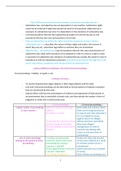
:: Basic differences and distinctions between substantive and adjective law ::
- Substantive law and adjective law are dependent on one another. Substantive rights
could not be enforced if adjective law did not exist for this purpose. Adjective law is
accessory to substantive law since it is dependent on the existence of substantive law
- Criminal procedure enforces the substantive principles of criminal law just as civil
procedure enforces the rules and provisions of civil law
- Rules of substantive law define the rights and duties of persons in their ordinary
relationship with e o; describes the nature of these rights and duties, the manner in
which they are est., what their legal effect is and how they are terminated
- Adjective law – ‘procedural law’. Law of procedure enforces the rules and provisions of
substantive law; deals with procedure to be adopted in order to enforce a right or duty;
is accessory to substantive law; existence of substantive law creates the need for rules of
procedure to enforce substantive provisions; provides the procedures through which the
courts may enforce compliance with the provisions of substantive law
:: general difference between civil and criminal proceedings ::
Civil proceedings = liability, not guilt, is est.
:: function of courts ::
- To resolve disputes btwn legal subjects or btwn legal subjects and the state
- Civil and criminal proceedings can be described as formal systems of dispute resolution
that are sanctioned by the state
- Judicial officer will hear the presentation of evidence and arguments of both parties in
an environment that is controlled y formal rules, and then decide the matter in form of
judgment or order that is enforced by state
:: Civil proceedings :: :: Criminal proceedings ::
:: subject matter of proceedings Relate to a dispute btwn legal Btwn State and ordinary citizen
in each instance :: subjects State acts through prosecutor
Described as a claim in mag crt and state advocate in
H.Crt on behalf of citizen
against whom the alleged
*is possible for a person to lay a offence has been committed
criminal charge and institute Arise from alleged
civil proceedings on same cause transgression of rules of
of action common law dealing with
crimes or stat provisions of
criminal law
:: role of and terminology In matter commenced by Parties are State and accused
relating to the parties to these summons, person who starts Person who suffered as a result
proceedings :: proceedings by issuing a of criminal conduct of acc is
summons = plaintiff complainant
Person against whom summons State prosecutes acc on behalf
is issued = defendant of compl
Proceedings brought on State initiates proceedings and
1
, application, person bringing conducts procedures
appl = applicant
Opposite party = respondent
If matter goes on appeal,
person lodging appeal =
appellant
Other party = respondent
:: differing objectives of civil To establish the liability of To establish whether the
and criminal proceedings :: defendant/respondent to accused is guilty of a crime and
compensate the plaintiff or to to impose a penalty if so
perform or not perform acts in
relation to the
plaintiff/applicant
:: nature of compulsion Voluntary – aggrieved party is Element of compulsion
involved :: not compelled to commence State may initiate criminal
proceedings proceedings wo consent of
At discretion of plaintiff/appl complainant
If doesn’t initiate proceedings – Accused is compelled to appear
ends there before crt to hear and defend
If defendant/respondent the criminal charge
choose not to defend/respond
then judgment is granted in
their absence
Can reach out of court
settlement by
negotiation/withdraw
proceedings
State has no interest, provides
infrastructure
Crt will not interfere except
upon application
Parties are compelled to follow
rules of crt which prescribe
minimum stds for conduct of
proceedings
:: onus of proof :: Balance of probabilities Beyond all reasonable doubt
Crt must be satisfied that That acc committed offence as
version put forward by charged
plaintiff/appl is more probable Crt must be satisfied that no
than that put by def/resp probable conclusion other than
that the accused committed
the offence so charged, can be
reached
:: implications of term ‘inherent jurisdiction’ ::
- Its jurisdiction is derived from common law and not from statute
- Superior crt exercising its inherent jurs has a discretion in regard to its own procedure
- Crt may condone any procedural mistakes or determine any point of procedure
- S 173 Const
2
, :: meaning of phrase ‘creatures of statute’ ::
- Lower crts do not have inherent jurisdiction
- They derive their powers from the particular statute which created them
- Exercise of jurs in lower crts is dependent on the extent to which its enabling statute
permits it to exercise such jurs
- Each enabling statute has to be carefully interpreted in order to determine scope of jurs
- Mag crt (created by leg and derives powers and competence from Mag Crts Act of 1944
1. why superior courts may exercise an inherent jurisdiction?
A superior court exercises inherent jurisdiction because its competence is not reliant only on
statutory law but also on common law. This is confirmed by section 173 of Constitution.
Because it has inherent jurisdiction a superior court may condone a mistake in its
procedures
2. why inferior courts are creatures of statute?
A lower court is a creature of statute because it is restricted to the competence conferred
upon it by its enabling (constituent) Act
:: who has the competence to make, amend or repeal rules of court ::
- From 1965, proceedings have been uniformly conducted in all divisions of the then
Supreme Court, now the High Courts, under a common set of rules still known as the
Uniform Rules of Court
- Competence to make rules now vests in the Rules Board
- S 16 Constitutional Court Complimentary Act provides that president of CC, in
consultation with chief justice, may make rules relating to the manner in which that Crt
may be engaged and for all matters relating to the proceedings of and before that Crt
- Minister of Justice may make rules that regulate proceedings in small claims crts
:: nature of rules of court ::
- Rules of court have statutory force and are binding on a court (delegated leg)
- Rules exist for a crt and not crt for rules
- Purpose of rules is to facilitate inexpensive and efficient litigation and not to obstruct
the admin of just
- Crt, subject to its competence to do so, may condone non-compliance with procedure
that would lead to substantial injustice to a litigant
- Superior crt may exercise its inherent jurs to grant relief in circumstances where rules do
not cover a particular matter or where strict compliance with a rule would result in
substantial prejudice to a litigant
:: important common law sources for civil procedure ::
civil procedure of the High Court does not consist exclusively of statutory provisions and
rules of court
a portion of it comprises rules of common law
3
, especially in the matter of provisional sentence one finds the appropriate rules in the
common law with the rules of court themselves affecting only a small part of provisional
sentence
many of our rules of courts and statutes are based on English law and that our system
of pleadings is largely modelled on the English one
when it comes to the interpretation of such rules of court and statutes or when guidance
is sought in drawing up pleadings it is often profitable to refer to English procedural law
page 17 sg
:: important statutes ::
1. Supreme Court Act 59 of 1959
2. Magistrates’ Courts Act 32 of 1944
3. Small Claims Courts Act 61 of 1984
:: differences between Anglo-American and Continental systems of civil procedure ::
SA adheres to the adversarial system of litigation
all SA courts (except small-claims courts apply adversarial principles and procedures)
Continental civil procedure → inquisitorial, controlled and conducted by judicial officer, judicial
officers participate directly in process of litigation from commencement of proceedings to
conclusion of proceedings, actively involved in and determine facts of case
pleadings are in the form of notice to the parties & include evidence, may be involved in
gathering evidence, may ask questions and lead evidence, judicial officer is trier of fact and law,
reliance on statutory law, courts decisions are persuasive only
Anglo-American → adversarial, regards litigation as pvt, relies on legal representatives of parties
to prosecute respective claims, legal representatives responsible for gathering and presenting
evidence, marked by its morality, viva voce evidence is led by the counsel for both litigants by
means of examination, cross-examination and re-examination, judicial officer give oral
judgment, distinct pre-trial and trial stages
pre-trial = opens with exchange of pleadings btwn litigants to define issues in dispute, after
pleadings have closed a trial date is requested & litigants prepare cases for trial → judicial officer
plays a passive role, doesn't interfere with proceedings except upon request of one of litigants
::principles of bilaterality, party-prosecution and party presentation ::
Adversial procedure: both litigants; independently initiate and prosecute their respective claims or
defences; investigate and gather info that supports their respective claims or defences & present
this as evidence before a court
BILATERALITY
assumes that both litigants will have a fair and balanced opportunity to present either their
respective claims or defences
belief that the truth will emerge if each party presents his own biased view of issues in dispute
as rivals each litigant presents separate and contradictory versions of the case for consideration
by the court
PARTY PROSECUTION
competence of a litigant either to commence or defend proceedings and to move the case
4
- Substantive law and adjective law are dependent on one another. Substantive rights
could not be enforced if adjective law did not exist for this purpose. Adjective law is
accessory to substantive law since it is dependent on the existence of substantive law
- Criminal procedure enforces the substantive principles of criminal law just as civil
procedure enforces the rules and provisions of civil law
- Rules of substantive law define the rights and duties of persons in their ordinary
relationship with e o; describes the nature of these rights and duties, the manner in
which they are est., what their legal effect is and how they are terminated
- Adjective law – ‘procedural law’. Law of procedure enforces the rules and provisions of
substantive law; deals with procedure to be adopted in order to enforce a right or duty;
is accessory to substantive law; existence of substantive law creates the need for rules of
procedure to enforce substantive provisions; provides the procedures through which the
courts may enforce compliance with the provisions of substantive law
:: general difference between civil and criminal proceedings ::
Civil proceedings = liability, not guilt, is est.
:: function of courts ::
- To resolve disputes btwn legal subjects or btwn legal subjects and the state
- Civil and criminal proceedings can be described as formal systems of dispute resolution
that are sanctioned by the state
- Judicial officer will hear the presentation of evidence and arguments of both parties in
an environment that is controlled y formal rules, and then decide the matter in form of
judgment or order that is enforced by state
:: Civil proceedings :: :: Criminal proceedings ::
:: subject matter of proceedings Relate to a dispute btwn legal Btwn State and ordinary citizen
in each instance :: subjects State acts through prosecutor
Described as a claim in mag crt and state advocate in
H.Crt on behalf of citizen
against whom the alleged
*is possible for a person to lay a offence has been committed
criminal charge and institute Arise from alleged
civil proceedings on same cause transgression of rules of
of action common law dealing with
crimes or stat provisions of
criminal law
:: role of and terminology In matter commenced by Parties are State and accused
relating to the parties to these summons, person who starts Person who suffered as a result
proceedings :: proceedings by issuing a of criminal conduct of acc is
summons = plaintiff complainant
Person against whom summons State prosecutes acc on behalf
is issued = defendant of compl
Proceedings brought on State initiates proceedings and
1
, application, person bringing conducts procedures
appl = applicant
Opposite party = respondent
If matter goes on appeal,
person lodging appeal =
appellant
Other party = respondent
:: differing objectives of civil To establish the liability of To establish whether the
and criminal proceedings :: defendant/respondent to accused is guilty of a crime and
compensate the plaintiff or to to impose a penalty if so
perform or not perform acts in
relation to the
plaintiff/applicant
:: nature of compulsion Voluntary – aggrieved party is Element of compulsion
involved :: not compelled to commence State may initiate criminal
proceedings proceedings wo consent of
At discretion of plaintiff/appl complainant
If doesn’t initiate proceedings – Accused is compelled to appear
ends there before crt to hear and defend
If defendant/respondent the criminal charge
choose not to defend/respond
then judgment is granted in
their absence
Can reach out of court
settlement by
negotiation/withdraw
proceedings
State has no interest, provides
infrastructure
Crt will not interfere except
upon application
Parties are compelled to follow
rules of crt which prescribe
minimum stds for conduct of
proceedings
:: onus of proof :: Balance of probabilities Beyond all reasonable doubt
Crt must be satisfied that That acc committed offence as
version put forward by charged
plaintiff/appl is more probable Crt must be satisfied that no
than that put by def/resp probable conclusion other than
that the accused committed
the offence so charged, can be
reached
:: implications of term ‘inherent jurisdiction’ ::
- Its jurisdiction is derived from common law and not from statute
- Superior crt exercising its inherent jurs has a discretion in regard to its own procedure
- Crt may condone any procedural mistakes or determine any point of procedure
- S 173 Const
2
, :: meaning of phrase ‘creatures of statute’ ::
- Lower crts do not have inherent jurisdiction
- They derive their powers from the particular statute which created them
- Exercise of jurs in lower crts is dependent on the extent to which its enabling statute
permits it to exercise such jurs
- Each enabling statute has to be carefully interpreted in order to determine scope of jurs
- Mag crt (created by leg and derives powers and competence from Mag Crts Act of 1944
1. why superior courts may exercise an inherent jurisdiction?
A superior court exercises inherent jurisdiction because its competence is not reliant only on
statutory law but also on common law. This is confirmed by section 173 of Constitution.
Because it has inherent jurisdiction a superior court may condone a mistake in its
procedures
2. why inferior courts are creatures of statute?
A lower court is a creature of statute because it is restricted to the competence conferred
upon it by its enabling (constituent) Act
:: who has the competence to make, amend or repeal rules of court ::
- From 1965, proceedings have been uniformly conducted in all divisions of the then
Supreme Court, now the High Courts, under a common set of rules still known as the
Uniform Rules of Court
- Competence to make rules now vests in the Rules Board
- S 16 Constitutional Court Complimentary Act provides that president of CC, in
consultation with chief justice, may make rules relating to the manner in which that Crt
may be engaged and for all matters relating to the proceedings of and before that Crt
- Minister of Justice may make rules that regulate proceedings in small claims crts
:: nature of rules of court ::
- Rules of court have statutory force and are binding on a court (delegated leg)
- Rules exist for a crt and not crt for rules
- Purpose of rules is to facilitate inexpensive and efficient litigation and not to obstruct
the admin of just
- Crt, subject to its competence to do so, may condone non-compliance with procedure
that would lead to substantial injustice to a litigant
- Superior crt may exercise its inherent jurs to grant relief in circumstances where rules do
not cover a particular matter or where strict compliance with a rule would result in
substantial prejudice to a litigant
:: important common law sources for civil procedure ::
civil procedure of the High Court does not consist exclusively of statutory provisions and
rules of court
a portion of it comprises rules of common law
3
, especially in the matter of provisional sentence one finds the appropriate rules in the
common law with the rules of court themselves affecting only a small part of provisional
sentence
many of our rules of courts and statutes are based on English law and that our system
of pleadings is largely modelled on the English one
when it comes to the interpretation of such rules of court and statutes or when guidance
is sought in drawing up pleadings it is often profitable to refer to English procedural law
page 17 sg
:: important statutes ::
1. Supreme Court Act 59 of 1959
2. Magistrates’ Courts Act 32 of 1944
3. Small Claims Courts Act 61 of 1984
:: differences between Anglo-American and Continental systems of civil procedure ::
SA adheres to the adversarial system of litigation
all SA courts (except small-claims courts apply adversarial principles and procedures)
Continental civil procedure → inquisitorial, controlled and conducted by judicial officer, judicial
officers participate directly in process of litigation from commencement of proceedings to
conclusion of proceedings, actively involved in and determine facts of case
pleadings are in the form of notice to the parties & include evidence, may be involved in
gathering evidence, may ask questions and lead evidence, judicial officer is trier of fact and law,
reliance on statutory law, courts decisions are persuasive only
Anglo-American → adversarial, regards litigation as pvt, relies on legal representatives of parties
to prosecute respective claims, legal representatives responsible for gathering and presenting
evidence, marked by its morality, viva voce evidence is led by the counsel for both litigants by
means of examination, cross-examination and re-examination, judicial officer give oral
judgment, distinct pre-trial and trial stages
pre-trial = opens with exchange of pleadings btwn litigants to define issues in dispute, after
pleadings have closed a trial date is requested & litigants prepare cases for trial → judicial officer
plays a passive role, doesn't interfere with proceedings except upon request of one of litigants
::principles of bilaterality, party-prosecution and party presentation ::
Adversial procedure: both litigants; independently initiate and prosecute their respective claims or
defences; investigate and gather info that supports their respective claims or defences & present
this as evidence before a court
BILATERALITY
assumes that both litigants will have a fair and balanced opportunity to present either their
respective claims or defences
belief that the truth will emerge if each party presents his own biased view of issues in dispute
as rivals each litigant presents separate and contradictory versions of the case for consideration
by the court
PARTY PROSECUTION
competence of a litigant either to commence or defend proceedings and to move the case
4


