Fresenius Nurse Final Exam Part 2 Questions and Answers 2024/2025 (100% Verified)
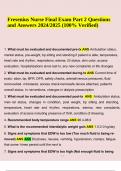
What must be evaluated and documented pre-tx ANS Ambulation status, mental status, pre-weight, bp sitting and standing if patient is able, temperature, heart rate and rhythm, respirations, edema, GI status, skin color, access evaluation, hospitalizations since last tx, any new complaints or life changes 2. What must be evaluated and documented during tx ANS Current time of evalu- ation, bp, BFR, DFR, safety checks, arterial/venous pressures, fluid removed/ad- ministered, access check-hemosafe device attached, patient's overall status, in- terventions, changes in dialysis presecription 3. What must be evaluated and documented post-tx ANS Ambulation status, men- tal status, changes in condition, post weight, bp sitting and standing, temperature, heart rate and rhythm, respirations, edema, new complaints, evaluation of access including presence of thrill, condition of dressing 4. Recommended body temperature range ANS 96.4-98.9 5. What is the recommended interdialytic weight gain ANS 1.5-2.0 kg/day 6. Signs and symptoms that EDW is too low (Too much fluid is being removed) ANS ANS Dizziness, nausea, vomiting, hypotension, cramps, fatigue that some- times persist until the next tx 7. Signs and symptoms that EDW is too high (Not enough fluid is being Fresenius Nurse Final Exam Part 2 Questions and Answers 2024/2025 (100% Verified) 3 / 6 removed) ANS ANS Htn, headaches, SOB, edema, distended neck veins 8. What is AW and how is it calculated ANS In the weight loss plan, AW means "available weight", this is calculated by subtracting the EDW from the patient's pre-tx weight 9. What makes up the goal for fluid removal ANS The AW (available weight), priming and rinseback saline, and any other fluid the patient will receive during the tx (oral fluids, saline rinses, packed cells, IDPN, IVPB medications etc. ) 10. is the measurement of how well we are cleaning wastes from our patients' blood ANS Adequacy of Dialysis 11. How can we measure how well we clean our patients' blood ANS By measur- ing the amount of wastes in the patient's blood before and after dialysis, we can calculate the amount of clearance we achieve. 12. The following interventions improve the clearance of urea during hemodialysis ANS 1.Well functioning 2.Proper of the circuit 4 / 6 3.Optimal (autoflow 1.5 or 2 as ordered and flow 4.Larger and 5. Ensuring needle tips are at inches aprt 6. longer ANS 1. access 2. priming 3. dialysate & blood 4. dialyzer membrane and needle gauges 5. 1.5 to 2 inches 6. tx times 13. What are 2 consequences of improperly primed dialyzer ANS 1. When the # of fibers available to affect clearance is greatly reduced, the result is a lesseffective tx for the patient. 2. Clotted fibers/ dialyzer will also result in a certain amount of blood loss for the patient, resulting in a potential for reduced hgb level. 14. What is considered the best method currently available for determining tx effectiveness and is mandatory in all FMC clinics ANS UKM (Urea Kinetic Modeling) 15. In addition to UKM, these are two other methods of determining adequacy. ANS kt/V and URR 16. Why is measuring the adequacy of the dialysis tx so important ANS When the tx is more effective, patients live longer and have fewer health problems. 17. What does Kt/v stand for ANS K stands for the clearance (think k sound) of urea, t is the time in minutes, and v is the total volume of waste (urea) that exist 5 / 6 in the patient 18. What is the difference between spKt/v and eKt/v and how is it determined ANS ~single pool or spKt/v is the amount of dialysis having been delivered upon completion of the HD tx, it's the reduction from one pool of fluid (vascular space) ~double pool or eKt/v is the measured amount of dialysis accounting for the volume of urea distribution in both intracellular and extracellular compartments representing the amount of urea distribution of the entire body. 19. What is FMCNA's goal for spKt/v and eKt/v ANS Minimum 1.4 L for spKt/v and 1.2 L for eKt/v 20. OLC stands for ANS On Line Clearance 21. T machines are equipped with technology that that can measure single pool Kt/v. OLC test measure transfer across the dialysis membrane 6 / 6 which serves as a substitute for urea, so it's removal reflects how urea is removed. ANS Sodium 22. These lights on the HD machines provide a visual indicator for tx adequacy. ANS AMP 23. KECN is the acronym for and refers to the clearance of sodium as measured by the conductivity changes during the OLC test. ANS clearance effective by conductivity sodium 24. KECN normal range is ANS 200-300 25. KCEN should be less than ANS The BFR 26. Less than KECN is poor clearance and will not be used by Proton to generate and OLC Volume ANS 150 27. Greater than KECN indicates that the machine may potentially need temp and conductivity calibrated ANS 350
Document information
- Uploaded on
- April 17, 2024
- Number of pages
- 12
- Written in
- 2023/2024
- Type
- Exam (elaborations)
- Contains
- Questions & answers