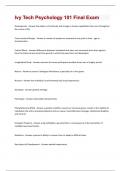
Ivy Tech Psychology 101 Final Exam Questions With All Correct Answers.
Development - Answer-the pattern of continuity and change in human capabilities that occur throughout the course of life Cross-sectional Design - Answer-a number of people are assessed at one point in time...age vs. characteristics Cohort Effects - Answer-differences between individuals that stem not necessarily from their age but from the historical and social time period in which they were born and developed Longitudinal Study - Answer-assesses the same participants multiple times over a lengthy period Nature - Answer-a person's biological inheritance, especially his or her genes Nurture - Answer-the individual's environmental and social experiences Genotype - Answer-genetic heritage Phenotype - Answer-observable characteristics Phenylketonuria (PKU) - Answer-a genetic condition cause by 2 recessive genes, results in the inability to metabolize the amino acid phenylalanine and can cause irreversible brain damage, intellectual disability, and seizures Emergent Property - Answer-a big entity(like a person) that is a consequence of the interaction of multiple lower-level factors Resilience - Answer-a person's ability to recover from or adapt to difficult times Key Aspect of Development - Answer-optimal experiencesLife Themes - Answer-involve activities, social relationships, and life goals Successful People w/ Optimal Experiences - Answer-Dr. Martin Luther King Jr., Mother Teresa, Nelson Mandela, Bill and Melinda Gates, and Oprah Winfrey 3 Domains of Life - Answer-Physical, Cognitive, and Socioemotional Physical Processes - Answer-involves changes in an individual's biological nature Cognitive Processes - Answer-involves changes in an individual's thought, intelligence, and language Socioemotional Processes - Answer-involves changes in an individual's relationships with other people, changes in emotions, and changes in personality Childhood - Answer-infancy(birth to 24 months) through childhood(up to about age 10) Adolescence - Answer-Around ages 10-12 and spanning the transition from childhood to adulthood Adulthood - Answer-early(the 20s and 30s), middle(the 40s and 50s), and late(age 60 and beyond) Prenatal Physical Changes - Answer-before birth Conception - Answer-a single sperm cell from the male merges with the female's ovum(egg) to produce a zygote, a single cell with 23 chromosomes from the mother and 23 from the father Germinal Period - Answer-weeks 1 and 2, after 1 week the zygote contains up to 100-150 cells and by week 2 the mass of cells attach to the uterine wallEmbryonic Period - Answer-weeks 3 to 8; organs begin to appear, the neural tube(spinal cord) begins to take shape and by the end of the embryonic period the heart begins to beat, the arms and legs become more noticeable, the face starts to form, and the intestinal tract appears Fetal Period - Answer-months 2 through 9,at 2 months the fetus is the size of a kidney bean and has already started to move around. at 4 months, the fetus is 5 in. long and weighs about 5 oz. at 6 months, the fetus has grown to a pound and a half. the last 3 months are when the organ functioning increases and the fetus puts on a lot of weight because of baby fat and etc. the average newborn is about 19 inches long and weighs about 7 lbs. Teratogen - Answer-any agent that causes a birth defect ex: nicotine, rubella, German measles, and heroin Fetal Alcohol Spectrum Disorders (FASD) - Answer-a cluster of abnormalities and problems that appear in the offspring of mothers who drink alcohol heavily during pregnancy FASD Effects on Fetus - Answer-small head, wide-spaced eyes, a flattened nose, underdeveloped upper lip, defects in the libs and heart, and below average intelligence Heroin Effects on Fetus - Answer-premature birth, low birth weight, physical defects, breathing problems, and death Ultimate Effects of Prenatal Insults - Answer-the environment the child encounters after birth can be an influence Sexually Transmitted Infections (STI's) - Answer-Gonorrhea can be transferred to the baby during delivery. Syphilis and AIDS, can also infect the fetus while it is in the womb. Enhances the risk of stillbirth, eye infections, blindness, and preterm birth
Written for
- Institution
- Ivy Tech Psychology 101
- Course
- Ivy Tech Psychology 101
Document information
- Uploaded on
- April 12, 2024
- Number of pages
- 11
- Written in
- 2023/2024
- Type
- Exam (elaborations)
- Contains
- Questions & answers
Subjects

Also available in package deal