

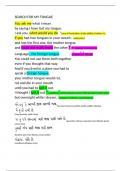
SEARCH FOR MY TONGUE
You ask me what I mean
by saying I have lost my tongue.
I ask you, what would you do *tone of frustration at the ability of others to
if you had two tongues in your mouth, understand
and lost the first one, the mother tongue,
and could not really know the other * 2 language always poses
nd
Language, the foreign tongue. a degree of difficulty
You could not use them both together
even if you thought that way.
And if you lived in a place you had to
speak a foreign tongue,
your mother tongue would rot,
rot and die in your mouth
until you had to spit it out.
I thought I spit it out * repetition; reinforcing the sense of being made to feel native
but overnight while I dream, language is inferior; onomatopoeia
(munay hutoo kay aakhee jeebh aakhee bhasha)
(may thoonky nakhi chay)
(parantoo rattray svupnama mari bhasha pachi
aavay chay)
(foolnee jaim mari bhasha nmari jeebh)
(modhama kheelay chay)
, (fullnee jaim mari bhasha mari jeebh)
(modhama pakay chay)
it grows back, a stump of a shoot * repetition; echoes the continual growth
grows longer, grows moist, grows strong veins,
it ties the other tongue in knots, *foreign tongue becomes ‘other tongue’
the bud opens, the bud opens in my mouth, giving it a lesser
it pushes the other tongue aside. Importance now
Everytime I think I've forgotten, importance of mother
I think I've lost the mother tongue, tongue has been
it blossoms out of my mouth. re-established
Content and Language
Sujata Bhatt’s poem is about what it is like to live in a foreign country feeling disconnected
from the cultural background. Even when you become familiar with a 2 nd language you “could
not really know” it with all its complexities and nuances in the same way as you know your
“mother tongue”. The term “mother tongue” reinforces the fact that your native language is
your birth-right and something precious that you inherit. It is something to be cherished and
preserved. The word “mother” reminds us of the status of a person’s first language. It should
never be allowed to “rot” and it is not something unpleasant to “spit” out. The word “mother”
therefore conveys the emotional attachment to one’s first language; it also connotes that one’s
first language is an intrinsic part of us as it is part of our DNA.
The poet feels at the beginning of the poem that she has lost her original language now that
she is living elsewhere. The feeling of loss is conveyed by the use of the verb “search” which has
connotations of a desperate endeavour to recover something that is lost. The word “search”
You ask me what I mean
by saying I have lost my tongue.
I ask you, what would you do *tone of frustration at the ability of others to
if you had two tongues in your mouth, understand
and lost the first one, the mother tongue,
and could not really know the other * 2 language always poses
nd
Language, the foreign tongue. a degree of difficulty
You could not use them both together
even if you thought that way.
And if you lived in a place you had to
speak a foreign tongue,
your mother tongue would rot,
rot and die in your mouth
until you had to spit it out.
I thought I spit it out * repetition; reinforcing the sense of being made to feel native
but overnight while I dream, language is inferior; onomatopoeia
(munay hutoo kay aakhee jeebh aakhee bhasha)
(may thoonky nakhi chay)
(parantoo rattray svupnama mari bhasha pachi
aavay chay)
(foolnee jaim mari bhasha nmari jeebh)
(modhama kheelay chay)
, (fullnee jaim mari bhasha mari jeebh)
(modhama pakay chay)
it grows back, a stump of a shoot * repetition; echoes the continual growth
grows longer, grows moist, grows strong veins,
it ties the other tongue in knots, *foreign tongue becomes ‘other tongue’
the bud opens, the bud opens in my mouth, giving it a lesser
it pushes the other tongue aside. Importance now
Everytime I think I've forgotten, importance of mother
I think I've lost the mother tongue, tongue has been
it blossoms out of my mouth. re-established
Content and Language
Sujata Bhatt’s poem is about what it is like to live in a foreign country feeling disconnected
from the cultural background. Even when you become familiar with a 2 nd language you “could
not really know” it with all its complexities and nuances in the same way as you know your
“mother tongue”. The term “mother tongue” reinforces the fact that your native language is
your birth-right and something precious that you inherit. It is something to be cherished and
preserved. The word “mother” reminds us of the status of a person’s first language. It should
never be allowed to “rot” and it is not something unpleasant to “spit” out. The word “mother”
therefore conveys the emotional attachment to one’s first language; it also connotes that one’s
first language is an intrinsic part of us as it is part of our DNA.
The poet feels at the beginning of the poem that she has lost her original language now that
she is living elsewhere. The feeling of loss is conveyed by the use of the verb “search” which has
connotations of a desperate endeavour to recover something that is lost. The word “search”


