

FLG 211 Copyright Micaela de Jager
Unit 3 – Neurophysiology
UNIT 3.1 - NERVOUS SYSTEM
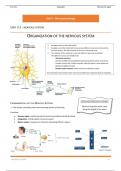
ORGANIZATION OF THE NERVOUS SYSTEM
1. Receptors pick up the information
2. Receptors send the information (via sensory/afferent neurons) to the central
nervous system. The CNS consists of the brain and spinal cord.
3. The impulse of the response is sent (via efferent neurons) to effectors
The efferent neurons are divided into:
- Autonomic neurons
(further divided into sympathetic & parasympathetic which control the
smooth muscle cells, cardiac muscles, exocrine glands, some endocrine
glands and adipose tissue)
- Somatic motor neurons which control the skeletal muscles.
The autonomic and somatic motor neurons provide tissue responses back to receptors.
Action potentials/nerve impulses:
FUNDAMENTALS OF THE NERVOUS SYSTEM
Electrical impulses which carry
The master controlling and communicating system of the body
along the length of the axons
Functions:
• Sensory input: monitoring stimuli occurring inside & outside the body
• Integration: interpretation of sensory input
• Motor output: response to stimuli by activating effector organs
MICAELA DE JAGER 47
, FLG 211 Copyright Micaela de Jager
HISTOLOGY OF NERVE TISSUE
The two principal cell types of the nervous system are:
1. Neurons → excitable cells that transmit electrical signals
2. Glial/Supporting cells → cells that surround and wrap neurons
= Supporting cells
MYELIN SHEATH
Whitish, fatty (protein-lipoid), segmented sheath around most long axons
Functions:
• Protect the axon
• Electrically insulate fibers from one another
• Increase the speed of nerve impulse transmission
CONDUCTION VELOCITIES OF AXONS
Impulse propagation rate is determined by:
o Axon diameter
(larger diameter = faster impulse)
o Presence of a myelin sheath
(myelination dramatically increases impulse speed)
MICAELA DE JAGER 48
Unit 3 – Neurophysiology
UNIT 3.1 - NERVOUS SYSTEM
ORGANIZATION OF THE NERVOUS SYSTEM
1. Receptors pick up the information
2. Receptors send the information (via sensory/afferent neurons) to the central
nervous system. The CNS consists of the brain and spinal cord.
3. The impulse of the response is sent (via efferent neurons) to effectors
The efferent neurons are divided into:
- Autonomic neurons
(further divided into sympathetic & parasympathetic which control the
smooth muscle cells, cardiac muscles, exocrine glands, some endocrine
glands and adipose tissue)
- Somatic motor neurons which control the skeletal muscles.
The autonomic and somatic motor neurons provide tissue responses back to receptors.
Action potentials/nerve impulses:
FUNDAMENTALS OF THE NERVOUS SYSTEM
Electrical impulses which carry
The master controlling and communicating system of the body
along the length of the axons
Functions:
• Sensory input: monitoring stimuli occurring inside & outside the body
• Integration: interpretation of sensory input
• Motor output: response to stimuli by activating effector organs
MICAELA DE JAGER 47
, FLG 211 Copyright Micaela de Jager
HISTOLOGY OF NERVE TISSUE
The two principal cell types of the nervous system are:
1. Neurons → excitable cells that transmit electrical signals
2. Glial/Supporting cells → cells that surround and wrap neurons
= Supporting cells
MYELIN SHEATH
Whitish, fatty (protein-lipoid), segmented sheath around most long axons
Functions:
• Protect the axon
• Electrically insulate fibers from one another
• Increase the speed of nerve impulse transmission
CONDUCTION VELOCITIES OF AXONS
Impulse propagation rate is determined by:
o Axon diameter
(larger diameter = faster impulse)
o Presence of a myelin sheath
(myelination dramatically increases impulse speed)
MICAELA DE JAGER 48


