NR324 (Adult Health I) Final Review 2024/2025.
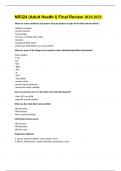
NR324 (Adult Health I) Final Review 2024/2025. What are some conditions/procedures that put patient @ high risk for fluid volume deficit? -diabetes insipidus -osmotic diuresis -hemorrhage -GI losses: vomiting, NG suction -diuretics -inadequate fluid intake -third-space fluid shifts: burns, pancreatitis What are some of the things nurse monitors when administering fluids/electrolytes? -Daily weights -x-ray -I/O -labs: --BUN --NA --K --HCT --Osmolality -monitor vitals -monitor tissue perfusion -assess skin turgor/mobility How do we know we're on the right track with fluid balance? -when I/O's are WNL -when BP and HR stabilize What are the vitals fluid volume deficit -BP decreases -HR increases -RR increased (shallow) Vitals fluid volume excess -BP increases -HR decreases -RR decreases Respiratory alkalosis 1. Causes: hyperventilation, pain, anxiety, fever 2. Effects: Restlessness, muscle twitching, paresthesia, coma 3. Compensation: kidneys conserve H+ ions, kidneys eliminate bicarb 4. Results: pH 7.45, HCO3 22 (compensation) Respiratory acidosis 1. Causes: hypoventilation, overdose, sedation, chronic COPD 2. Effects: confusion, high urine pH, lethargy, coma, death 3. Compensation: kidneys secrete acid, increased bicarbonate 4. Lab results: pH 7.35, HCO3 26 (compensation) Metabolic acidosis 1. Causes: renal failure, diarrhea, DKA, shock 2. Effect: confusion, high urine pH, lethargy, coma, death 3. Compensation: Lungs increase RR, kidneys retain HCO3- and eliminate H+ ions 4. Lab results: pH 7.35, PCO2 35 (compensation) Metabolic alkalosis 1. Causes: excessive vomiting, excessive GI suction/drainage, excessive antacids, hypokalemia 2. Effects: restlessness, muscle twitching, paresthesia, coma 3. Compensation: -lungs decrease RR -kidneys conserve H+ & eliminate HCO3- 4. Lab results: -pH 7.45, PCO2 45 (compensation) Normal ABG'S a. pH: 7.35-7.45 b. PaCO2: 35-45 c. HCO3: 22-26 PaO2: 92-100% Hypoxia s/s mild: -restlessness, tachycardia, dysrhythmias, dyspnea HTN moderate: -confusion -lethargy -dysrhythmias severe -cyanosis -coma -resp/cardiac arrest How do you reduce resp. complications after surgery? -monitor vitals, esp pulse O2, capnography, resp assessment -position patient in lateral "recovery" position to keep airway open/reduce aspiration risk if vomiting occurs Meds prescribed to patient after MI to prevent clot -nitrates -angiotensin-converting enzyme (ACE) inhibitors, -beta blockers, -calcium channel blockers Why do you assess apical/radial pulses? -to evaluate their heart health -if radial pulse apical pulse, this signals pulse deficit. patient has atrial fib, decreased left ventricular output, or congestive heart failure What do you tell a patient who has a pacemaker inserted newly? -follow up with provider to check function -report signs of infection @ incision site -keep incision dry for 4 days after insertion -avoid lifting arm on that side until approved -don't go in MRI -don't drive/have sex until cleared -tell security it will set off metal detector -always carry ICD identification card Common blood tests to determine depth of tissue injury in MI -creatine-kinase (CK) --CK-MB band is specific to heart muscle cells & helps quantify myocardial damage. --CK-MM (muscle) --Ck-BB (brain) and troponin. How do we determine the location of the cardiac muscle injury? -10-lead EKG Pre-cardiac catheterization -assess for allergies (contrast dye) -perform baseline assessment: a.) vitals, pulse ox, heart, breath sounds b.) neurovascular assessment of extremities -NPO 6-12 hours before -assess baseline lab values (cardiac biomarkers, creatinine) -teach client about procedure Post cardiac catheterization -perform assessment & compare to baseline -assess neurovasculalr status -place compression devices over site for homeostasis if needed -observe site for hematoma/bleeding Q15min for 1st hr -monitor EKG for dysrhythmias -monitor for chestpain -maintain bedrest, IV, fluid intake Which electrolytes are essential for cardiac fxn? what can happen if they're abnormal? -potassium and calcium - with calcium: contraction/relaxation impaired, can lead to congestive heart failure due to tired heart cells -with potassium: -EKG changes (dysrythmias) -peaked t-waves -prolonged PR -loss of p waves -bizarre QRS complexes Pre-blood product administration -verify doctor's order, inform client -check for cross-matching/typing to ensure compatibility -obtain/record baseline vitals -practice strict asepsis -@ least 2 RN's check label of blood for serial #, blood component, type, Rh factor, expiration date, screening test Intra-blood product administration -warm blood @ room temp to avoid chills -2 nurses check client's ID -use 18-19G needle for easy blood flow -use BT set with special micron mesh filter to prevent administration of blood clots/particles -start infusion slowly @ 10 gtts/min, remain @ bed for 15-30 min because most adverse rxnx occur in this time -monitor vitals Intra-blood prod administration cont'd -increased temp, RR = febrile rxn -don't mix meds w blood to prevent adverse effects -flush with 0.9% NaCl before, during, after BT -nvr administer dextrose fluids because they cause hemolysis -administer BT for 4 hrs if whole blood, packed RBC's -for plasma, platelets, cryoprecipitate, transfuse quickly (20 min) because clotting factor can be destroyed -observe for potential complications What are nursing assessment needs for a patient receiving blood? periodic vital signs every 15 min per doctor's protocol Acute hemolytic transfusion reaction -type II hypersensitivity, worst reaction -most common when incompatible RBC's transfused into patient -begins within 1st few minutes -client reports: --impending doom --flushing --chills --dyspnea --abdominal pain --tachycardia --febrile --hypotensive --n/v treat by stopping transfusion, lots of iv fluids, diuretics Febrile blood transfusion reaction -during transfusion and up to two hours after due to antigens reacting with WBC'S -one of the most common rxns -fever -chills, malaise treat by stopping transfusion acetaminophen Allergic blood transfusion reaction
Document information
- Uploaded on
- April 11, 2024
- Number of pages
- 19
- Written in
- 2023/2024
- Type
- Exam (elaborations)
- Contains
- Questions & answers