Lecture homeostasis and organ systems: Lung
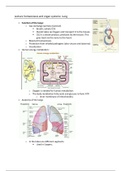
Function of the lungs:
o Gas exchange (primary function)
▪ Breath; exhale CO2
▪ Alveoli takes op Oxygen and transport it to the tissues.
▪ CO2 is a waste product, produces by the tissues. This
goes back via the veins to the heart.
o Blood pH homeostasis
o Protection from inhaled pathogens (also viruses and bacteria)
o Vocalization
Human energy metabolism:
o Oxygen is needed for human metabolism.
o The body metabolise Fatty acids and glucose to form ATP.
o Inner membrane of mitochondria
Anatomy of the lungs
o In the lobes are different segments.
▪ Used in Surgery.
, Barrel chest; pulmonary emphysema.
o Bigger lungs.
o Hyperfeminization of the lungs
o Front diameter is enlarged
Diaphragm on the right lies higher because of the liver.
X ray ^ normal
Black= air. white = holding back ventilation
White stripes = blood vessels of the lungs.
→ looking from below.
(CT scan gives more
information, also
muscles, heart and
tissue and bones)
→ bronchoscopy : we enter via the mount through the
trachea of the patient.
→ till 3-4 generations of bronchi
Trachea → primary bronchi → smaller bronchi → bronchioles → alveoli
Diameter decrease, number of bronchi increase.
Function of the lungs:
o Gas exchange (primary function)
▪ Breath; exhale CO2
▪ Alveoli takes op Oxygen and transport it to the tissues.
▪ CO2 is a waste product, produces by the tissues. This
goes back via the veins to the heart.
o Blood pH homeostasis
o Protection from inhaled pathogens (also viruses and bacteria)
o Vocalization
Human energy metabolism:
o Oxygen is needed for human metabolism.
o The body metabolise Fatty acids and glucose to form ATP.
o Inner membrane of mitochondria
Anatomy of the lungs
o In the lobes are different segments.
▪ Used in Surgery.
, Barrel chest; pulmonary emphysema.
o Bigger lungs.
o Hyperfeminization of the lungs
o Front diameter is enlarged
Diaphragm on the right lies higher because of the liver.
X ray ^ normal
Black= air. white = holding back ventilation
White stripes = blood vessels of the lungs.
→ looking from below.
(CT scan gives more
information, also
muscles, heart and
tissue and bones)
→ bronchoscopy : we enter via the mount through the
trachea of the patient.
→ till 3-4 generations of bronchi
Trachea → primary bronchi → smaller bronchi → bronchioles → alveoli
Diameter decrease, number of bronchi increase.