Lecture the gastrointestnal system
Overview of functon GI tract :
o Chew the food,
o Lubricate saliva
o Transported
o Stomach acid mixes with food.
o Digeston and reabsorpton in
intestnes.
Fluid in the small intestne:
o 2 L food
o 1,5 L saliva
o 2 L gastric juice
o 2 L pancreatc juice /bile
o 1 L small intestnal secreton
Big load of small intestne from -10 litres
o Reabsorbed: 6.5 L
o Presented to colon: 2 L
o Reabsorbed: 1.9 L
o Colon excreton feces) +/- 200 g
On average you consume 2 litres of food, includes fuids.
Structure of the lecture:
o Digestve secretons
o GI motlity
o Neural and hormonal regulaton
Digestve secretons
o Starts in the mouth saliva lubricaton in
mouth, otherwise our mouth is very dry and it is
difcult to mix with the food.
o Lubricaton is do due the mucins in saliva: these
are glycoproteins.
o The digeston starts because there is some
amylase produced and a litle bit of lipase. litle bit of fat digeston.
o We do also have a lot of antmicrobial proteins in our saliva, this is to protect
us against for example bacteria. also the water content helps with
protecton)
o Ph is litle bit basic to protect us against acid food.
Parotd serous amylase and lipase)
Sublingual mainly mucous, bit serous glycoproteins)
, Submandibular serous/ mucous
Ions, water, mucins, a amylase, lipase, antmicrobial proteins.
Lubricaton, dissolving, start
digeston, protecton.
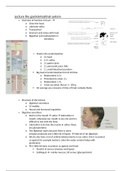
o Secretory unit of saltatory gland
o The head of the gland is visible `9 the upper part
with the bigger cells, and the acinus.
o The head is responsible for the primary secreton:
Ions, mucous proteins, enzymes and the
antmicrobial proteins
o Then we have the duct cells:
Rate of secreton is slow, tme for
reabsorpton in the duct cells.
Sodium and chloride
o Sodium is absorbed in
exchange for potassium.
o Chloride is absorbed in
exchange for Bicarbonate.
Slow secreton rate: hypotonic
High secreton rate: hypertonic actve secretng of. Bicarbonate.
Less acid.
o Secreton in the stomach:
Stomach depicted: Stomach upperpart; fundus part.
The big corpus: The body, we also call it the oxyntc mucosa.
Oxyntc: the acid secreton part
The antrum part.
Diferent regions in the stomach: the region where the acid is secreted
and the region with the more regulatory functons.
Folds in the layer and glands.
A lot of cell types in glands:
o Superfcial epithelial cell bicarbonate, mucous
Bicarbonate to countract the acid
, Very watery mucous secreton.
o Mucous neck cells/ goblet cells mucous
protecton
o Parietal cells/oxyntc HCl, intrinsic factor,
gastroferrin
Intrinsic factor is needed for the absorpton of
vitamin B12, this is needed for maturaton of red
blood cells.
o Chief cells pepsinogen and lipase
Actvated to pepsin
o Endocrine cells gastrin, histamine, somatostatn
Peptde hormones for regulaton
Functon of gastric acids
o Protecton of gastric mucosa.
o Acid: ph below 2
Actvates pepsinogen
Denaturaton proteins
Protecton against bacteria
o Mucosa needs to be protected against the acid. Alkaline mucus layer
Mucous secreted by neck cells.
Chemical and mechanical protector.
o Inhibits prostaglandin synthesis paracetamol /
ibuprofen.
Prostaglandin: stmulated the mucous secreton
and acid secreton.
small intestne:
Overview of functon GI tract :
o Chew the food,
o Lubricate saliva
o Transported
o Stomach acid mixes with food.
o Digeston and reabsorpton in
intestnes.
Fluid in the small intestne:
o 2 L food
o 1,5 L saliva
o 2 L gastric juice
o 2 L pancreatc juice /bile
o 1 L small intestnal secreton
Big load of small intestne from -10 litres
o Reabsorbed: 6.5 L
o Presented to colon: 2 L
o Reabsorbed: 1.9 L
o Colon excreton feces) +/- 200 g
On average you consume 2 litres of food, includes fuids.
Structure of the lecture:
o Digestve secretons
o GI motlity
o Neural and hormonal regulaton
Digestve secretons
o Starts in the mouth saliva lubricaton in
mouth, otherwise our mouth is very dry and it is
difcult to mix with the food.
o Lubricaton is do due the mucins in saliva: these
are glycoproteins.
o The digeston starts because there is some
amylase produced and a litle bit of lipase. litle bit of fat digeston.
o We do also have a lot of antmicrobial proteins in our saliva, this is to protect
us against for example bacteria. also the water content helps with
protecton)
o Ph is litle bit basic to protect us against acid food.
Parotd serous amylase and lipase)
Sublingual mainly mucous, bit serous glycoproteins)
, Submandibular serous/ mucous
Ions, water, mucins, a amylase, lipase, antmicrobial proteins.
Lubricaton, dissolving, start
digeston, protecton.
o Secretory unit of saltatory gland
o The head of the gland is visible `9 the upper part
with the bigger cells, and the acinus.
o The head is responsible for the primary secreton:
Ions, mucous proteins, enzymes and the
antmicrobial proteins
o Then we have the duct cells:
Rate of secreton is slow, tme for
reabsorpton in the duct cells.
Sodium and chloride
o Sodium is absorbed in
exchange for potassium.
o Chloride is absorbed in
exchange for Bicarbonate.
Slow secreton rate: hypotonic
High secreton rate: hypertonic actve secretng of. Bicarbonate.
Less acid.
o Secreton in the stomach:
Stomach depicted: Stomach upperpart; fundus part.
The big corpus: The body, we also call it the oxyntc mucosa.
Oxyntc: the acid secreton part
The antrum part.
Diferent regions in the stomach: the region where the acid is secreted
and the region with the more regulatory functons.
Folds in the layer and glands.
A lot of cell types in glands:
o Superfcial epithelial cell bicarbonate, mucous
Bicarbonate to countract the acid
, Very watery mucous secreton.
o Mucous neck cells/ goblet cells mucous
protecton
o Parietal cells/oxyntc HCl, intrinsic factor,
gastroferrin
Intrinsic factor is needed for the absorpton of
vitamin B12, this is needed for maturaton of red
blood cells.
o Chief cells pepsinogen and lipase
Actvated to pepsin
o Endocrine cells gastrin, histamine, somatostatn
Peptde hormones for regulaton
Functon of gastric acids
o Protecton of gastric mucosa.
o Acid: ph below 2
Actvates pepsinogen
Denaturaton proteins
Protecton against bacteria
o Mucosa needs to be protected against the acid. Alkaline mucus layer
Mucous secreted by neck cells.
Chemical and mechanical protector.
o Inhibits prostaglandin synthesis paracetamol /
ibuprofen.
Prostaglandin: stmulated the mucous secreton
and acid secreton.
small intestne: