

Primary Care 2 Dunphy Exam 2 `& Verified Answers | Latest Update | Rated 100%
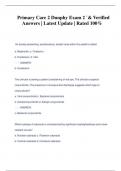
An acutely presenting, erythematous, tender lump within the eyelid is called: a. Blepharitis. c. Chalazion. b. Hordeolum. d. Iritis. ANSWER: b. Hordeolum The clinician is seeing a patient complaining of red eye. The clinician suspects conjunctivitis. The presence of mucopurulent discharge suggests which type of conjunctivitis? a. Viral conjunctivitis c. Bacterial conjunctivitis b. Keratoconjunctivitis d. Allergic conjunctivitis ANSWER: c. Bacterial conjunctivitis Which subtype of cataracts is characterized by significant nearsightedness and a slow indolent course? a. Nuclear cataracts c. Posterior cataracts b. Cortical cataracts d. Immature cataracts ANSWER: a. Nuclear cataracts Which of the following statements is true concerning the use of bilberry as a complementary therapy for cataracts? a. The body converts bilberry to vitamin A, which helps to maintain a healthy lens. b. Bilberry blocks an enzyme that leads to sorbitol accumulation that contributes to cataract formation in diabetes. c. Bilberry boosts oxygen and blood delivery to the eye. d. Bilberry is a good choice for patients with diabetes as it does not interact with antidiabetic drugs. ANSWER: c. Bilberry boosts oxygen and blood delivery to the eye. A 65-year-old man presents to the clinician with complaints of increasing bilateral peripheral vision loss, poor night vision, and frequent prescription changes that started 6 months previously. Recently, he has also been seeing halos around lights. The clinician suspects chronic open-angle glaucoma. Which of the following statements is true concerning the diagnosis of chronic open-angle glaucoma? a. The presence of increased intraocular pressure measured by tonometry is definitive for the diagnosis of open-angle glaucoma. b. The clinician can definitively diagnosis open-angle glaucoma based on the subjective complaints of the patient. c. Physical diagnosis relies on goniscopic evaluation of the angle by an ophthalmologist. d. Early diagnosis is essential in order to reverse any damage that has occurred to the optic nerve. ANSWER: c. Physical diagnosis relies on goniscopic evaluation of the angle by an ophthalmologist. 6. Acute angle-closure glaucoma involves a sudden severe rise in intraocular pressure. Which of the following ranges represents normal intraocular pressure? a. 0 to 7 mm Hg c. 22 to 40 mm Hg b. 8 to 21 mm Hg d. 40 to 80 mm Hg ANSWER: b. 8 to 21 mm Hg As diabetic retinopathy progresses, the presence of "cotton wool" spots can be detected. Cotton wool spots refer to: a. Nerve fiber layer infarctions. c. Venous beading. b. Blood vessel proliferation. d. Retinal hemorrhage. ANSWER: a. Nerve fiber layer infarctions. Which of the following is an example of sensorineural hearing loss? a. Perforation of the tympanic membrane c. Cholesteatoma b. Otosclerosis d. Presbycusi
Document information
- Uploaded on
- April 9, 2024
- Number of pages
- 29
- Written in
- 2023/2024
- Type
- Exam (elaborations)
- Contains
- Questions & answers


