
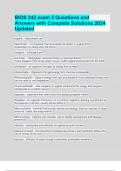
BIOS 242 exam 2 Questions and Answers with Complete Solutions 2024 Updated
organic - heterotrophs are? heterotroph - •An organism that must obtain its carbon in organic form •Dependent on eating other life forms inorganic - autotrophs are? autotroph - •"Self-feeder" (photosynthesis or chemosynthesis) •Uses inorganic CO2 as its carbon source; builds organiccompounds from the CO2 phototroph - an organism that gets its energy from sunlight chemotrophs - Organisms that get energy from chemical compounds Photoautotrophs - Capture energy from light and transform it into chemical energy that can be used for cell metabolism Chemoautotroph - •Use inorganic or organic compounds for energy and inorganic compounds as a carbon source saprobes - organisms that obtain food from decaying organic matter Parasites - An organism that lives in or on another organism, deriving nourishment at the expense of its host, usually without killing it Macronutrients - nutrients that provide calories and energy, they are required in large amounts. Carbs, fats and proteins Micronutrients - vitamins and minerals. vital to healthy development and disease prevention vitamins - coenzymes and cofactors for optimal enzyme function passive transport - the movement of substances across a cell membrane without the use of energy by the cell osmosis - Diffusion of water through a selectively permeable membrane facilated diffusion - Movement of specific molecules across cell membranes through protein channels active transport - Energy-requiring process that moves material across a cell membrane against a concentration difference isotonic solution - A solution in which the concentration of solutes is essentially equal to that of the cell hypertonic solution - A solution in which the concentration of solutes is greater than that of the cell hypotonic solution - A solution in which the concentration of solutes is less than that of the cell cardinal temperatures - the minimum, optimum, and maximum temperatures at which an organism grows max growth temp - highest temp at which growth is possible mini growth temp - lowest temp at which growth is possible psychrophiles - Cold-loving Microbes. 0-20 degrees C. optimum growth temp is 15 degrees. Found in arctic, antarctic, and ocean depths thermophiles - Heat-loving microbes. general growth range 45 c to 80 c hyperthermophiles - Archaea growing about 80 degrees celcius and some above 100 degrees celcius mesophiles - those growing best between 20 degrees and 40 degrees celcius; the human pathogens are in this group -majority of medically significant organisms acidophiles - grow in acidic environments Alkalinophiles - grow at extreme alkaline pH barophiles - can survive under extreme pressure and will rupture if exposed to normal atmospheric pressure Halophiles - "salt-loving" archaea that live in environments that have very high salt concentrations aerobes - Bacteria that require oxygen to grow
Document information
- Uploaded on
- April 8, 2024
- Number of pages
- 10
- Written in
- 2023/2024
- Type
- Exam (elaborations)
- Contains
- Questions & answers


