

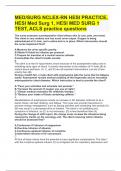
MED/SURG NCLEX-RN HESI PRACTICE, HESI Med Surg 1, HESI MED SURG 1 TEST, ACLS practice questions
MED/SURG NCLEX-RN HESI PRACTICE, HESI Med Surg 1, HESI MED SURG 1 TEST, ACLS practice questions The nurse assesses a postoperative client whose skin is cool, pale, and moist. The client is very restless and has scant urine output. Oxygen is being administered at 2 L/min, and a saline lock is in place. Which intervention should the nurse implement first? A.Measure the urine specific gravity. B.Obtain IV fluids for infusion per protocol. C.Prepare for insertion of a central venous catheter. D.Auscultate the client's breath sounds. B The client is at risk for hypovolemic shock because of the postoperative status and is exhibiting early signs of shock. A priority intervention is the initiation of IV fluids (B) to restore tissue perfusion. (A, C, and D) are all important interventions, but are of less priority than (B). During a health fair, a male client with emphysema tells the nurse that he fatigues easily. Assessment reveals marked clubbing of the fingernails and an increased anteroposterior chest diameter. Which instruction is best to provide the client? A."Pace your activities and schedule rest periods." B."Increase the amount of oxygen you use at night." C."Obtain medical evaluation for antibiotic therapy." D."Reduce your intake of fluids containing caffeine." A Manifestations of emphysema include an increase in AP diameter (referred to as a barrel chest), nail bed clubbing, and fatigue. The nurse can provide instructions to promote energy management, such as pacing activities and scheduling rest periods (A). (B) may result in a decreased drive to breathe. The client is not exhibiting any symptoms of infection, so (C) is not necessary. (D) is less beneficial than (A). During the change of shift report, the charge nurse reviews the infusions being received by clients on the oncology unit. The client receiving which infusion should be assessed first? A.Continuous IV infusion of magnesium B.One-time infusion of albumin C.Continuous epidural infusion of morphine D.Intermittent infusion of IV vancomycin C All four of these clients have the potential to have significant complications. The client with the morphine epidural infusion (C) is at highest risk for respiratory depression and should be assessed first. (A) can cause hypotension. The client receiving (B) is at lowest risk for serious complications. Although (D) can cause nephrotoxicity and phlebitis, these problems are not as immediately life threatening as (C). The nurse is planning care for a client with diabetes mellitus who has gangrene of the toes to the midfoot. Which goal should be included in this client's plan of care? A.Restore skin integrity. B.Prevent infection. C.Promote healing. D.Improve nutrition. B The prevention of infection is a priority goal for this client (B). Gangrene is the result of necrosis (tissue death). If infection develops, there is insufficient circulation to fight the infection and the infection can result in osteomyelitis or sepsis. Because tissue death has already occurred, (A and C) are unattainable goals. (D) is important but of less priority than (B). The nurse is conducting an osteoporosis screening clinic at a health fair. What information should the nurse provide to individuals who are at risk for osteoporosis? (Select all that apply.) A.Encourage alcohol and smoking cessation. B.Suggest supplementing diet with vitamin E. C.Promote regular weight-bearing exercises. D.Implement a home safety plan to prevent falls. E.Propose a regular sleep pattern of 8 hours nightly. A, C, D (A, C, and D) are factors that decrease the risk for developing osteoporosis. Vitamin D and calcium are important supplements to aid in the decrease of bone loss (B). Regular sleep patterns are important to overall health but are not identified with a decreasing risk for osteoporosis (E). An 81-year-old male client has emphysema. He lives at home with his cat and manages self-care with no difficulty. When making a home visit, the nurse notices that this client's tongue is somewhat cracked and his eyeballs appear sunken into his head. Which nursing intervention is indicated? A.Help the client determine ways to increase his fluid intake. B.Obtain an appointment for the client to have an eye examination. C.Instruct the client to use oxygen at night and increase the humidification. D.Schedule the client for tests to determine his sensitivity to cat hair. A Clients with COPD should ingest 3 L of fluids daily but may experience a fluid deficit because of shortness of breath. The nurse should suggest creative methods to increase the intake of fluids (A), such as having fruit juices in disposable containers readily available. (B) is not indicated. Humidified oxygen will not effectively treat the client's fluid deficit, and there is no indication that the client needs supplemental oxygen at night (C). These symptoms are not indicative of (D) and may unnecessarily upset the client, who depends on his pet for socialization. The nurse is assessing a client who presents with jaundice. Which assessment finding is most important for the nurse to follow up? A.Urine specific gravity of 1.03 B.Frothy, tea-colored urine C.Clay-colored stools D.Elevated serum amylase and lipase levels D Obstructive cholelithiasis and alcoholism are the two major causes of pancreatitis, and elevated serum amylase and lipase levels (D) indicate pancreatic injury. (A) is a normal finding. (B and C) are expected findings related to jaundice. Which content about self-care should the nurse include in the teaching plan of a female client who has genital herpes? (Select all that apply.) A.Encourage annual physical and Pap smear. B.Take antiviral medication as prescribed. C.Use condoms to avoid transmission to others. D.Warm sitz baths may relieve itching. E.Use Nystatin suppositories to control itching. F.Use a douche with weak vinegar solution to decrease itching. A, B, C, D The nurse should include (A, B, C, and D) in the teaching plan of a female client with genital herpes. (E) is specific for Candida infections, and (F) is used to treat Trichomonas. The nurse is interviewing a client who is taking interferon-alfa-2a (Roferon-A) and ribavirin (Virazole) combination therapy for hepatitis C. The client reports experiencing overwhelming feelings of depression. Which action should the nurse implement first? A.Recommend mental health counseling. B.Review the medication actions and interactions. C.Assess for the client's daily activity level. D.Provide information regarding a support group. B Interferon-alfa-2a and ribavirin combination therapy can cause severe depression (B); therefore, it is most important for the nurse to review the medication effects and report these to the health care provider. (A, C, and D) might be implemented after the physiologic aspects of the situation have been assessed. A client in the emergency department is bleeding profusely from a gunshot wound to the abdomen. In what position should the nurse immediately place the client to promote maintenance of the client's blood pressure above a systolic pressure of 90 mm Hg? A.Place the client in a 45-degree Trendelenburg position to promote cerebral blood flow. B.Turn the client prone to place pressure on the abdominal wound to help staunch the bleeding. C.Maintain the client in a supine position to reduce diaphragmatic pressure and visualize the wound. D.Put the client on the right side to apply pressure to the liver and spleen to stop hemorrhaging. C Placing the client in a supine position (C) reduces diaphragmatic pressure, thereby enhancing oxygenation, and allows for visualization of the abdominal wound. (A) compromises diaphragmatic expansion and inhibits pressoreceptor activity. (B) places the client at risk of evisceration of the abdominal wound and increased bleeding. (D) will not stop internal bleeding in the liver and spleen caused by the gunshot wound. The nurse assesses a client who has been prescribed furosemide (Lasix) for cardiac disease. Which electrocardiographic change would be a concern for a client taking a diuretic? A.Tall, spiked T waves B.A prolonged QT interval C.A widening QRS complex D.Presence of a U wave D A U wave (D) is a positive deflection following the T wave and is often present with hypokalemia (low potassium level). (A, B, and C) are all signs of hyperkalemia. When a nurse assesses a client receiving total parenteral nutrition (TPN), which laboratory value is most important for the nurse to monitor regularly? A.Albumin B.Calcium C.Glucose D.Alkaline phosphatase C TPN solutions contain high concentrations of glucose, so the blood glucose level is often monitored as often as q6h because of the risk for hyperglycemia (C). (A) is monitored periodically because an increase in the albumin level, a serum protein, is generally a desired effect of TPN. (B) may be added to TPN solutions, but calcium imbalances are not generally a risk during TPN administration. (D) may be decreased in the client with malnutrition who receives TPN, but abnormal values, reflecting liver or bone disorders, are not a common complication of TPN administration. A 62-year-old woman who lives alone tripped on a rug in her home and fractured her hip. Which predisposing factor most likely contributed to the fracture in the proximal end of her femur? A.Failing eyesight resulting in an unsafe environment B.Renal osteodystrophy resulting from chronic kidney disease (CKD) C.Osteoporosis resulting from declining hormone levels
Document information
- Uploaded on
- April 6, 2024
- Number of pages
- 83
- Written in
- 2023/2024
- Type
- Exam (elaborations)
- Contains
- Questions & answers


