

ESRM 101 Final Quiz Questions with 100% Correct Answers | Latest Version 2024 | Verified Historically what has been the typical response of people to any natural disturbance? By ignoring major disturbances that occur over longer time scales, how was land management for timber, conservation and endangered species management impacted? Realistica lly, can humans manage large scale natural disturbances? - ✔✔Historically the response has been to try and control or mitigate the effects of natural disturbance. Land management is impacted positively when ignoring major disturbances as they are beneficial for the environment. Humans cannot realistically manage lar ge scale natural disturbances. Why care about natural disturbances? - ✔✔Impacts landscapes planning efforts, management of protected areas, and endangered species management Why can disturbances be defined as being either GOOD, BAD or UGLY? How does each type of disturbance impact the environment and societies? Why do some disturbances maintain the health of our environments? - ✔✔Disturbances can be good because some habitat areas need disturbances (ex. fire for prairies) to exist. Disturbances can be bad because can be caused by humans and lead to societal collapse - due to droughts, too much rain, bad land use (Deforestation), an d economic decisions. Prior to the 1960s, forests fires were considered to be ecologically bad for the environment so the focus was on fire suppression and control. Today, we recognize the importance of fire in ecosystems. What knowledge changed our view of fires? Which tree sp ecies was responsible for these changed views and what is the relationship of this tree to fire? Why do some animals need fire to survive? - ✔✔The lodgepole pine tree was responsible for changing our view of fires - it is highly flammable, and causes large scale fires when trees are over 100 years old, burning up its competitors and exposing bare ground to germinate new seeds (have serotinous cone s that open after fire) What are the environmental and ecological repercussions of the loss of fires in prairies in North America? Who loses and who wins when prairies cease to exist? Today, what is the major reason explaining the loss of prairies? - ✔✔The loss of prairies is an unexpected consequence of fire control - loss of prairies by forests encroaching into meadows. Fire keeps forests out. Fire control lets forests out compete and encroach into meadows. When you allow fires to burn there will be no trees in prairie. Many Native American root crops collected in prairies, introducing fire to get prairies back. Farmers/ranchers win because do not have to deal w prairie dogs eating crops or fires burning crops or houses. Animals that depend on prairie dogs lose (black -footed ferret extinct because not enough prairie dogs) Why is it realistic to call humans 'disturbance agents' in ecosystems [Answer according to the class lecture]? What is a common human management activity that starts the collapse of a civilization [It is not the tipping point]? What factor finally pushes a civilization to collapse? - ✔✔It is realistic to call them disturbance agents because of what they do and how they alter the landscape (making the land less resilient to disturbances in some cases). A common human management activity that starts the collapse of a civilization is defore station? The Nazca people in Peru collapsed despite their construction of an elaborate aqueduct system to collect ground water to farm. What series of activities started the process causing their collapse? What was the final trigger explaining this collapse? What w as the forest link to the collapse of the Nazca people? - ✔✔Extreme weather event (El nino) caused tipping point following bad land -use decisions = collapse. Deforestation and occurrence of extreme el nino event resulted in heavy floods - which caused loss of surface irrigation systems used to grow crops - which led to dry winds of desert blowing away soil. Final trigger was bad land -use decisions. FORESTS PROTECTED against extreme climatic events. acid rain - ✔✔any form of precipitation or rain with high levels of nitric and sulfuric acids. It can occur in form of snow, fog, and tiny bits of dry material that settle to Earth. Most acid rain caused by human activities. Biggest producer of acid rain: burning of fos sil fuels by coal -burning power plants, factories, and automobiles. Rotting veg/erupting volcanoes release some similar chemicals but minor compare to fossil fuels. Acidic rain or acid rain is caused by humans. It is a 'bad' disturbance that degrades natural ecosystems. Why? What can people do to mitigate their impacts? Is acid rain a recent environmental problem facing global societies? Is acid rain an issue we need to deal with today? - ✔✔The acidity of the rain kills forests. Acid rainfall indirectly affects plants - insects attack weak trees. It directly affects plants by weakening or killing them. It directly affects soils by leaching of base cations (ex Ca and Mg). Depletes soil nutrien ts, causes eutrophication of water bodies, etc. Acid rain combined w a drought is devastating to natural/human built environments. People can mitigate impacts by stopping release of pollutants that cause acid rain (capturing by -products of burning fossil fuels) Marble statues are pitted when exposed to acid rain. Why does this occur? What approach are being used to stop this pitting of statues and is it realistic to implement? - ✔✔This occurs because statues are made of marble or limestone, acid rain turns calcium carbonate molecules into calcium sulfate molecules which dissolve in water. Statue surfaces eroded severely in last few decades. Not reversible for statues. One approach w as putting statues inside or encircling in a glass bubble. [Reading] Why do so many communities practice shifting cultivation to grow food crops? In general, what is the view of many centralized governments towards shifting cultivators? Why do they hold these views? Define Shifting Cultivator when answering this q uestion. - ✔✔Shifting cultivation - Shifting cultivation is an agricultural system in which a person uses a piece of land, only to abandon or alter the initial use a short time later. This system often involves clearing of a piece of land followed by several years of w ood harvesting or farming until the soil loses fertility. Centralized governments do not like shifting cultivators due to the negative effect on the land. Communities practice this agricultural technique for efficiency. [Reading] How did Dr. Janet Sturgeon describe the Chinese and Thai government view of the Akha people? How did these views of the Akha people affect the age and type of forests found in both countries? Speculate what these data suggest is needed to retain a diverse old growth forest in these landscapes? - ✔✔ Was the Grand Coulee dam - hydro -electric dam on the Columbia River - built because of an urgent regional demand for electricity? What industries were attracted to the Seattle region because of the dam? How did the dam contribute to the growth of Seattle? What other business enterprises divert water from the dams to grow a product that are sold in global markets? - ✔✔No, it was built for irrigation/agriculture. Not many people needed electricity when dam was built, but Coulee powered Boeing aircraft Works and shipyards in Vancouver, Washington, and Portland, Oregon. Projects were created in which people and businesses were given cheap power to incentivize them to use the abundant power in NW generated by Hydroelectric dams. Before the dams were built, how did Native People control over -exploitation of salmon in these river systems? Why was salmon fishing regulated and what were its repercussions on people who survived by eating salmon? Did different tribes fight over how much salmon each tribe could harvest? - ✔✔Appointed a "salmon chief" whos only duty was to regulate salmon fishing/fisheries. They regulated to sustain their salmon resource for the future (not catching all the fish, let enough go to spawn and repopulate). Different tribes fought but cooperated ov er regulating salmon exploitation and jointly manage rivers.
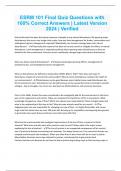
Preview 3 out of 19 pages
Exam (elaborations)
ESRM 101 Final Quiz Questions with 100% Correct Answers | Latest Version 2024 | Verified
Preview 3 out of 19 pages
Historically what has been the typical response of people to any natural disturbance? By ignoring major disturbances that occur over longer time scales, how was land management for timber, conservation and endangered species management impacted? Realistically, can humans manage large scale natural disturbances? - Historically the response has been to try and control or mitigate the effects of natural disturbance. Land management is impacted positively when ignoring major disturbances as they are beneficial for the environment. Humans cannot realistically manage large scale natural disturbances. Why care about natural disturbances? - Impacts landscapes planning efforts, management of protected areas, and endangered species management Why can disturbances be defined as being either GOOD, BAD or UGLY? How does each type of disturbance impact the environment and societies? Why do some disturbances maintain the health of our environments? - Disturbances can be good because some habitat areas need disturbances (ex. fire for prairies) to exist. Disturbances can be bad because can be caused by humans and lead to societal collapse - due to droughts, too much rain, bad land use (Deforestation), and economic decisions. Prior to the 1960s, forests fires were considered to be ecologically bad for the environment so the focus was on fire suppression and control. Today, we recognize the importance of fire in ecosystems. What knowledge changed our view of fires? Which tree species was responsible for these changed views and what is the relationship of this tree to fire? Why do some animals need fire to survive? - The lodgepole pine tree was responsible for changing our view of fires- it is highly flammable, and causes large scale fires when trees are over 100 years old, burning up its competitors and exposing bare ground to germinate new seeds (have serotinous cones that open after fire) What are the environmental and ecological repercussions of the loss of fires in prairies in North America? Who loses and who wins when prairies cease to exist? Today, what is the major reason explaining the loss of prairies?
Content preview
Document information
- Uploaded on
- April 2, 2024
- Number of pages
- 19
- Written in
- 2023/2024
- Type
- Exam (elaborations)
- Contains
- Questions & answers
$12.99
Wrong document? Swap it for free
Within 14 days of purchase and before downloading, you can choose a different document. You can simply spend the amount again.
Written by students who passed
Immediately available after payment
Read online or as PDF

Reputation scores are based on the amount of documents a seller has sold for a fee and the reviews they have received for those documents. There are three levels: Bronze, Silver and Gold. The better the reputation, the more your can rely on the quality of the sellers work.
Available in package deal
Package deal
ESRM Bundled Exams with Complete Solution | Verified Answers | 2024

