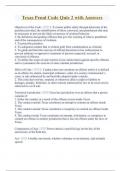
Texas Penal Code Quiz 2 with Answers
Objectives of the Code - 1. To insure public safety through deterrents of the penalties provided, the rehabilitation of those convicted, and punishment that may be necessary to prevent the likely recurrence of criminal behavior. 2. By definition and grading offenses that give fair warning of what is prohibited and of the consequences of violation. 3. To prescribe penalties. 4. To safeguard conduct that is without guilt from condemnation as criminal. 5. To guide and limit the exercise of official discretion in law enforcement to prevent arbitrary or oppressive treatment of persons suspected, accused, or convicted of offenses. 6. To define the scope of state interest in law enforcement against specific offenses and to systematize the exercise of state criminal jurisdiction. Effect of Code - 1. Conduct does not constitute an offense unless it is defined as an offense by statute, municipal ordinance, order of a county commissioner’s court, or rule authorized by and lawfully adopted under a statute. 2. This code does not bar, suspend, or otherwise affect a right or liability to damages, penalty, forfeiture, or other remedy authorized by law to be recovered or enforced in a civil suit. Territorial Jurisdiction - Texas has jurisdiction over an offense that a person commits if: 1. Either the conduct or a result of the offense occurs inside Texas. 2. The conduct outside Texas constitutes an attempt to commit an offense inside Texas. 3. The conduct outside Texas constitutes a conspiracy to commit an offense inside Texas. 4. The conduct inside Texas constitutes an attempt, solicitation, or conspiracy to commit an offense in another jurisdiction that is also an offense under the laws of Texas. Computation of Age - Person attains a specified age on the day of the anniversary of his birth day. Act - A bodily movement, whether voluntary or involuntary, and includes speech. Bodily Injury - Physical pain, illness, or any impairment of physical condition Coercion - A threat, however communicated: 1. To Commit an offense 2. To inflict bodily injury in the future on the person threatened 3. To accuse a person of any offense 4. To expose a person to hatred, contempt, or ridicule 5. To harm the credit or reputation of any person 6. To take or withhold action as a public servant
Document information
- Uploaded on
- April 1, 2024
- Number of pages
- 7
- Written in
- 2023/2024
- Type
- Exam (elaborations)
- Contains
- Questions & answers