

BIOD 151 Lab 2
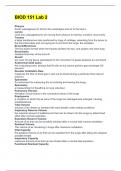
BIOD 151 Lab 2 Pharynx throat; passageway for food to the esophagus and air to the larynx Larynx voice box; passageway for air moving from pharynx to trachea; contains vocal cords Trachea a large membranous tube reinforced by rings of cartilage, extending from the larynx to the bronchial tubes and conveying air to and from the lungs; the windpipe. Bronchi/Bronchus The two tubes formed when the trachea divides into two, one passes into each lung Bronchioles smallest branches of the bronchi Alveoli tiny sacs of lung tissue specialized for the movement of gases between air and blood Anatomical dead space the conducting zone; airways that fill with air but cannot perform gas exchange (30 percent) Alveolar Ventilation Rate measures the flow of fresh gas in and out of alveoli during a particular time interval (ml/min) Spirometer An instrument for measuring the air entering and leaving the lungs. Spirometry a measurement of breathing (or lung volumes) Pulmonary Fibrosis formation of scar tissue in the connective tissue of the lungs Emphysema a condition in which the air sacs of the lungs are damaged and enlarged, causing breathlessness. Tidal Volume amount of air inhaled or exhaled with each breath under resting conditions Inspiratory Reserve Volume the maximal amount of additional air that can be drawn into the lungs by determined effort after normal inspiration Expiratory Reserve Volume Amount of air that can be forcefully exhaled after a normal tidal volume exhalation Residual Volume The volume of air remaining in lungs after maximum exhalation. Vital Capacity the greatest volume of air that can be expelled from the lungs after taking the deepest possible breath. Inspiratory Capacity maximum amount of air that can be inhaled after a normal tidal expiration Functional Residual Capacity
Document information
- Uploaded on
- March 31, 2024
- Number of pages
- 2
- Written in
- 2023/2024
- Type
- Exam (elaborations)
- Contains
- Questions & answers


