Exam 1: NR324/ NR 324 (Latest 2024/ 2025 Update) Adult Health I | Complete Guide with Questions and Verified Answers | Weeks 1-3 Covered| 100% Correct | Grade A - Chamberlain
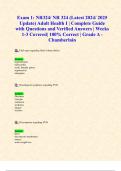
Exam 1: NR324/ NR 324 (Latest 2024/ 2025 Update) Adult Health I | Complete Guide with Questions and Verified Answers | Weeks 1-3 Covered| 100% Correct | Grade A - Chamberlain Q: Vital signs regarding fluid volume deficit Answer: hyperthermia tachycardia weak, thready pulses hypotension tachypnea Q: Neurological symptoms regarding FVD Answer: Dizziness syncope confusion weakness fatigue seizures Q: GI symptoms regarding FVD Answer: thirst dry mucous membranes nausea acute weight loss Q: Renal symptoms regarding FVD Answer: oliguria Q: Respiratory symptoms regarding FVD Answer: hypoxia Q: other symptoms regarding FVD Answer: diminished capillary refill cool clammy skin diaphoresis, sunken eyeballs flat neck veins poor skin turgor and tenting Q: Normal plasma osmolality Answer: 280-295 mOsm/kg Q: Hemoglobin and Hematocit, BUN, Urine specific gravity, Serum sodium, and Blood osmolality labs regarding FVO Answer: all are decreased Q: Hemoglobin and Hematocrit, BUN, Urine specific gravity, Serum sodium, and Blood osmolality labs regarding FVD Answer: all increased or slightly elevated Q: The nurse is caring for several clients with altered fluid balance. Which diagnostic tests can determine if a client's condition is worsening or improving? Answer: Comprehensive metabolic panel (CMP) Chest x-ray Complete blood count (CBC) Q: Medication and/or intravenous fluid administration can help improve fluid balance for FVO Answer: Diuretics ACE inhibitors Beta Blockers Calcium Channel Blockers Q: Medication and/or intravenous fluid administration can help improve fluid balance for FVD Answer: Intravenous (IV) fluid replacements (isotonic, hypotonic, hypertonic) Blood transfusion, if needed (For DI, give desmopressin) Q: Clients with fluid volume deficit are at risk for falling. Which nursing action best promotes safety? Answer: Change positions slowly when rising from a bed Q: Fluid volume deficit can significantly impair oxygenation. Which nursing actions are appropriate to resolve oxygenation problems? Answer: Continuously monitor oxygen saturation Monitor arterial blood gas results Administer supplemental oxygen Q: Fluid volume deficit most commonly occurs due to... Answer: abnormal loss of body fluids (diarrhea, vomiting, hemorrhage, polyuria) inadequate fluid intake (dehydration). Q: what can directly cause FVD? Answer: Illness and disease (burns and DKA) Diuretic medications colonoscopy preparation Perioperative clients Q: Isotonic fluids 0.9% NaCl(normal saline)
Document information
- Uploaded on
- March 28, 2024
- Number of pages
- 48
- Written in
- 2023/2024
- Type
- Exam (elaborations)
- Contains
- Questions & answers