Psy 699 Final Exam Study Guide Ch 9
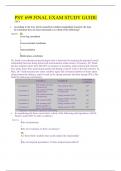
PSY 699 FINAL EXAM STUDY GUIDE CH 9 1. According to the text, when researchers conduct longitudinal research, the type of correlation they are most interested in is which of the following? Answers: 1. Cross-lag correlation 2. Cross-sectional correlation 3. Autocorrelation 4. Multivariate correlation Dr. Farah is an educational psychologist who is interested in studying the potential causal relationship between doing homework and academic achievement. In January, Dr. Farah has her students report their fall GPA (a measure of academic achievement) and estimate how many hours they spent doing homework during a typical week in the fall semester. In May, Dr. Farah measures the same variables again (the estimated number of hours spent doing homework during a typical week in the spring semester and their spring GPA). She finds the following correlations. Variable A Variable B Correlation Coefficient Correlation 1 Fall number of hours of homework Fall semester GPA .83* Correlation 2 Fall number of hours of homework Spring number of hours of homework .36* Correlation 3 Fall number of hours of homework Spring semester GPA .69* Correlation 4 Fall semester GPA Spring number of hours of homework .18 Correlation 5 Fall semester GPA Spring semester GPA .45* Correlation 6 Spring number of hours of homework Spring semester GPA .80* * Indicates a statistically significant relationship. 2. In considering the three causal rules, which of the following rules/questions will Dr. Farah’s study NOT be able to address? Answers: 1. Rule of parsimony 2. Rule of covariance: Is there covariance? 3. Are there third variables that could explain the relationship? 4. Rule of temporal precedence: Is there temporal precedence? 3. Of the correlations listed in the table, how many are autocorrelations? Answers: 1. Two 2. Five 3. Three 4. Four 4. What type of study design is Dr. Farah using? Answers: 1. Quasi-experimental design 2. Longitudinal design 3. Multiple regression design 4. Bivariate correlational design 5. Which of the correlations is an autocorrelation? Answers: 1. Correlation 4 2. Correlation2 3. Correlation 1 4. Correlation 6 6. Based on her pattern of correlations, which of the following can Dr. Farah safely conclude? Answers: 1. Because Correlation 4 is stronger than Correlation 5, Dr. Farah has no evidence that increased homework comes before academic achievement. 2. Because Correlation 3 is significant but Correlation 4 is not, Dr. Farah has evidence that increased homework comes before academic achievement. 3. Because Correlations 2 and 3 are significant, Dr. Farah has evidence that increased homework comes before academic achievement. 4. Because not all the correlations are significant, Dr. Farah has no evidence that increased homework comes before academic achievement. 7. For Dr. Farah to make the claim that homework causes academic achievement, which correlation does she predict will NOT be significant? Answers: 1. Correlation 1 2. Correlation 4 3. Correlation 3 4. Correlation 2 8. A colleague of Dr. Farah’s questions the internal validity of her causal claim. He is curious as to whether the relationship between homework and academic achievement could be explained by interest in one’s classes. Specifically, he thinks that students who are interested in their classes will both do more homework and have higher GPAs. Which of the following is a solution to this possible threat to internal validity? Answers: 1. Dr. Farah should study a different sample. 2. Dr. Farah should measure students’ interest in their class instead of GPA. 3. Dr. Farah should also measure students’ interest in their class. 4. Dr. Farah should measure students’ interest in their class instead of time spent doing homework. 9. Imagine that Dr. Farah noted a cyclical, reinforcing relationship between homework and academic achievement. For this to be case, which of the following correlations would need to be significant? Answers: 1. Correlations 2 and 3 2. Correlations 2 and 5 3. Correlations 1 and 6 4. Correlations 3 and 4 10. Correlation 5 is an example of which of the following types of correlations? Answers: 1. Cross-lag correlation 2. Autocorrelation 3. Cross-sectional correlation 4. Multivariate correlation 11. Correlation 1 is an example of which of the following types of correlations? Answers: 1. Multivariate correlation 2. Autocorrelation 3. Cross-sectional correlation 4. Cross-lag correlation 12. Of the correlations listed, how many are cross-sectional correlations? Answers: 1. Two 2. Four 3. Three 4. One 13. Correlation 4 is an example of which of the following types of correlations? Answers: 1. Cross-sectional correlation 2. Multivariate correlation 3. Cross-lag correlation 4. Autocorrelation 14. Which of the following correlations is a cross-lag correlation? Answers: 1. Both Correlations 3 and 4 2. Both Correlations 3 and 5 3. Both Correlations 2 and 5 4. Both Correlations 1 and 6 Dr. Sparrow is a social psychologist who studies romantic relationships. Several researchers have found that there is a link between income and marital satisfaction (e.g., Dakin & Wampler, 2008). Dr. Sparrow is curious as to whether there is a causal link between the two variables, such that having a higher income causes higher levels of marital satisfaction. He is confident that he cannot reasonably or ethically manipulate people’s income level, so he decides to use a multivariate design. He is also curious as to whether there is a causal link between these two variables or if two other variables (number of arguments and life satisfaction) can explain the relationship. He measures his three variables in a sample of 124 married couples recruited from a local community center. Below are his results. DV: Marital Satisfaction Variable Beta () Significance ( p) Income .69 .03 Number of arguments –.73 .01 Life satisfaction .13 .81 15. Which of the following can be concluded based on the results of Dr. Sparrow’s study? Answers: 1. The beta for the relationship between life satisfaction and marital satisfaction is significantly different than zero. 2. As the number of arguments a couple has increases, their marital satisfaction increases as well, controlling for income but not life satisfaction. 3. The relationship between life satisfaction and marital satisfaction has the weakest effect size. 4. Income is a stronger predictor of martial satisfaction than either the number of arguments or life satisfaction. 16. Given Dr. Sparrow’s design, which of the following problems is his study best able to overcome? Answers: 1. The issue of possible third variables 2. The issue of external validity of his findings 3. The issue of temporal precedence between his two variables 4. The ethical issue of manipulating income level 17. Given Dr. Sparrow’s design, which of the following problems is his study best able to overcome? Answers: 1. The issue of possible third variables 2. The issue of external validity of his findings 3. The issue of temporal precedence between his two variables 4. The ethical issue of manipulating income level 18. One of Dr. Sparrow’s colleagues argues that he should have considered years of marriage in his study, which is a known predictor of marital satisfaction. If Dr. Sparrow conducts his study again and asks people to report on how many years they have been married as well, which of the following statements is true? Answers: 1. The beta value for number of arguments will remain unchanged. 2. The beta value for number of arguments may no longer be statistically significant. 3. He will need to delete a predictor variable. 4. He will need to add another criterion variable. 19. Cross-lag correlations are NOT helpful for answering/addressing which rule of causation? Answers: 1. Are there third variables that could explain the relationship? 2. Rule of covariance: Is there covariance? 3. Rule of temporal precedence: Is there temporal precedence? 4. Rule of parsimony 20. When determining mediation, how many steps are necessary? Answers: 1. Two 2. Five 3. Four 4. Three 21. According to the textbook, which of the following is a reason that multiple regression designs are inferior to experimental designs? Answers: 1. They take longer to conduct. 2. They cannot establish covariance. 3. They are more expensive to conduct. 4. They can only control for third variables that are measured. 22. If a researcher is asking why the relationship between two variables exists, she is curious about which of the following? Answers: 1. Third variables 2. Mediation 3. Controlling variables 4. Moderation 23. Why is the statistical validity of a multiple regression design more complicated to interrogate than a bivariate design? Answers: 1. Betas and rs share no similarities. 2. These designs require more participants.
Document information
- Uploaded on
- March 28, 2024
- Number of pages
- 54
- Written in
- 2023/2024
- Type
- Exam (elaborations)
- Contains
- Questions & answers