

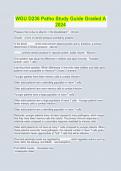
WGU D236 Patho Study Guide Graded A 2024
Pressure that is due to albumin in the bloodstream? - Oncotic Oncotic - a form of osmotic pressure exerted by proteins In the blood, _____ is the most common plasma protein and is, therefore, a primary determinant of oncotic pressure - albumin _____ controls osmotic pressure in vascular system, builds volume - Albumin One question was about the difference in children and adult immunity - Possible answer: naive T cells Learning check question: Which differences in immunity make children and older adult patients more susceptible to infections? Choose 2 answers Younger patients have fewer memory cells to combat infection Older adult patients have a dwindling population of naive T cells Older adult patients have more memory cells to combat infection Younger patients have a large population of naive T cells Older adult patients have a large population of naive T cells - Younger patients have fewer memory cells to combat infection Older adult patients have a dwindling population of naive T cells Rationale: younger patients have not been exposed to many pathogens, which means that they have fewer memory cells than adults. The primary immune response is relatively weak compared to a secondary response mediated by memory cells. Older adult patients do not have as many T cells compared to younger patients. When these patients encounter novel pathogens, the reduced number of naive T cells gives clonal selection fewer opportunities to "find" T cells that will be effective. Fluid and electrolyte levels are regulated by _______, which regulates actions such as thirst, ADH, the kidneys, and RAAS. - osmoreceptors Fluid deficit causes - -Excessive loss -Inadequate intake -Or combination of both Fluid deficit risk factors - -Vomiting/diarrhea -Excessive sweating -Insufficient water intake Fluid deficit manifestations - -dry mucous membranes -decreased skin turgor -decreased urine output -low blood pressure -tachycardia -confusion ROME for ABGs - Respiratory Opposite Metabolic Equal If pH and pCO2 are moving in opposite directions, then it is pCO2 levels that are causing the imbalance and it is respiratory in nature If they are moving the same direction then it is metabolic in nature Buffers, renal compensation, and respiratory compensation help to maintain a blood pH of _______ - 7.35-7.45 A patient with a viral illness and severe vomiting has an elevated CO2 level and a blood pH of 7.53. She is breathing slowly. What condition does the patient have? Metabolic alkalosis Metabolic acidosis Respiratory alkalosis Respiratory acidosis - Metabolic alkalosis The patient's pH and CO2 level are both elevating (moving in the same direction). This indicates metabolic alkalosis. The CO2 level is high because her respiratory system is attempting to compensate for the high pH by exhaling less and retaining more CO2 To prevent changes in pH, the body employs buffer systems. The body utilizes 3 buffer systems: - proteins, phosphates, and the carbonic acid-bicarbonate system Carbonic acid-bicarbonate system first line of defense is _____, second line of defense is _____ - respirations; kidneys Carbonic acid-bicarbonate system equation - The equation moves in both directions CABS Equation: When CO2 levels are elevated, the equation moves ________, forming more H+ and HCO3- ions - toward the right CABS Equation: When H+ ions are elevated, the equation moves _____, as H+ ions are converted to CO2 and the CO2 is exhaled. - toward the left CO2 levels - 35-45 HCO3 levels - 22-26 Michael's pulmonary edema leads to respiratory acidosis. How does pH impact Michael's basal metabolic panel? Choose 3 answers. His CO2 level is increased because his lungs have difficulty removing it from the bloodstream. His K+ is elevated because, as H+ moves inside of cells in an attempt to get it out of the bloodstream, K+ moves from cells into the bloodstream. His sodium level is decreased due to hypervolemia. His calcium level is reduced because the elevated concentration of H+ makes it easier for Ca+ to bind to albumin. His CO2 level is decreased because his lungs have difficulty adding it into the bloodstream - His CO2 level is increased because his lungs have difficulty removing it from the bloodstream. His K+ is elevated because, as H+ moves inside of cells in an attempt to get it out of the bloodstream, K+ moves from cells into the bloodstream. His sodium level is decreased due to hypervolemia. There is a question about hypoventilation or hyperventilation - Metabolic acidosis pH 7.35 = respirations increase in depth and rate to blow off CO2 Metabolic alkalosis pH 7.45 = respirations slow down to increase CO2 retention Respiratory acidosis = excess CO2 has accumulated which is generating H+ Respiratory alkalosis = lungs blow off too much CO2, creating less H+ in blood What is excreted in response to fluid volume overload? - Natriuretic peptides Natriuretic peptides - hormonal signals released by the brain and heart in response to excess fluid in the body Natriuretic peptides signals _____ urine output and ____ fluid volume - increase; reduce
Document information
- Uploaded on
- March 25, 2024
- Number of pages
- 34
- Written in
- 2023/2024
- Type
- Exam (elaborations)
- Contains
- Questions & answers


